Choices

8.16.23

In his installment of our Ten Questions series, Jamel Brinkley talks about developing the characters of his short story collection Witness (Farrar, Straus and Giroux, 2023) who are faced with the ethics of being an observer or bystander in a changing New York City landscape. “The collection gathers characters who, in many cases, fail to perceive or fail to act,” he writes. “One challenge was to find ways around their perceptual limitations and deliver stories that were still vivid, sharp, true, and full of feeling.” This week write a story in which a character witnesses a conflict or accident. What does their ability, or inability, to act in the moment say about them?

Raymond Luczak Reads “Otters”

Caption: 

“in a documentary / they dove in / into the burble / of river, braiding / around each other....” Raymond Luczak reads and performs his poem “Otters,” which appears in his forthcoming collection, Animals Out-There W-i-l-d: A Bestiary in English and ASL Gloss (Unbound Edition Press, 2024), in this Academy of American Poets video. The poem is translated into American Sign Language (ASL) gloss, which uses English words and ASL idioms in the ASL sign order.

Genre: 

Let’s Meet Our Contestants

8.15.23

“For $200: When inheritance begins // What is: in the womb / What is: decades before I announced my father dead / to me,” writes Taylor Byas in the poem “Jeopardy! (The Category Is Birthright),” which appears in her debut collection, I Done Clicked My Heels Three Times (Soft Skull Press, 2023). In this emotional poem, which follows the familiar format of the classic trivia game show referenced in the title, each stanza is framed with a dollar amount and clue in the form of an answer, followed by a list of potential responses in the form of questions. Try writing a poem that turns the format of your favorite game show into a poetic form. Whether you experiment with Wheel of Fortune, Pyramid, or Lingo, what limits of language can you reach when pushing your use of form?

Rebekah Bergman: The Museum of Human History

Caption: 

In this video, Rebekah Bergman celebrates the release of her debut novel, The Museum of Human History (Tin House, 2023), with author Rita Bullwinkel at Green Apple Books in San Francisco. Bergman is featured in “First Fiction 2023” in the July/August issue of Poets & Writers Magazine.

Genre: 

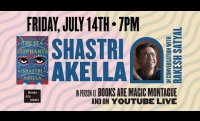
Shastri Akella in Conversation With Rakesh Satyal

Caption: 

In this Books Are Magic event, Shastri Akella reads from his debut novel, The Sea Elephants (Flatiron Books, 2023), and speaks about his journey navigating the writing life with author Rakesh Satyal. Akella is featured in “First Fiction 2023” in the July/August issue of Poets & Writers Magazine.

Genre: 

Anton Hur on Translating Literature

Caption: 

“I’m not there to serve the author or serve the text, I’m there to interpret it.” In this video, writer and translator Anton Hur speaks about the role of the translator, Korean literature, and his work on the novel Counterweight (Pantheon, 2023) by the pseudonymous South Korean science fiction author Djuna.

Between Seasons

8.10.23

As August rolls on, the last days of summer seem to move faster and faster. Late summer reminds us that the season is coming to an end and fall is just around the corner with shorter days and cooler temperatures. Poet and translator Jennifer Grotz summarizes it well in her poem “Late Summer,” as she writes: “Summer lingers, but it’s about ending. It’s about how things / redden and ripen and burst and come down.” What associations do you make with late summer? From taking a final dip in a lake to enjoying a late sunset during a picnic at the park, write an essay that meditates on a memorable late summer day. What is it about the interstice between seasons that is so evocative?

CAConrad Reads Jack Spicer’s “For Mac”

Caption: 

“A dead starfish on a beach / He has five branches / Representing the five senses / Representing the jokes we did not tell each other.” CAConrad reads Jack Spicer’s poem “For Mac” in this short film directed by Matthew Thompson and produced by the Adrian Brinkerhoff Poetry Foundation, in collaboration with the 92nd Street Y, for their Read By poetry film series.

The Allure of Villains

From lago in Shakespeare’s Othello to Darth Vader in the Star Wars franchise, some of literature and cinema’s most dynamic characters are villains. According to a 2020 research paper published in the journal Psychological Science, people may find fictional villains surprisingly likable because they identify with them. Fiction can act as a cognitive safety net, say researchers, allowing readers and viewers to compare themselves to a villainous character and engage with dark aspects of their personalities without questioning their morals. Who are some of your favorite villains? This week consider your dark side and write a story centered around a sympathetic antihero. Try to create a compelling backstory that connects and attracts readers to your character.

Pages

Subscribe to Poets & Writers RSS