Genre: Poetry

Eileen Myles

Caption: 

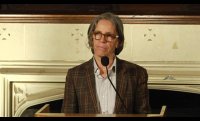
The author of eighteen collections of poetry, fiction, and nonfiction is introduced by poet Carolyn Forché at the Lannan Center for Poetics and Social Practice at Georgetown University on October 28. Her new and selected poems, I Must Be Living Twice, will be published by Ecco/Harper Collins in 2015.

Genre: 

Death as a Symbol

11.4.14

In Tom Stoppard’s play Rosencrantz and Guildenstern Are Dead, Rosencrantz muses, “We might as well be dead. Do you think death could possibly be a boat?” If you were to imagine death as something tangible—an object, a location, or a living thing—what would it be? Write a poem meditating on why this particular thing symbolizes loss, and the coming of an end.

Katonah Poetry Series: Forty-Seven Years and More to Come

For over forty-five years, the Katonah Poetry Series (KPS) has hosted nationally and internationally acclaimed poets in the welcoming and intimate setting of the Katonah Village Library in Northern Westchester County. Each reading is followed by an interactive Q&A session, as well as a reception and book signing. The distinguished poets who have appeared over the years include six poets laureate of the United States, six poets laureate of New York State and sixteen winners of the Pulitzer Prize in poetry. Billy Collins, U.S. poet laureate from 2001-2003, directed the series for seventeen years and continues to serve on the poetry advisory board. The series draws an audience, not only from Northern Westchester, but also the greater Tri-State region. The series provides a valuable service to the community—hearing live poetry is an important experience that differs from reading a poem on the page. KPS believes it is important to broaden the audience for poetry, and reaches out to regional high schools and colleges. The series is pleased to take part in creating a vibrant and intellectual literary community of readers, writers, and educators.
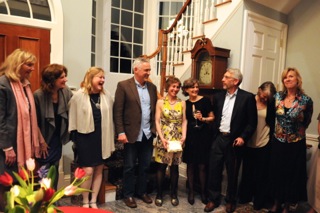
How many years and poets does it take to make an incredible reading series? In the case of the Katonah Poetry Series (KPS), forty-seven years, six U.S. poets laureate, sixteen Pulitzer Prize winners, and a host of renowned poets. This lively poetic scene would not be possible without vital support from grantors like Poets & Writers, a dedicated group of poetry lovers of all ages, and the wonderful venue of the Katonah Village Library.
The series began in 1967 with Robert Phillips showing up at the library with a gallon of wine, some cheese, and a poet in tow. When Bob left to join the faculty at the University of Texas, he handed the baton to Billy Collins. A few years later, prompted by the small turnout at a Samuel Menashe reading, I offered, as good friends tend to do, to help Billy with the series. I didn’t realize that I would inherit most of the organizational duties due to his 2001 inauguration as U.S. poet laureate! After my stead as Co-director, Director, and now as Poetry Advisor, I continue to be nourished by my involvement in the series and fondly refer to it as my personal MFA program. As Billy Collins aptly said, “If you sat on the steps of the Katonah Village Library for the past twenty-three years [and now forty-seven!] without moving, nearly every notable American poet would walk by you."

The intimate, informal atmosphere of our readings, and the book signing reception that follows, encourages everyone to interact with each other and the featured poet. Visiting poets often comment on the vibrancy and enthusiasm of our audience. Not only have we built an audience, but along with them, a thriving community of readers and writers.
Some highlights:

• Stephen Dunn’s reading two weeks after September 11, 2001, which audience members said helped them cope with the tragedy

• The Ilya Kaminsky reading in 2003 moved people to tears

• Many moments of laughter provoked by Billy Collins, Kay Ryan, Ellen Bass, and other poets

• A young mother with leukemia who credited the series with upgrading her quality of life as she underwent treatment

• Dylan Thomas’s "A Child’s Christmas in Wales" recited by James Navé every December, a community ritual drawing families and folks of all ages
Given the current strength of KPS, it is hard to believe that in the 2009-2010 season, the series came close to losing solvency. Help came in the unlikely guise of a September 2010 article in the New York Times, “Even Poetry is Undergoing Setbacks.” Surprisingly, unsolicited checks arrived from as far away as California! With those funds and the creation of a new Executive Committee, the series was revived. KPS now offers four annual readings, as well as some additional community events and workshops. The Katonah Poetry Series also has a new media presence to take it into the twenty-first century, including a website (featuring unique poet interviews), a Facebook page, a Twitter account, and coming soon—Instagram! Our recent Billy Collins reading attracted nearly three hundred people, and we are confident that we will be celebrating our fiftieth anniversary in 2017. Does that make us one of the oldest— and newest— reading series in the United States? Please “friend us” and we’ll look forward to welcoming you to the KPS family.

Photo: (top) Committee members from left: Van Kozelka, Director of Katonah Village Library; Leisha Douglas, Ph.D., KPS Poet Advisor; Julie Nord, KPS Publicity; Andy Kuhn, KPS VP; Moira Thielking, KPS President; Marlene Gallagher, KPS; Stephen Peeples, KPS Treasurer; Jessica Bennett, KPS; Barb Chintz, KPS.
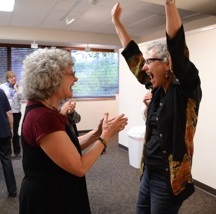
Photo: (2nd from top) Ellen Bass reading from her new collection, Like a Beggar (Copper Canyon Press, 2014).
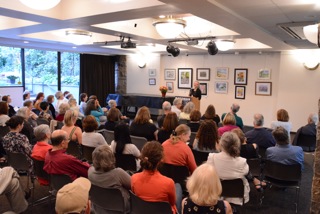
Photo: (3rd from top) Billy Collins Reading.
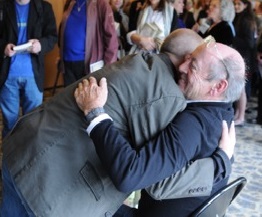
Photo: (bottom) Billy Collins connecting with fans. Photo Credit: Leslye Smith, Studio Smith Photography.

Support for Readings & Workshops in New York is provided, in part, by public funds from the New York State Council on the Arts, with additional support from the Friends of Poets & Writers.

Galway Kinnell

Caption: 

The late Pulitzer Prize–winning poet is seen here in 1997 reading selections of his work at the Museum of Contemporary Art San Diego for the series “Artists on the Cutting Edge,” accompanied by interview segments discussing his influences. The former Vermont poet laureate died at his home in Sheffield, Vermont, this past Tuesday.

Genre: 

Haunted House

10.28.14

Haunted houses are a classic setting for ghost stories. This week, write a poem about the house you live in as though it were haunted. Imagine what kind of spirits might live there, why they remain, and how they inhabit the space. Describe the sound of the creaky floorboard near the refrigerator, the way the windows slide shut on their own, and the weird smell near the fireplace. For inspiration, read Henry Wadsworth Longfellow’s poem “Haunted Houses.” 

Deadline Approaches for the Madison Review Prizes

Submissions are currently open for the Madison Review’s Phyllis Smart-Young Prize in Poetry and Chris O’Malley Prize in Fiction. The prizes are given annually for a trio of poems and a short story. Each winner will receive $1,000 and publication in the Madison Review.

Using the online submission system, submit either three poems totaling no more than fifteen pages, or a story of up to thirty pages with a $10 entry fee by November 1. The editors of the Madison Review will judge.

Established in the early 1970s, the Madison Review is the undergraduate student­–run journal of the University of Wisconsin in Madison. The biannual review has published the work of poets Stephen Dunn, Lisel Mueller, and C. K. Williams, and fiction writers Charles Baxter and Isaac Bashevis Singer.

The 2013 poetry prize–winner was Steve Tomasko for his poems “And No Spiders Were Harmed,” “The Plane of the Ecliptic,” and “An Inordinate Fondness.” Phillippe Diederich won the fiction prize for his short story “The Falling.” The winning pieces were published in the Spring 2014 issue of the Madison Review.

Amazing Facts

10.21.14

Is there a simple fact that you find amazing? Think of some tidbit of knowledge that somehow altered your perspective or filled you with a new sense of wonder. It could be something very basic that changed your daily routine, or something that sparked your interest to learn about a new topic further. For example, did you know your age actually represents the number of times you have orbited around the sun? Write a poem incorporating your fact and meditate on why it fascinates you.

Douglas Kearney Raps, Scats, and Grows Beautiful, Thorny Horns

Poet, performer, and librettist Douglas Kearney’s third poetry collection, Patter (Red Hen Press, 2014), examines miscarriage, infertility, and parenthood. His second book, The Black Automaton (Fence Books, 2009), was a National Poetry Series selection. He has received residencies and fellowships from Cave Canem, The Rauschenberg Foundation, and others. His work has appeared in a number of journals, including Poetry, nocturnes, Pleiades, The Boston Review, The Iowa Review, Ninth Letter, Washington Square, and Callaloo. Raised in Altadena, CA, he lives with his family in California’s Santa Clarita Valley and teaches at CalArts.

Douglas KearneyWhat are your reading dos?
Gosh—reading dos. I remember that the writing of these poems was driven by some kind of dynamic source—intellectual, emotional, physical. If I remember that, it animates the poems, even the quieter ones. Going to hear a reader read a poem is simply not the same thing as reading it yourself. So as a poet giving a reading, I see no point in being absent from the work while presenting it live (reading in Times New Roman, I call it). That’s what the book is for. That does not mean that you have to shout, switch accents, and sing (though that’s often an honest part of the composition for me and many others)—but I think being present is necessary and audiences can tell, even when your version of present is to read without much affect.

How do you prepare for a reading?
Most of my preparation is around getting my voice ready. I’ll scat a bit so I know where my range will be and to get my tongue limber. It’s funny, it also gets me surer of enunciation. Then, there are two rap tracks I perform: Mos Def and Talib Kweli are Blackstar’s “Definition,” and Latyrx’s “Say That.” Both are two-emcee crews, so it stretches me out a bit in terms of timbre, cadence, and breath control. As the work has gotten more mercurial, more shard-full, I sometimes do Nicki Minaj’s verse from “Monster.” Then, I pray that I don’t get in the way of the work, that I don’t embarrass my ancestors and contemporary friends and family, and give thanks I get to do this at all.

When it comes to picking my “set,” I want to do a different one for every reading. But if I’m a bit nervous, I lean on past sequencing. I want to get out of that habit—explore the “deep cuts” (ha!) a bit more.

What’s your crowd-pleaser, and why does it work?
I don’t know how pleased crowds are with my poems that work. I’ll say the ones that are probably the most likely at getting the unsettled responses, that I think the work solicits, are the “Miscarriage” poems from Patter, and my “peppy poem about the Middle Passage,” “Swimchant for Nigger Mer-folk” from The Black Automaton. These work because most folks seem to know how they should react to the surface subject matter—yet, the poems don’t go there without some complications. I think the surprise of that is engaging to audiences.

Additionally, I’ve come to pay a lot more attention to the banter between poems as an extension of the writing in a live setting. So I rework setups a lot. A dear friend of mine, playwright, performer, poet, and musician Eisa Davis has referred to the banter as “my stand-up.” I do study comedians to work out timing, cringe humor, and audience interaction.

What’s the craziest (or funniest or most moving or most memorable) thing that’s happened at an event you’ve been a part of?
Two things! Once, way back at a group reading in San Diego, some guy stood up in the middle of one of my poems, shouted “Parasites!,” and stormed out. That was fun!

And once, I was having a public dialogue with Amiri Baraka in the Bay Area. I read a poem called “The Chitlin Circuit.” This involved me leaping from the stage and stalking around the crowd, getting louder and louder as I repeated a passage of the poem. When I got back to the stage, Mr. Baraka looked at me like I had grown horns—but bright, beautiful, thorny horns! Then, he read “Ka’Ba”—and it was like a balm spread over the room. I had never truly known so much love and yearning for peace was in that poem—and I understood viscerally something about the late poet and the power of poetry I had never known before.

What you probably spent your R/W grant check on:
Something for my kids. They are working at being high-maintenance.

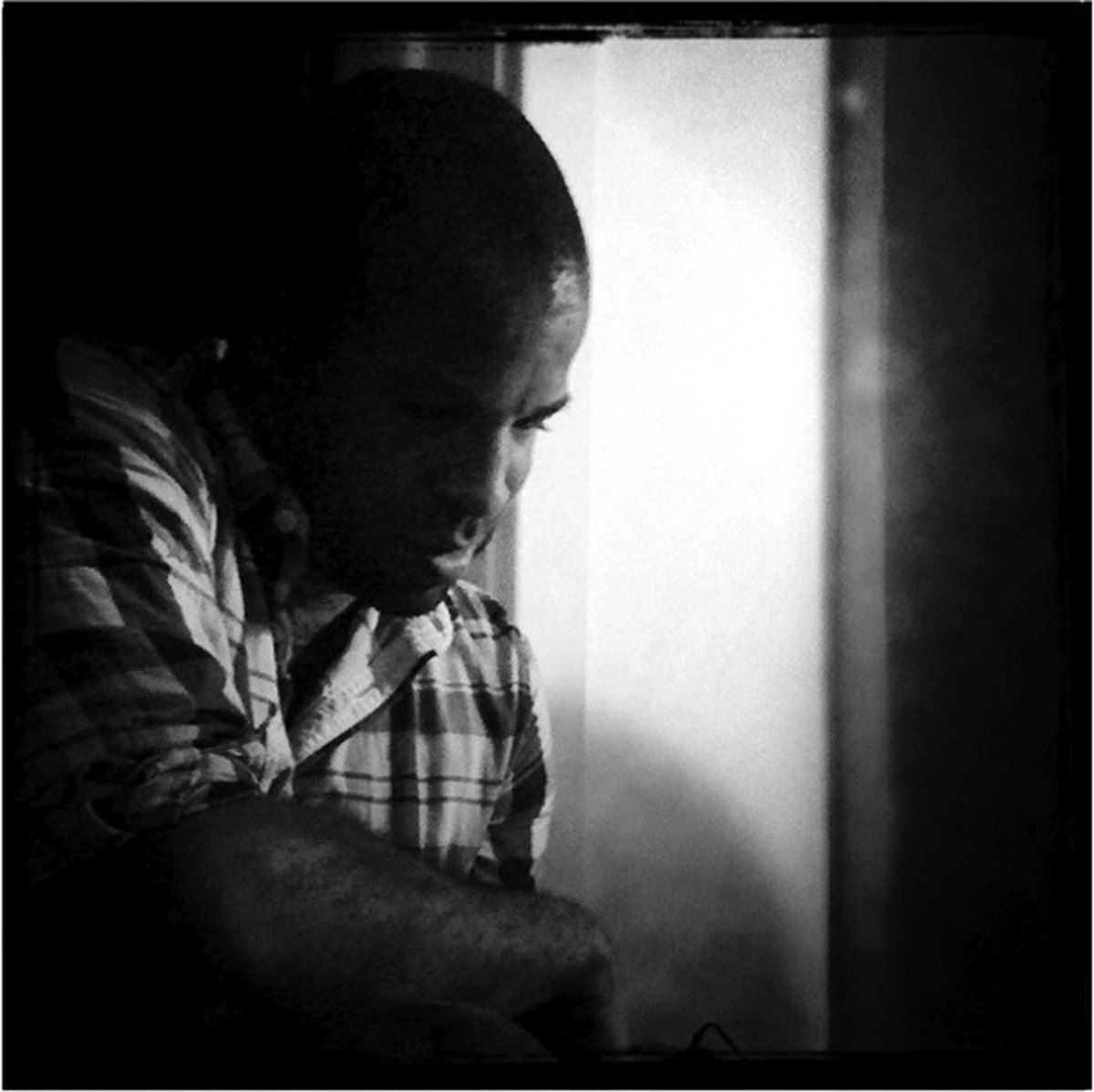
Photo: Douglas Kearney     Credit: Eric Plattner

Major support for Readings & Workshops in California is provided by the James Irvine Foundation. Additional support comes from the Friends of Poets & Writers

Pages

Subscribe to Poetry