Genre: Poetry

PEN Announces Literary Award Winners

This morning, PEN American Center announced the winners of the 2015 PEN Literary Awards. The annual awards, which total more than $150,000, honor emerging and established writers in seventeen categories including poetry, debut fiction, science writing, translation, biography, and drama. On June 8, the winners will be honored in a ceremony at the New School in New York City. The shortlists and complete list of winners can be found on PEN’s website. Below are the winners for a select few prizes:
Saeed Jones won the $5,000 PEN/Joyce Osterweil Award for Poetry for his collection Prelude to Bruise (Coffee House). Marie Howe, Mary Szybist, and Craig Morgan Teicher judged. The biennial award recognizes the work of an emerging American poet who shows promise of further literary achievement.

Joshua Horwitz won the $10,000 PEN/E. O. Wilson Literary Science Writing Award for his book War of the Whales: A True Story (Simon & Schuster). Sue Halpern, Marie Myung-Ok Lee, and Carl Zimmer judged. The annual prize is given for a book of literary nonfiction on the subject of the physical or biological sciences published in the previous year.

Sheri Fink won the $10,000 PEN/John Kenneth Galbraith Award for Nonfiction for her book Five Days at Memorial: Life and Death in a Storm-Ravaged Hospital (Crown). Andrew Blechman, Paul Elie, Azadeh Moaveni, Rahna Reiko Rizzuto, and Paul Reyes judged. The biennial award is given to an author of a book of general nonfiction published in the previous two years that possesses notable literary merit and critical perspective.

Denise Newman won the $3,000 PEN Translation Prize for her translation from the Danish of Naja Heather Cleary’s book Baboon (Two Lines). Lucas Klein, Tess Lewis, and Allison Markin Powell judged. The annual award is given for a translation of book-length prose from any language into English published in the previous year.

PEN will announce the winners of the $25,000 Prize for Debut Fiction, the $10,000 Art of the Essay Award, and the $5,000 Open Book Award at the Literary Awards Ceremony on June 8. Visit the PEN website for the shortlists. The winner of the $10,000 PEN/Fusion Emerging Writers Prize and recipients of the $2,000-$4,000 PEN/Heim Translation Fund Grants will be announced later this month.

PEN American Center has administered its literary awards for nearly fifty years. Established in 1922, PEN works globally to defend freedom of expression and to promote international literature and culture.
Made of Glass

5.12.15

Cervantes's short story The Glass Graduate recounts the tale of a man who was poisoned by a quince, intended to be an aphrodisiac, that brought about the delusion that his body was made of glass. This week, write a poem from the perspective of someone who believes his limbs could shatter with the slightest touch, and will not let others near him. Think about what would cause someone to think this way, and the limitations attached to this mindset.

Alice Notley Wins Ruth Lilly Poetry Prize

The Poetry Foundation announced today that Alice Notley has won the 2015 Ruth Lilly Poetry Prize. The annual award of $100,000 honors the outstanding lifetime achievement of a living U.S. poet.

With a career spanning more than four decades, Notley, sixty-nine, is the author of twenty-five books of poetry, including The Descent of Alette (Penguin, 1996); Mysteries of Small Houses (Penguin, 1998), which received the Los Angeles Times Book Prize; Disobedience (Penguin, 2001), which won the Griffin International Poetry Prize; and Grave of Light: New and Selected Poems 1970-2005 (Wesleyan, 2006), which was awarded the Lenore Marshall Poetry Prize. Notley’s other honors and awards include the Poetry Society of America’s Shelley Memorial Award, an Arts and Letters Award from the Academy of Arts and Letters, and a Foundation of Contemporary Arts grant. Later this year, Notley will publish two new poetry collections: Certain Magical Acts and Benediction.

Poetry magazine editor Don Share said of Notley’s work, “Like Whitman, she is simultaneously one of a kind and a poet for each of us: an exemplary, humane, and ultimately essential writer.” Robert Polito, the president of the Poetry Foundation, added, “Book by surprising book, [Notley] reinvents not only herself as a poet, but also what it means for anyone to write a poem at this volatile moment in our history.”

Established in 1986 by Ruth Lilly and sponsored by the Poetry Foundation, the prize is one of the most prestigious American poetry awards and among the largest literary honors for English language works. Adrienne Rich won the inaugural award, and recent winners include Nathaniel Mackey, Marie Ponsot, and W. S. Di Piero.

Notley and the winner of the Pegasus Award for Poetry Criticism will be honored at a ceremony in Chicago on June 8. The Poetry Foundation will announce the winner of the Pegasus Award later this month.

At the Poetry Foundation website, listen to a podcast featuring Notley, who reads and discusses her work, and read a new interview with the Ruth Lilly Prize winner.

Digital Poetry

Digital poetry is a form of electronic literature that incorporates the use of computers to display and interact with the work. Heavily influenced by concrete and visual poetry, digital poetry includes use of hypertext, computer generated animation, coding, and holograms. This week, look into some of the digital poems in the Electronic Literature Collection and brainstorm how you'd create one of your poems digitally. If you have programming skills, or know someone who does, put your plan into action and create your own piece of electronic literature!

Fourteen Years of Grassroots Gatherings on Staten Island

Beth Gorrie volunteers her time as Executive Director of Staten Island OutLOUD. She spearheads the organization’s program planning and has adapted over twenty-five global classics for OutLOUD’s spoken-word performances. As an actor during the first few years of her working life, she performed with the Chicago Theatre of the Deaf and served as an Adjunct Instructor at the University of Chicago. In New York City, she appeared in a variety of Off-Off Broadway productions and in a series of film installations by award-winning filmmaker William Lundberg, a recipient of the Guggenheim Fellowship. Gorrie attended Columbia University Law School where she was an editor of the Journal of Law & Social Problems, and spent a summer in rural India on a human rights fellowship. She is a former partner in a leading New York law firm and has participated in community service in Harlem.

What makes your programs unique?
Staten Island OutLOUD gathers neighbors to explore global literature together, and to share ideas. Our first event took place shortly after September 11, 2001 when we had a deep need to gather together.

Since then, Staten Island OutLOUD has grown and has continued that spirit with a varied series of grassroots gatherings. Throughout the year, we host free events to explore global literature, our diverse backgrounds, our history, and our mutual concerns. OutLOUD is entirely volunteer-driven.

We operate on a small budget, but we’re very productive. Since our establishment in September 2001, we’ve served over 23,000 participants with over six hundred free events, in twenty-one languages.

What recent project have you been especially proud of, and why?
From September 2014 through March 2015, Staten Island OutLOUD hosted a series of forty community events about Harper Lee’s novel To Kill a Mockingbird. When we started planning our series a year earlier, we never guessed how timely it would be, following the July 2014 death of Eric Garner, an African-American neighbor of ours who died in police custody.

Our “Mockingbird” series explored national and local civil rights history, together with music and poems from the Civil Rights Movement, and from the Depression years in which the novel is set.

Tensions ran high during the months after Garner’s death, but our series fostered thoughtful discussions. Staten Islanders talked, listened, and considered the many facets of the crisis.

What’s the most memorable thing that’s happened at an event you’ve hosted?
Adults with special needs sometimes attend Staten Island OutLOUD programs. At one event when we discussed a variety of twentieth-century poems, a woman with mental disabilities gathered her courage to comment on a poem by Dylan Thomas. She had never spoken in public before, and she knew that the audience included teachers, attorneys, and other professionals. Everyone encouraged her, and as she spoke, she began to hold herself more confidently, and her voice grew stronger. Everyone was moved when she read, “Do not go gentle into that good night.”

What are the benefits of writing workshops for special groups?
Staten Island OutLOUD’s work proves that when people have a forum and a stimulating entrée for conversation, they respond thoughtfully. Stereotypes can fade and real communication can begin. Our work with teens and with elders underscores the value of writing workshops for those members of our community. Our writing workshops have enabled people to find their unique voices. For teens who may have manifested behavior problems before they began our workshops, some of those problems began to ebb as they focused their energy on writing and as they gained confidence in their work. Elders who had never done any creative writing before participating in our memoir and poetry workshops have drawn real satisfaction in exploring their writing talent, in reflecting on their life experiences, and in recognizing how powerful their pens can be.

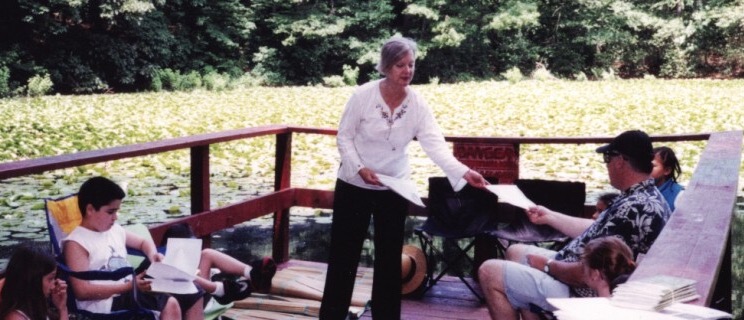
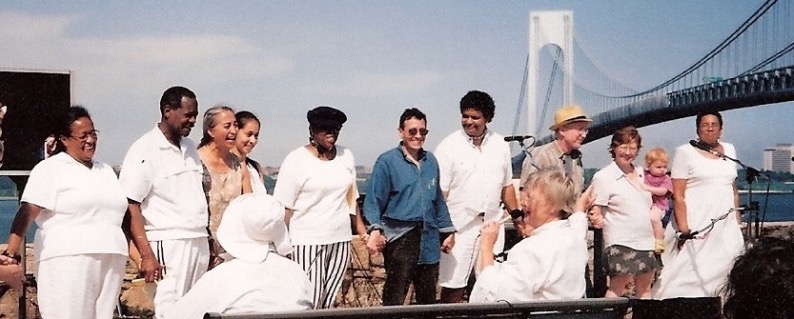
Photo: (top) Beth Gorrie at Huckleberry Finn at High Rock workshop. Photo: (bottom) Cast of Moby Dick marathon reading. Photo Credit: Staten Island OutLOUD.

Support for Readings & Workshops in New York City is provided, in part, by public funds from the New York State Council on the Arts, and the New York City Department of Cultural Affairs, with additional support from the Louis & Anne Abrons Foundation, the Axe-Houghton Foundation, the A.K. Starr Charitable Trust, and the Friends of Poets & Writers.

Deadline Approaches for Pleiades Press Poetry Prize

Submissions are currently open for the inaugural Pleiades Press Editors Prize for Poetry. A prize of $2,000 and publication by Pleiades Press, with distribution by Louisiana State University Press, will be given annually for a poetry collection. The winner will also be invited to read at the University of Central Missouri in Warrensburg. The editors will judge.

Using the online submission manager, send a poetry manuscript of at least 48 pages with a $25 entry fee, which includes a poetry collection published by Pleiades Press, by May 4. Submissions may also be sent via postal mail to Pleiades Press, Department of English, Martin 336, University of Central Missouri, Warrensburg, MO 64093.

Established in 2000, Pleiades Press is housed at the University of Central Missouri. The press releases several poetry books each year and also publishes the literary journal Pleiades. For the past fifteen years, the press has also administered the Lena-Miles Wever Todd Poetry Prize. Recent winners include Adrian C. Louis, Katie Bichkham, Abigail Cloud, Katy Didden, Bruce Snider, and Julianna Baggott.

Pages

Subscribe to Poetry