Naming Things
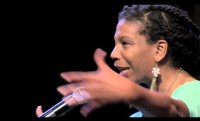
Caption:
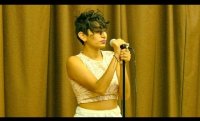
"On the quiet days, the view out my window pops a hip." Angelique Palmer reads her poem "Naming Things" at the 2015 Women of the World Poetry Slam Finals in Albuquerque, New Mexico.
Genre:
Jump to navigation Skip to content
"On the quiet days, the view out my window pops a hip." Angelique Palmer reads her poem "Naming Things" at the 2015 Women of the World Poetry Slam Finals in Albuquerque, New Mexico.
Poet and translator George Szirtes says: "Nobody reads a poem to find out what happens in the last line. They read the poem for the experience of travelling through it." This week, choose a short poem—it can be one of your own or someone else’s—and cross out the last line. Read it again now without its last line, and imagine how the poem might take a different turn at this juncture. Write a continuation of the poem, allowing it to travel to an entirely new conclusion.
"I meet another Henry. And he's nothing like me. Why are we both called Henry when there's no commonality?" This short film, produced by Naresh Ramchandani and directed by Chris Dada, features seven poems by Henry Ponder, a British poet who tweets daily poems.
Submissions are open for the 2015 Dermot Healy International Poetry Prize, sponsored by the Five Glens Arts Festival in Manorhamilton, Ireland. The annual prize is given for a single poem. The winner will receive €1,000 (approximately $1,085) and publication on the festival website. Peter Fallon will judge.
 Submit a poem of any length with a €5 (approximately $5) entry fee by July 24. Multiple submissions are accepted, and the prize is open to international writers. Submit via e-mail to competition@fiveglensartsfestival.com, or via postal mail to Dermot Healy Poetry Competition, 2 Old Orchard, Manorhamilton, Co. Leitrim, F91A9N3, Ireland. Visit the website for the required entry form and complete guidelines.
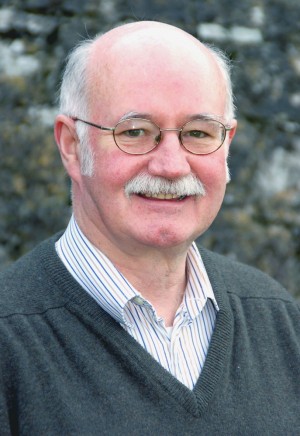
Judge Peter Fallon is the publisher and founder of the Gallery Press, one of Ireland’s most well-established independent publishers. He is also the author of several poetry collections, most recently Strong, My Love (The Gallery Press, 2014). In 2009, Fallon judged the Fish Poetry Prize, and chose Annie Atkins as the winner for her poem “The Locksmith.” Fallon said, “I warmed to ‘The Locksmith’ for its innocence, for the purity of its lines and for the way it unfolds the drama of a relationship and its two protagonists.” Fallon’s explanation of his judging process can be read on the Fish Publishing website.
The Five Glens Arts Festival will be held from August 21 to August 23 in Manorhamilton, a castellated town on the northwest coast of Ireland. The winner will be announced at the festival. Patrick Deeley won the inaugural prize in 2014 for his poem “Vixen,” which can be read on the festival website.
Photo: Peter Fallon
"Today, I broke your solar system. Oops. / My bad. Your graph said I was supposed / to make a nice little loop around the sun." Fatimah Asghar reads her poem "Pluto Shits on the Universe," which was published in April in Poetry magazine, at the 2015 Rustbelt Regional Poetry Slam in Rockford, Illinois.
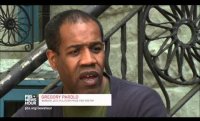
"I was born in minutes in a roadside kitchen a skillet / whispering my name." Gregory Pardlo speaks with PBS NewsHour's Jeffrey Brown about his life and his poetry collection Digest (Four Way Books, 2014), which won the 2015 Pulitzer Prize for poetry.
Choose a genre for a poem: science fiction, fantasy, romance, thriller, noir, or historical—perhaps the one that seems the furthest from your usual subject matter. Experiment with vocabulary typically associated with that genre. Perhaps words like “android” or “femme fatale” might offer unexpected inspiration.
Bill Berry, Jr. founded aaduna, Inc. in 2010 and published the inaugural issue of aaduna in February 2011. Committed to providing a publication platform for people of color—people who have been traditionally denied access to publication platforms, and others who seek a different plateau for creative shifts not generally associated with their previous work—aaduna is currently read in eighty-three countries. Berry publishes aaduna along with Lisa Brennan, visual arts editor; Pam Havens and Rosemarie Blake, fiction editors; Timothy Ogene, poetry editor; and Ketih Leonard, submissions manager. There is info staff and they enjoy anonymity.
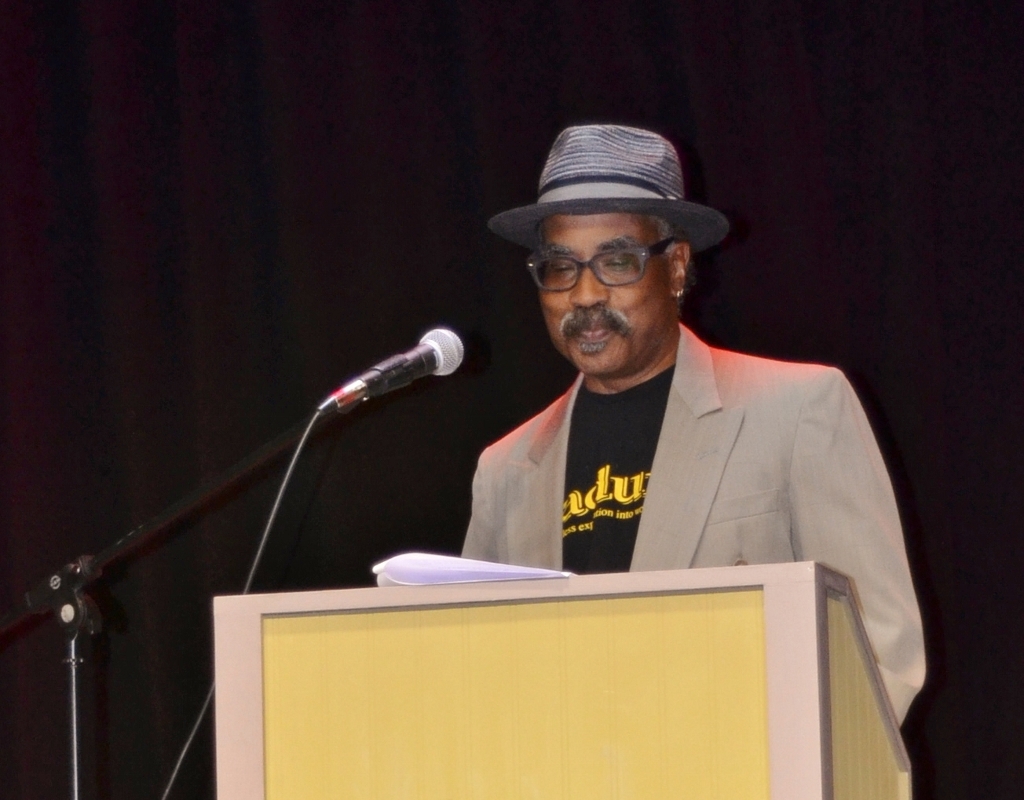
Auburn, nestled in rural and agricultural Cayuga County, and listed by NerdWallet as the best small city in New York State and the fourteenth best small city in the United States to live in, has a vibrant cultural identity. While diversity and multiculturalism are generally associated with larger cities and remain an elusive characteristic for Auburnians, aaduna, Inc. is changing that scenario on an annual basis through aaduna, its online literary and visual arts journal. To further its diversity initiative, a yearly literary fundraiser is convened to celebrate the spirit of the Harlem Renaissance and the racial, social, and artistic interactions between artists and their diverse supporters—an integral component of the Renaissance’s vibrant cultural exchange and camaraderie.
With the support of Poets & Writers and the New York State Council on the Arts, the May 28, 2015 affair, “In the Spirit of the Harlem Renaissance… Revisited, 2015,” brought downtown to uptown or more specifically, downstate to upstate. Aaduna contributors Cyd Charisse Fulton, Raymond Nat Turner, Dr. Kevin Jenkins, and Catherine C. Poku, all New York City-based poets and writers, traveled to the Finger Lakes region. They joined Auburn contributors Bobbie Dumas Panek, special guests Howard Nelson and Heidi Nightengale along with Rochester-based spoken word performance artist, poet, novelist and aaduna contributor Tearzs in an evening of readings that exposed an audience of more than eighty people to a wide range of poetic magic and diverse themes. Prior to the evening event, Raymond Nat Turner conducted a poetry workshop at Auburn High School hosted by aaduna, Inc., Harriet Tubman Boosters, and the Booker T. Washington Community Center, and funded by Poets & Writers.
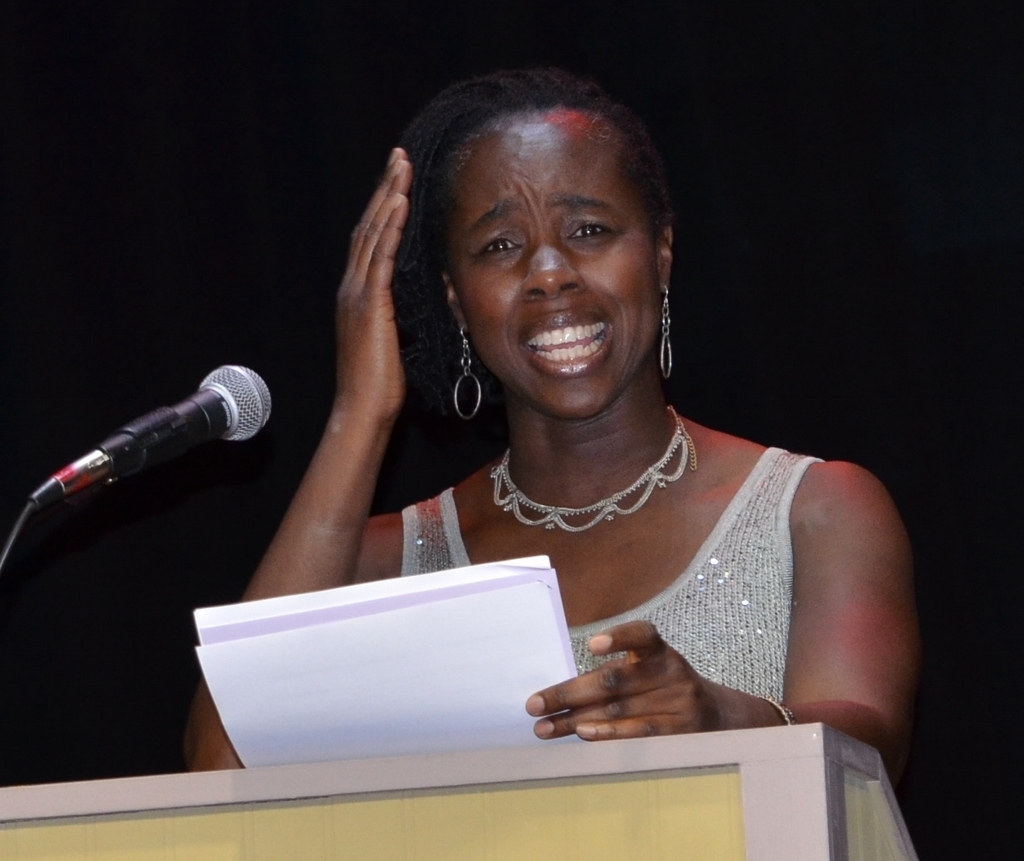 The Thursday evening event (which recognized that “back in that era” Thursdays were the day off for domestics who used the day to socialize and party) was filled with words that articulated stories and explored experiences that extolled James Brown, jazz syncopations through the diaspora, raising chickens, urban reflections, multi-racial upbringing, intimate reflections on life, Sly Stone, and love. Readers delivered their work in two rounds, and welcomed the guests when the doors opened and interacted with them during an extended intermission, a central component of this affair—the ability for the artists and guests to lessen the “divide” that often separates creative people from the public. The intermission was “the party within the party.” With a backdrop of jazz and contemporary tunes, pianist Andy Rudy set the ambiance complemented by a slide show that presented the artists, performances, and multi-racial social scenes generally associated with the Harlem Renaissance.
The event took place at Theater Mack, a sixty-five-seat performance space operating under the auspices of the Cayuga Museum of History and Art. Artists filled open space with colorful artwork that added another layer to the festivities. After two and a half hours, guests and readers left the venue feeling empowered, energized, and eager for 2016.
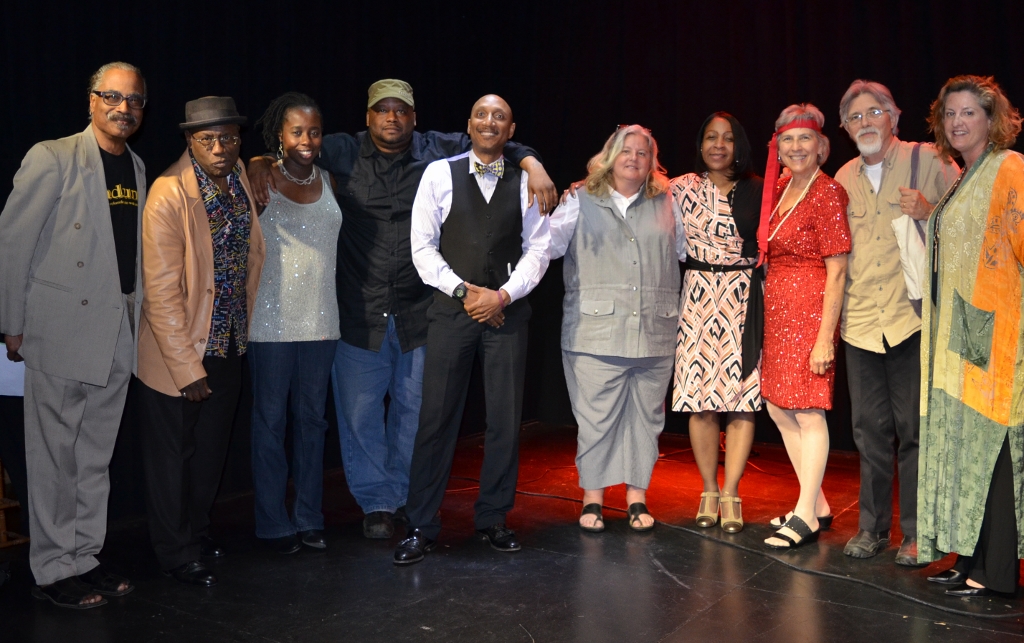
Photos: Bill Berry, Jr. (top), Catherine C. Poku (middle), Bill Berry, Jr., Raymond Nat Turner, Catherine C. Poku, Tearz, Dr. Kevin Jenkins, Heidi Nightengale, Cyd Charisse Fulton, Bobbie Dumas Panek, Howard Nelson, Lisa A. Brennan (bottom)
Photo Credit: Lisa A. Brennan
Support for Readings & Workshops in New York is provided, in part, by public funds from the New York State Council on the Arts, with additional support from the Friends of Poets & Writers.
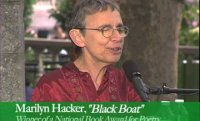
"One night I thought I saw a llama cross the road." James Tate reads "Llamas" at an event with poets Marilyn Hacker and Paul Muldoon for Bryant Park Reading Room's Word for Word Poetry reading series in 2010.
This week, imagine you have been deprived of one of your senses for a year, and then suddenly regained it. What specific sensations might you have missed and be eager to experience again? Write a poem about the longing and appreciation for this sense, focusing on creating fresh and unexpected phrases and descriptions. For example, if you choose the sense of taste, how might you express the sweetness of something without using the word sweet?