
Dreams don’t have an expiration date, rather they can lie dormant and find the right season in which to reemerge,” writes Radha Lin Chaddah in her essay for our eleventh annual feature on debut authors age fifty and over. This time around the essays articulate the expansive and enduring identity of being a writer: valuing one’s creative work and becoming untethered from the expectations of others; picking up poetry again, and starting meditation, due to a sense of impending loss; making space to write in a life spent focusing on others; coming back to a childhood wish more than four decades later; and learning firsthand about the care behind craft. While all these writers took different routes that eventually led to publication, the concept of returning to, or finally acknowledging, a lifelong love of literature holds true for most. May the essays that follow stand as testament to the promise of what some call fate, the idea of a book coming into the world exactly when it’s meant to and, as Judy Sandler writes, “not a moment earlier.”
Clockwise from top left: Hillary Behrman, Radha Lin Chaddah, John Fadely, Shanda McManus, and Judy Sandler.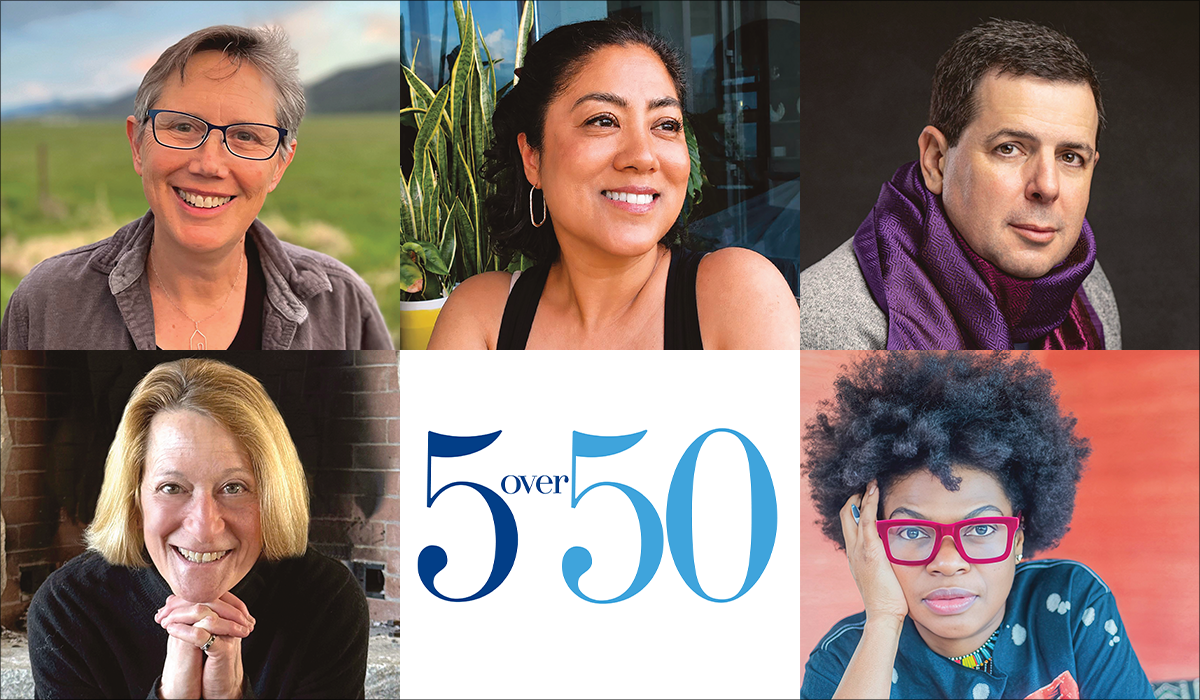
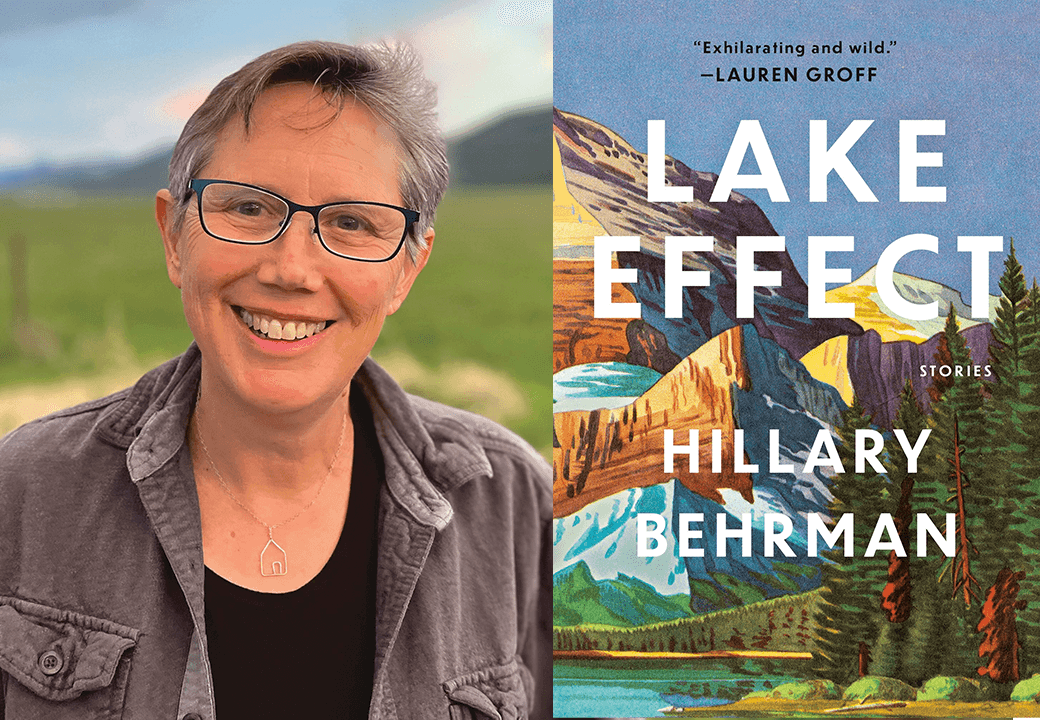
Hillary Behrman, author of Lake Effect (Sarabande Books)
Radha Lin Chaddah, author of And the Ancestors Sing (Rising Action)
John Fadely, author of Before Leaving the Island (Trail to Table Press)
Shanda McManus, author of Brother Epistles: A Sister’s Memoir (Split/Lip Press)
Judy Sandler, author of What Kind of Mother: A Reckoning (West Virginia University Press)
Hillary Behrman
Age: 62. Residence: Seattle. Book: Lake Effect (Sarabande Books, May 2026), a story collection full of remote landscapes, wilderness, and untended urban spaces that digs into the messiness, isolation, and tenderness found within our individual and collective humanity. Agent: None. Editor: Katherine Webb-Hehn.
I didn’t call myself a fiction writer until I was in my fifties. Unlike some of my other social and professional identities, writing fiction was expansive, internal, and quiet. It had no deadline, no expiration date, no built-in obsolescence. Becoming a writer wasn’t a status bestowed on me by institutions or biology.
I’ve spent most of my adult life as an advocate: a public defender, a children’s civil rights attorney, a counselor for the unhoused, and a parent. My legal writing has been an act of translation and partnership, a process of rendering other people’s stories into persuasive, palatable narratives intended to convince people in power to let a kid back into school, to keep someone out of prison, or to reunite a mother with her child. None of the stories I told were mine to tell. Writing in our legal systems is falsely constructed, a manipulation that is at best respectful of an individual’s life and circumstances, at worst reductive, dehumanizing, and silencing. Writing fiction embodies some of those same risks; we owe our characters care and resistance so we don’t flatten them by assumptions and stereotypes.
There’s a freedom in having my first book published at sixty-one. I’ve always cared too much about what other people think, and becoming older has enabled me to untether myself from others’ expectations. I like to think that showing up on the page and in my life, away from decades of self-censorship and an overly active need to please others, is what helped Lake Effect get written and published. But that isn’t entirely true. I needed to be the same fierce advocate for my stories as I was for my clients, which was harder than I thought it would be. It’s one thing to work zealously for a human and another to do so for your own manuscript. As a girl raised in the United States in the second half of the twentieth century, even one who read Free to Be…You and Me (McGraw-Hill, 1974) like a sacred text, I find it impossible not to undervalue my creative work.
My advice to older debut writers, or any emerging writer, is to trust that your work is of value and ignore anyone who says otherwise, including yourself. Asking to be read, recognized, and published is not asking for too much. Submit your work, and when it gets rejected submit it again. Don’t write what you think other people want to read, because it’s impossible to know what other people want to read. When I started submitting stories it felt revelatory that editors and judges were reading my work. I had lots of rejections, and some stories got published.
If you don’t have a writing community, find one. I’ve worked to become part of a wide-ranging, supportive literary ecosystem. People I barely know have championed my stories, and I get to do the same for other writers. What a joy to forge new creative relationships at a time in life when many people find their circles of intimacy and connection contracting.
Eventually Lake Effect was chosen by Lauren Groff as the winner of the Sarabande Books 2024 Mary McCarthy Prize in Short Fiction. The team at Sarabande is a model of literary advocacy and editorial excellence. My book is out in the world. People are reading it. A neighbor stops me on the street and says, “You always seemed so upbeat. I never knew you had such a dark side.” A stranger at a book event is convinced that one story is about them. A man in a book club cries. Another reader is sure I’m lying; I must have experienced homelessness. What an unexpected delight to be reminded of how we all read through the scrim of our own lived experiences.
An excerpt from Lake Effect
The Alvord
The voices know when the dinner rush is over and Viv starts the cleanup. They wait for the lull, swooping in to spew insults. They wait for Roy Howard, the last of the regulars, to finish his third cup of decaf and ease himself out of the brown vinyl booth closest to the door, nodding first to Viv as she wipes down the counter and then raising a hand to Dale as he scrapes a day’s worth of gristle and fat off the grill. By the time Viv has the ketchup bottles wiped, refilled, and lined up in three neat rows, looking like a full box of red Crayola crayons, they come clamoring down, zinging out of electrical sockets, buzzing around fluorescent light fixtures, separating and re-forming as they attempt to extricate themselves from the backup generator, industrial freezer, and hydraulic lift in the adjacent garage. They debate, revisit grudges, never know when to shut up.
If Viv moves fast, she will be in her car before she has the chance to hear what they’re going on about. She will be long gone before she starts talking back.
She never tells Dale about the voices, at least not in so many words. But he accepts her urgency and never asks her to stay late and help close up. Each night he makes the same offer.
“Go on, Viv, I’ll lock up tonight.”
As if each time the idea has just come to him.
Dale is not a big man, but Viv thinks he isn’t exactly small either. He carries most of his weight in his barrel chest and his thick upper arms. He works as hard as Viv does, and he has a daughter somewhere near Boise, who he’d like to see more of. Viv has tried not to listen when he calls the girl from the phone that hangs on a narrow strip of exposed drywall between the industrial freezer and the square metal sinks in the cafe’s cramped kitchen. More often than not, his daughter doesn’t answer and he just leaves a message.
Tonight, Viv makes it to her car just as the outside lights click on, flooding the gravel around the gas pumps, making bits of mica sparkle like the night sky crushed underfoot. She is almost too late. A tight band of pressure wraps around her chest and meets in two hot fists in the middle of her back. Once she’s in the car her hands are shaking so hard she can’t manage to jam the key into the ignition and drops it to the floor. She doesn’t pick it up, reaching instead for the door lock and slamming her right hand down hard on the button. The protective bulb of plastic is missing and she stabs her palm on the raw metal post. The pain focuses her. Her breath steadies and she carefully reaches from door to door and pushes down the rest of the locks before she retrieves the keys from the floor and starts the engine. She pulls away from The Fields Station—cafe-gas-garage-motel, all in one. The place constitutes most of the entire town of Fields, Oregon. She floats her foot on the pedal, resists the urge to gun it.
The car is baked from sitting in the sun all day behind the cabins, but she can’t unroll the windows to let in the cool night air, not yet. Not until she is free and clear of Fields and the half dozen electrical and telephone poles that populate the place.
The voices have done it before, jumping from the wires into the transmission of her car. She doesn’t want to take the chance. Her slick nylon work blouse, a fake 1950s bowling shirt with a cursive “V” above her right boob, is sweat soaked and her rope-thick braid of black and gray hair sticks to the wet at the base of her neck.
During the day Viv has ways of managing their buzz, but at night only the desert will do. The Alvord, not really a desert at all, is eighty-four square miles of hard-baked mud, stretching out from under the basalt ruffles of the eastern slope of Steens Mountain. Not another soul in sight. No telephone poles, transmission towers, nothing.
Twenty minutes down the road, the pavement takes a sharp turn east then corrects and heads north again along the dry shore of the Alvord. The road skirts the scalloped base of the mountain, crossing dry drainage after dry drainage. Ghost waterfalls funnel straight down from the frozen summit before petering out to almost nothing. She mutters to herself, “Wild Horse Creek, Hot Springs, Indian Creek.” The pressure across her chest eases as she ticks off each landmark. She leaves the road just before Pike Creek, nothing more than a bone-dry wash filled with bunchgrass and knotweed, and cuts cross-country toward the playa. The track is almost flat and Viv knows it well. Her Chevy Nova avoids most of the ditches, humps, and rocks, rarely bottoms out.
Then she is off the track onto the dried lakebed, burnished plumb over the centuries. It is so quiet here, even the car engine muffles itself as if subdued by the sanctuary of the place. Viv unrolls her window, then leans over to the passenger seat and cracks that window too. The temperature is dropping. She knows she should try and keep some of the warmth in the car till she falls asleep, but she can’t help from gulping in the night. Allowing the car to creep out into the center of the playa, she shifts into neutral, cuts the engine, and coasts the last half mile. As the car slows and stops she leans forward and rests her forehead on the steering wheel, almost drifts off right there, just like that, her head blessedly empty, clear of chatter. But she knows enough to rouse herself and make use of the reprieve. She unlocks the door and lands first one then the other boot firmly onto the dry mud. The lakebed is crackle patterned clear to the horizon. She is careful to place each foot inside the smooth unmarred space between the cracks, each cordoned off section of earth a comfortable pace apart. The voices are barely audible in the desert, more mosquitoes than words.
Reprinted with permission of Sarabande Books, Inc. www.sarabandebooks.org. Source: Lake Effect by Hillary Behrman (Sarabande Books, 2026).
Photo credit: Steve Johnson