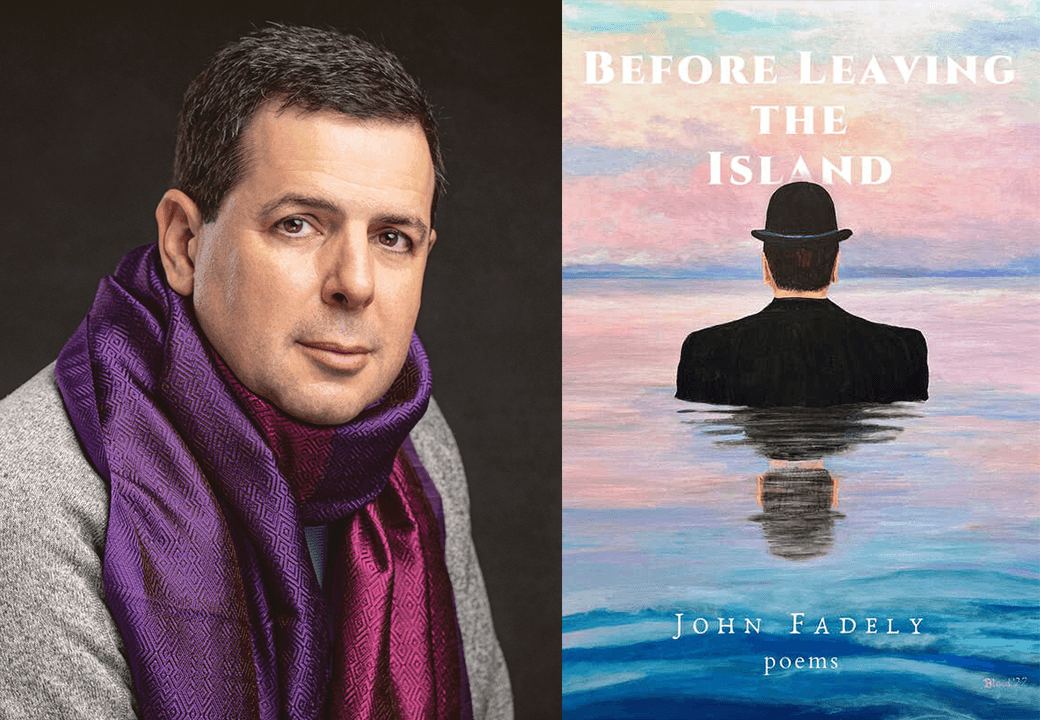
John Fadely
Age: 57. Residence: Portola Valley, California. Book: Before Leaving the Island (Trail to Table Press, April 2026), a technically versatile poetry collection that navigates the sensations, memories, and contemplations of finding one’s way in midlife and across continents. Agent: None. Editor: Tina Schumann.
In 2019, I was working as a lawyer in Hong Kong when the city erupted in protests against the assertion of increased control by mainland China. The demonstrations—quelled through mass arrests and incarcerations, then by pandemic restrictions against assemblies—ended both the Hong Kong I’d known for over two decades and the international openness on which my law career had thrived. To deal with this dual sense of impending loss, I turned to meditation. Along with the mental rewiring that ensued, I started writing poetry for the first time in thirty years, at first about the civil unrest—even as a nonparticipant, I’d been tear-gassed on the way to lunch one day—then expanding to include other experiences. I’d enjoyed taking creative writing classes in college but always had a nagging sense that I needed more life experience before having something to say—so I put poetry aside and majored in East Asian Studies, then completed a JD/MBA and practiced law in Asia for twenty-five years. Now I had something to say.
Before the pandemic I traveled frequently from Asia to the United States for work and family, but that ended in 2020 when Hong Kong imposed quarantines on inbound travelers. Entering the city meant spending up to three weeks in solitary confinement, followed by months of isolation from my family, who were back in the States. My mental health suffered. To maintain my sanity, I took Modern and Contemporary American Poetry, or “ModPo,” an online course offered through the University of Pennsylvania’s Kelly Writers House.
ModPo turned out to be more than just a way to get back into reading poetry: Al Filreis, the professor who developed and teaches the course, generously introduced me to Autumn McClintock, a Philadelphia poet and editor who has helped me grow as a writer. In our consultations, Autumn zeroed in on what made my poems tick and where they needed work, inspiring me to edit each poem until it emerged more fully. My meditation practice also helped; observing and letting go of my own thoughts and emotions as they arose during meditation was good training for letting go of lines that didn’t improve my poems.
Initially my goal wasn’t to publish but to explore midlife displacements: specifically, exiting my profession and a region I’d known for my entire adult life for an uncertain new chapter back “home.” But as my writing improved I sensed a book starting to emerge and began submitting my manuscript to publishers in 2024. Long silences punctuated by rejections made me doubt myself. Fortunately I won the 2025 Trail to Table Book Award in Poetry, and Trail to Table Press—an imprint of Wandering Aengus Press—published my book in April. Jill McCabe Johnson, the founder and editor in chief, and her team have been incredibly supportive.
In need of personal reinvention, I was inspired by this process to found Fifth Stanza Press, with Autumn McClintock as editor in chief, to publish first and second collections by poets in midlife or later. I’ve also returned to another interest, classical Chinese poetry. As part of a series on the Chinese classics, I’m co-translating an illustrated book of Tang poetry to make it accessible to a wider English-language audience.
After having lived for thirty years in Taiwan, Hong Kong, Japan, and Singapore, I returned to the States at the end of last year. Just as my law career was concluding, poetry provided me with a path forward. If you’re fifty or over and hoping to publish your first book, don’t assume that you’re late to the game, no matter how counterintuitive that may sound. Bringing more life experience to the page can be powerful. Going by that clock, you might be running right on time.
An excerpt from Before Leaving the Island
Three Days at Bryce
I.
The sun rose, painting colors into shapes
in an effort of memory. What I saw
was eroded, chipped and broken,
rubble that passes for beauty
in every landscape without us – the canyon
not a threshold to disembodiment
and no strangeness in the apparition of hoodoos.
But leaning against one, I gazed into a valley
until I saw my place in it,
learning by approximation
a language of necessity
marked like the landscape by ancient weather.
In it I was not unlike a mountain or tree,
which must know enough to be
mountain or tree. Having no purpose, this knowledge
comes without depletion and elicits
something more, a greater sun that evokes
our sun, gauzing the canyon in crepuscular light.
II.
The sun rose again above the canyon
rimmed by people, revealing our colors
and shapes, sunlit and clambering down
to explore its dimensions in a loose choral,
turning the rough bowl into our common instrument
where we dwelled in sound, unaware
as children who cover their heads in a game
imagine themselves unseen for not seeing,
but in these soundings we happened
upon each other and, both seeing and seen,
imagined the canyon and made it
a human location in a common mind
which had no history until that day,
and having started alone before
finding each other, dispersed as choristers
who in sound measured our dimensions
against each other, as if we were made of rock,
as if each hoodoo were one of us.
III.
The sun rose on the last day of the long weekend
to a canyon emptied of sound,
an instrument only of its own being
on the Monday of creation. I had beheld it alone
and sung into it to make sounds that,
unlike the forms of sun, gave knowledge
beyond necessity and I had thrilled
in that abundance, but was alone again
and in the knowledge of being alone,
as if at the end of the longest life
carrying memories alone and wondering why
my generation had passed before me,
whether deafness or blindness
would enclose me. Wondering
if there was ever anything
more than the song or sun, or less –
a sound that knew just enough to be sound,
light enough just to be light, revealing only itself.
The Bonesetter’s
palms cradle
his cranium’s full weight,
bend of his neck
in the fingers’ span,
clear porcelain clink
of pestle grinding
sentences to words:
to torque
unarticulated bone,
splay vertebrae
like teeth of a comb,
tease gravity that
pulls buildings down
in spongy spondylosis
and somehow get off
light – his joints shift
like a city’s:
no one will notice
until wire-stuffed drywall
falls into itself
tomorrow morning,
until the who
who, having looked
down too long and
then come begging
for manipulation,
who wears bones
he could never set straight
because they are his own,
snaps
enough back into place
to steer by rudder
of coccyx
him – no,
myself
out the door.
From Before Leaving the Island, copyright © 2026 by John Fadely (Wandering Aengus Press).
Photo credit: David J. Toman