
Judy Sandler
Age: 64. Residence: Lincolnville, Maine. Book: What Kind of Mother: A Reckoning (West Virginia University Press, September 2026), a poignant memoir written from the perspective of a mother about her son’s struggles with addiction and mental illness, thereby chronicling the turn from familial secrecy to painful truth and, ultimately, acceptance. Agent: None. Editor: Marguerite Avery.
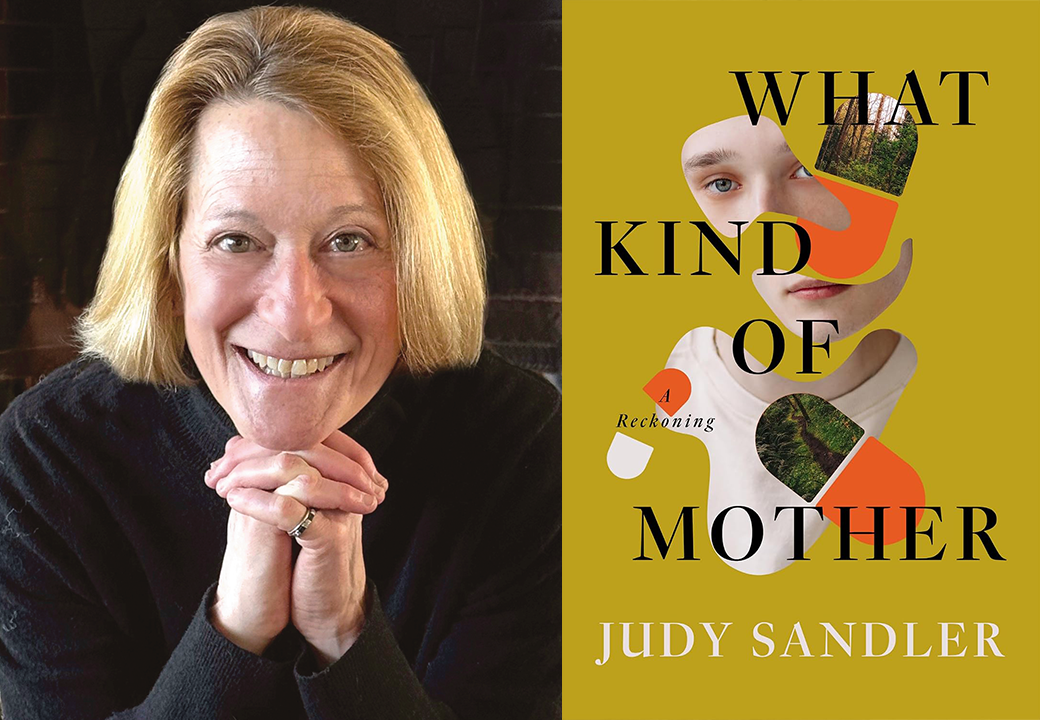
I am not a big believer in fate, but I can tell you that my debut memoir came into the world exactly when it was meant to, and not a moment earlier. I needed to learn two hard lessons before What Kind of Mother: A Reckoning could be published, and because I am an impatient person, I wasn’t doing myself any favors by looking way ahead when I needed to be paying attention to the two major issues plodding around in my brain.
During my two years at Stonecoast’s MFA program, I wrote thirty pages a month, turned them into my mentors for critique, and kept writing. Around this time I had a piece accepted by an online journal. Two days after it went live I received an email from the editors that read: “At your son’s request, we have removed the article from our website.” Apparently my son took issue with how I remembered the story of a shopping trip I made on his behalf—after he left, without necessary items, for a therapeutic living community in Vermont that claims to stabilize the manic episodes of bipolar disorder without the assistance of medication. Despite my efforts to contact the editors and make my case, the piece “Did You Find Everything You Were Looking For?” remained offline.
I now know that when that essay was taken down, my son was holding up a caution sign for me. He was letting me know, in no uncertain terms, that he and I saw his mental health journey through two completely different lenses. The most difficult part of writing this book was not the conjuring of memories or the making of sentences; it was granting myself permission to tell my story as his mother—to own the fact that this story made me who I am—while allowing my son’s voice to be heard and honored alongside my own and acknowledging that it was okay for our points of view to vary.
The other reason this book was not published years ago is that I had dreams of a deal with a Big Five publisher. When my alpha readers finally gave me the go-ahead to pitch to agents, I sent out query letters to my top five choices. What kind of mother hears back from a very big New York City agent on her first round of queries? This kind.
But stay with me while I sprint down the red carpet blindfolded. There were clues that this was not going to be a good fit, but I was too excited to pay attention to them. “Memoirs aren’t selling,” my big New York agent told me. After six months of being out on submission, and many, many top publisher rejections later, I suggested we try smaller publishing houses. But my big New York agent did not like that idea, and we broke up.
So I wasn’t Oprah. I was Judy Sandler and I knew how to tell a good story. I sent out my proposal to smaller publishers and university presses. I got a few encouraging replies, but when I heard back from Renée K. Nicholson, the Connective Tissue series editor at West Virginia University Press, I knew I had struck gold. Only now could I turn around and see what I had missed earlier: My book is a creative approach to a story of narrative medicine, and therefore it needed a publisher who appreciated the function and form of the book. My smaller press cares about my debut, and I can feel it in every move they make to help me sell the book.
Sometimes time is the teacher, the necessary evil that allows us to get what we need, but only when the moment is right.
An excerpt from What Kind of Mother: A Reckoning
Did You Find Everything You Were Looking For?
August 2020
I had made this trip to Reny’s before with a list in hand of one of my children’s needs for camp or school, written in pen on a piece of paper torn from a spiral notebook. But this time was different. I folded the paper in half, made a crease, and walked into the store. I yanked a cart away from the others; I needed a lot of stuff today. My son had forgotten most of the things he would need in the woods, considering he would be away at Compass Rose for at least three months and possibly a year. It was August in Maine, and the air-conditioning in the store felt like relief.
1. Rain Boots
I scanned my options on the shelf and spotted a pair of brown leather Blundstones low all-purpose boots for $150.00. Then I saw a pair of rubber black boots, size 8, for $22.00. I placed them into the cart.
“Can I help you?” A young woman with long brown hair approached me in the shoe aisle. Her pin, straight on her yellow work apron, said her name was Stacy.
No, I don’t think you can help me, Stacy.
“I’m good!” I told her.
“Well, if you need help finding anything, just let me know.” She returned to shelving shoes.
2. Tick Key
What even is a tick key? I picked up a flat piece of cardboard with a metallic yellow key attached to it. I saw it also came in metallic purple. James was good at picking ticks off the family dog with his fingers. He was never a squeamish child, loved to squeeze gloopy finger paint between his fingers, dig holes with sticks in the mud. At seven years old, I remember him groping around in a Styrofoam cup of worms. He pulled one out by its end and dangled it in front of his huge, brown eyes like a prize. “Put it on the hook,” I told him. Guiding the worm, he baited his fishhook, a look of concentration and pleasure on his face. Whoever had written this list didn’t know my son. He didn’t need a tick key to remove a tick from anything. I threw the yellow tick key, whatever it was, into the cart.
3. Work Gloves, Two Pairs
(One for Summer, One for Winter)
I tried to imagine James still in the woods of Vermont four months later, all the way into winter. Chopping wood, lighting fires, cooking, doing whatever he needed to do to stop the mania in his head. What size were his hands, anyway? His tiny hands used to fit inside my own, push Hot Wheels cars along orange plastic tracks, build LEGO airports. Then they packed weed tightly into rolling papers and rolled them into smooth thin joints. I thought his hands must have been medium sized now. I threw two pairs of work gloves into the cart, one lined with Thinsulate and one made of black pleather.
4. Two Sets of Twin-Size Sheets
He had left without bedding. What was he thinking? He believed someone was listening in on his cell phone conversations and that the photographs on our walls were talking to him, so how could he have remembered to pack two sets of twin sheets? I couldn’t bring myself to buy microfiber because I didn’t know what microfiber was, even though it promised to be “soft and wrinkle-free.” I went with a blue damask print and a depressed maroon color. Before I placed the sheets in the cart, I remembered we had twin sheets in the closet at home. They were white cotton, with tiny blue anchors all over them. Anchors were happier. I also had a blue cotton blanket I could throw in. I realized I was doing it again, enabling James, doing everything in my power to make him comfortable. But I drew the line at microfiber sheets.
5. A Bathrobe
They didn’t have bathrobes at the store. I asked Stacy, and she said they didn’t carry them in adult sizes. On my list it said, “A bathrobe for the sauna.” Since James was lucky enough to be taking saunas for the next few months, he could wrap a towel around his waist. Or Daniel had an extra bathrobe he could borrow. It had a Ralph Lauren symbol on it, and James wouldn’t like that. What did I care what he preferred in a bathrobe? I had to stop caring so much. That may have been how we had gotten here to begin with—me caring too much. Now he was at Compass Rose, and I was pushing this cart around Reny’s.
I rolled it to the checkout line.
“Did you find everything you were looking for?” Grant asked me, scanning each item I placed on the belt.
Everything I was looking for? I did not find the shelf holding the answer to whether three months or even a year at a place called Compass Rose in Vermont would bring my son back to himself. I did not find the rack where it was determined if an episode of bipolar disorder could be interrupted without pharmaceuticals. I could not find the aisle with the directions for how the saunas and the drawing and the work gloves at Compass Rose would quiet my son’s brain and reignite his soul.
Grant, could you tell me where I can find these things?
From What Kind of Mother, copyright © 2026 by Judy Sandler (West Virginia University Press).
Photo credit: Harrah Lord