Radha Lin Chaddah
Age: 56. Residence: Philadelphia. Book: And the Ancestors Sing (Rising Action, February 2026), a multigenerational historical novel that follows the challenge-filled journey of two rural migrant women in post–Cultural Revolution China through an expansive yet intricate lens. Agent: None. Editor: Tina Beier.
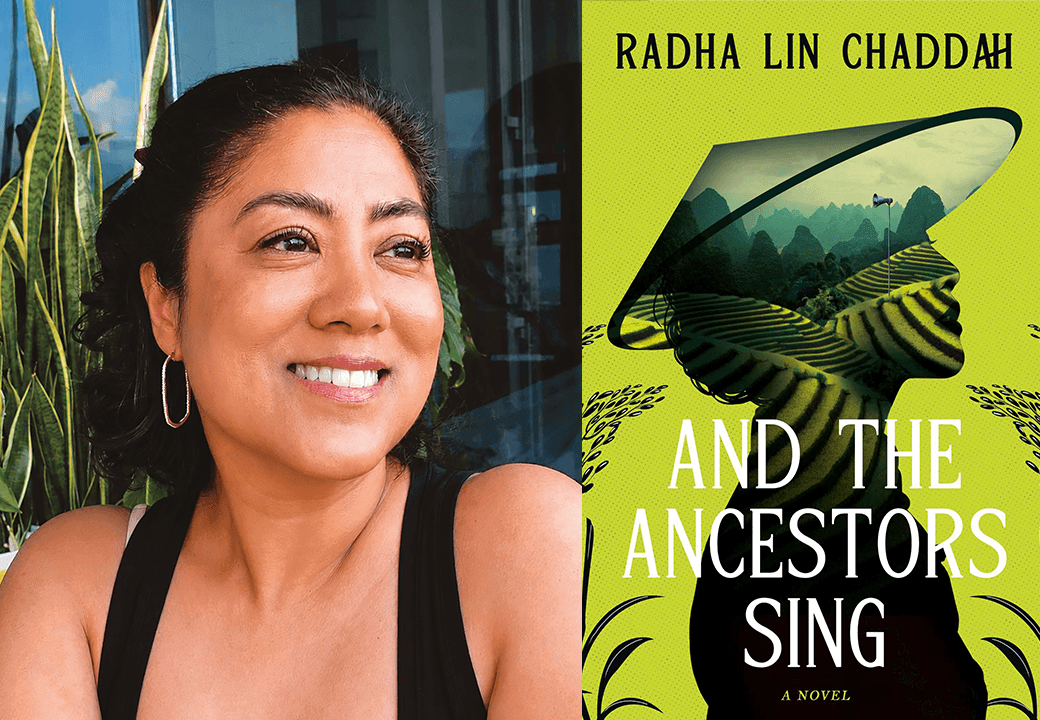
At the age of twelve I told my Indian father I wanted to be a historical-fiction author when I grew up. As a recent immigrant to the United States who was constantly concerned about the financial stability of his household, he was less than supportive of this fledgling career choice. He encouraged—more accurately, insisted—that I follow a path that would culminate in either a medical or law degree. As fate would have it, through my own series of academic interests and passions, I ended up attending both medical and law school and have had a wonderful career using both degrees. I never really thought of writing, at least not creative writing, for many years.
In 2008 my husband and I, along with our two young daughters, moved to East Asia. We had the privilege of living, working, and studying in Taipei, Shanghai, and Beijing for almost a decade; we immersed ourselves in the language, culture, and generous hospitality of our host cities. As the daughter of a Chinese mother, I deeply appreciated this opportunity to further explore aspects of my own heritage. Through my work in China as a physician with an international hospital and as a public health writer and editor, I developed deep relationships and friendships and also heard incredible stories of hardship, sacrifice, and hope from patients and families who lived through China’s Cultural Revolution. It was these experiences that rekindled my desire to tell a story, possibly to write one that would be worthy of becoming a book.
To prepare myself I took a few online creative writing courses from my living room in Beijing. I loved parsing short stories with fellow students, pulling out the craft elements that made a particular work so effective. I wrote a couple of pieces and quickly discovered that I preferred plotting over “pantsing”—creating a story without an outline, or “flying by the seat of your pants.” After eight months of planning, I ended up with a forty-three page, single-spaced novel outline that served as my guide.
I completed my manuscript in November 2019 and embarked on the journey to publication, naive to all that lay ahead. I queried dozens of agents and had some very positive responses, though none that ended in representation. I put the novel aside during the pandemic and focused on family, friends, and doctoring. In the fall of 2023 my husband encouraged me to pitch once again; I was reluctant, so I decided to head back into the world of writers by attending online workshops and conferences. These events helped me combat the sense of loneliness that would occasionally set in as I worked on updating my pitch letter and revising my manuscript. Ultimately it was through a literary conference that I met my publisher.
It is hard to believe that in 2026, over four decades since I first voiced my aspiration to become a historical-fiction author, my childhood wish came true. I appreciate that those forty years were filled with life experiences that eventually fueled my creativity and proved instrumental to my storytelling. Since the publication of And the Ancestors Sing, I have had the privilege of appearing on Good Morning America and being featured in Times Square on the Nasdaq tower. Best of all, I have connected with wonderful readers while on book tour, in person and remotely. I am thankful for those who have made their way into the world of my literary debut. An author can ask for nothing more than a reader who is willing to step into another time and place and listen closely. Dreams don’t have an expiration date, rather they can lie dormant and find the right season in which to reemerge.
An excerpt from And the Ancestors Sing
Part One
Da Long Village
China, 1978
Chapter One
Hooks
It is a place of staggering beauty, this spot tucked away in the middle of nowhere at the heart of the Middle Kingdom. The land is rich with the darkest of soil and, at the right time of year, the hills are thickly carpeted with greenery so bold that the land seems to cry with life. However, for the men and women who dot this landscape with their hard-fought lives, knowledge of the land’s capriciousness in delivering good fortune renders the image less vibrant.
In between the fields, outlined by irrigation canals furrowed by hand, wooden shacks protrude from the land. They lean this way and that, lacking any sense of fortitude; not one stands straight. When heavy rains flood the fields, the people of this land dare not complain that their leaky roofs leave them drenched to the bone. They humbly accept that these meekest of shelters, while unable to keep them dry, allow them to stay put, sparing the mud beneath them from softening to silt that might carry them away. The walls bear hooks that serve to pin all that these families own—collections of pots and hoes, plastic bags filled with roughly folded clothes and worn slippers, quilted coats, and sacks of rice—to their place on the land. Without these rains, life would be lost. The tiny rice seedlings, each one transplanted by hand to its spot in a row of these carefully tilled fields, would be lost.
The children of the land are not told stories of mythical monsters. Rather, they are regaled with the horrors of a famine that once stripped this land bare. Their nightmares are filled with the howl of empty bellies, and their daydreams soaked with abundant rains that fall as rice grains into an eternally filled bowl.
Squinting to avoid the glare of a brilliant harvest sun, if one focused on the dark dots scattered on the fields, one would come upon Fang Lei, bent over at the waist and knee deep in water cold enough to leave her feet numb. She is surrounded by others similarly disposed; human hooks stuck in the soft earth.

“Hurry up! Cut faster!” Fang Bo spat as he talked to his young wife. “Get your stems tied up quickly. I want to catch up with the others.” Bo stared after Pang and Shu as they waddled their way through the field, their full bodies wading steadily through the muddied water. Pang, nicknamed since boyhood with the common word for fat, was hampered neither by his corpulence nor by the considerable weight of the bundled rice stalks that he carried on one shoulder. Shu, Pang’s younger brother, was smaller but no less robust than Pang, and waded stride for stride with him.
Bo’s stomach churned at the thought of food. He was hungry and dreaded the long walk from the field to the Farmer Master’s house. A thin strip of a man, Bo could only manage half the haul of either Pang or Shu. He would have to face the embarrassment of having his day’s meager work weighed on the farmer master’s scale, then stretch his hand out to receive half the wage collected by each of the brothers.
This was no fault of his own. As a boy, Bo had not had a belly filled up on the ill-gotten rewards of a mother who curried favor with the Party leaders, whoring herself for extra rations of sugar and white pork fat. Bo had swallowed hard on the saliva that pooled in his mouth when, on his daily walk to school with the pudgy pair, the glistening ring of animal oil smeared around their mouths and the smell of the pork fat on their breaths teased at his stomach. The thought of it now still soured him.
“You are so slow. You will do nothing but cost us our dinner. I don’t want to wait around.” He kept his eyes on the brothers, on their backs stained with sweat, watching them move further from him. Bo didn’t look at Lei when he spoke. “I will not wait for you.”
Lei did not take her eyes off Bo, though he did not know this. She was careful to keep her head bowed to her work, studying his face from under the brim of her hat. His words did not turn her this way or that, and neither did her heart jump nor strain at his harshness, simply for the fact that she did not yet know him. She searched his face for clues. Its smallness and tightness reminded her of a clenched fist. His dark eyes were so black, absorbing almost all the light even on this brightest of days. She hoped there was a softness hidden behind them that she could not see. She had looked for this same softness on the night of their wedding, but the moon had been shuttered out of his hut so completely that not a ray of light had fallen across his face. She had become a woman in complete darkness with a man who was invisible to her.
From And the Ancestors Sing, copyright © 2026 by Radha Lin Chaddah (Rising Action).