Writing Rich and Complex Lives: Mary McMillan’s Writers Circle
Mary McMillan lives and works in Lake County, California. She has been facilitating the Writers Circle, a monthly free public writing workshop sponsored by the Lake County Arts Council and supported by Poets & Writers, for more than five years. She worked as a journalist for several years, and has written novels and creative nonfiction. In 2010, she was selected as Lake County’s Poet Laureate and published This Wanting, a poetry chapbook, as well as the textbook Get Inside Your Relationships, related to her work as a marriage and family therapist. Along with a private psychotherapy practice, McMillan works as a mediator for family court and teaches parents in the court system how to communicate better with their co-parents.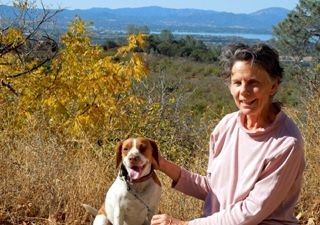 Since fall 2008, I have been funded by Poets & Writers to facilitate the Writers Circle, a free public writing workshop that meets once a month in the Lake County Arts Council gallery. Located in rural Northern California, in a valley isolated by mountain ranges, Lake County is both cursed with the problems that come with extreme poverty, and blessed by clean air and breathtaking scenery. Many artists, writers, and professionals retire in Lake County, where they can enjoy mountain trails and the largest natural freshwater lake in the state. Centuries ago, a now-dormant volcano created rich soil in the valleys—soil that now attracts small family farms growing organic produce, walnuts, pears, and wine grapes.
Since I took over the position of workshop facilitator, I've been fascinated and moved every month, as participants have brought in material often hoarded and hidden for years—and I have watched these writers bloom into confident authors of exquisitely funny, terrifying, or touching stories and poems.
Ten years ago, Fran Ransley began writing her memoir, This House Protected by Poverty, about being a welfare mother. This month she is preparing to submit the final version of her manuscript to Amazon’s CreateSpace to print her first edition. Each month, when Fran read her stories of frustration laced with irony and wit, participants practically fell off their chairs laughing—appreciating the absurdity Fran saw in every situation— yet offered constructive criticism. For instance, when Fran rambled into interesting or thoughtful digressions, we helped her construct ways to weave those observations into her central narrative.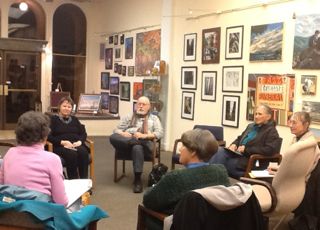 In 2010, participant Lourdes Thuesen started writing a short story about a developmentally delayed girl whose mother was addicted to methamphetamine. As we continued asking her questions about this mother and her history, Lourdes ended up writing a compelling novel with the addicted mother at the center of a complex web of relationships. And, recently, a middle-aged man in a wheelchair has joined us, keeping us enthralled with excerpts from his memoir, So You Want to be a Quadriplegic.
Over the years, I have offered an encouraging ear, and ensured a safe place for people to bring sensitive material and tell their stories. I have always felt impressed with the fine quality of both writing and listening that participants bring to the workshop, but even more, I have felt privileged to witness the rich and complex lives they have come to share.
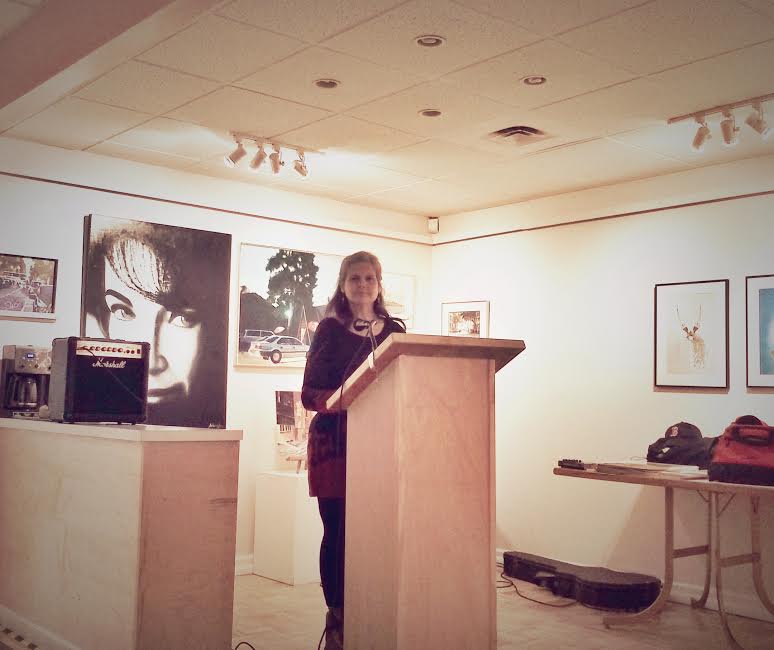
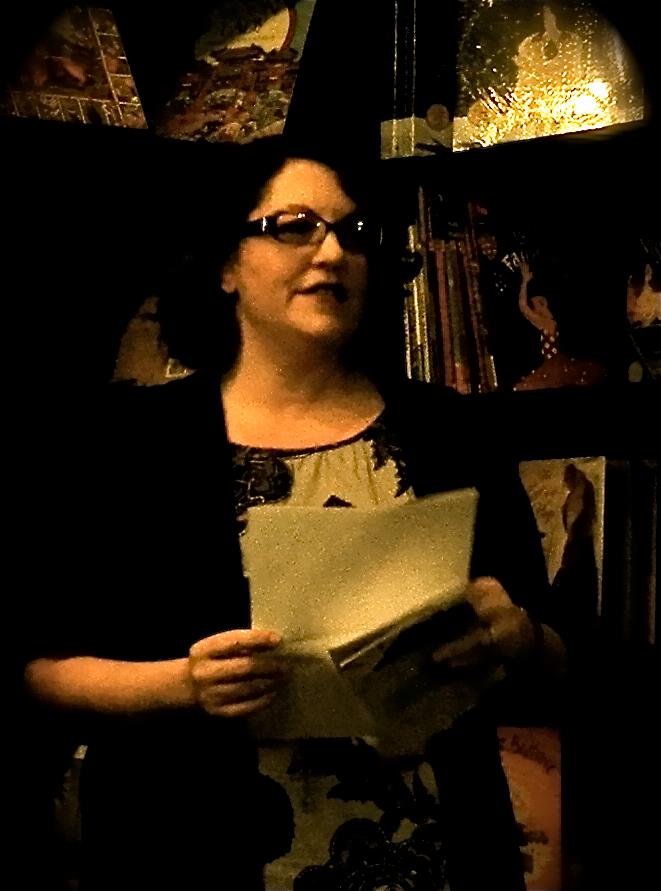
Top: Mary McMillan and her dog, Rosie; credit: Patty Dalton. Bottom: The Writers Circle; credit: JoAnn Sacato.
Major support for Readings & Workshops in California is provided by the James Irvine Foundation. Additional support comes from the Friends of Poets & Writers.
 What makes your reading series and its events unique?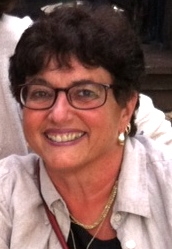
 What are your reading do's?
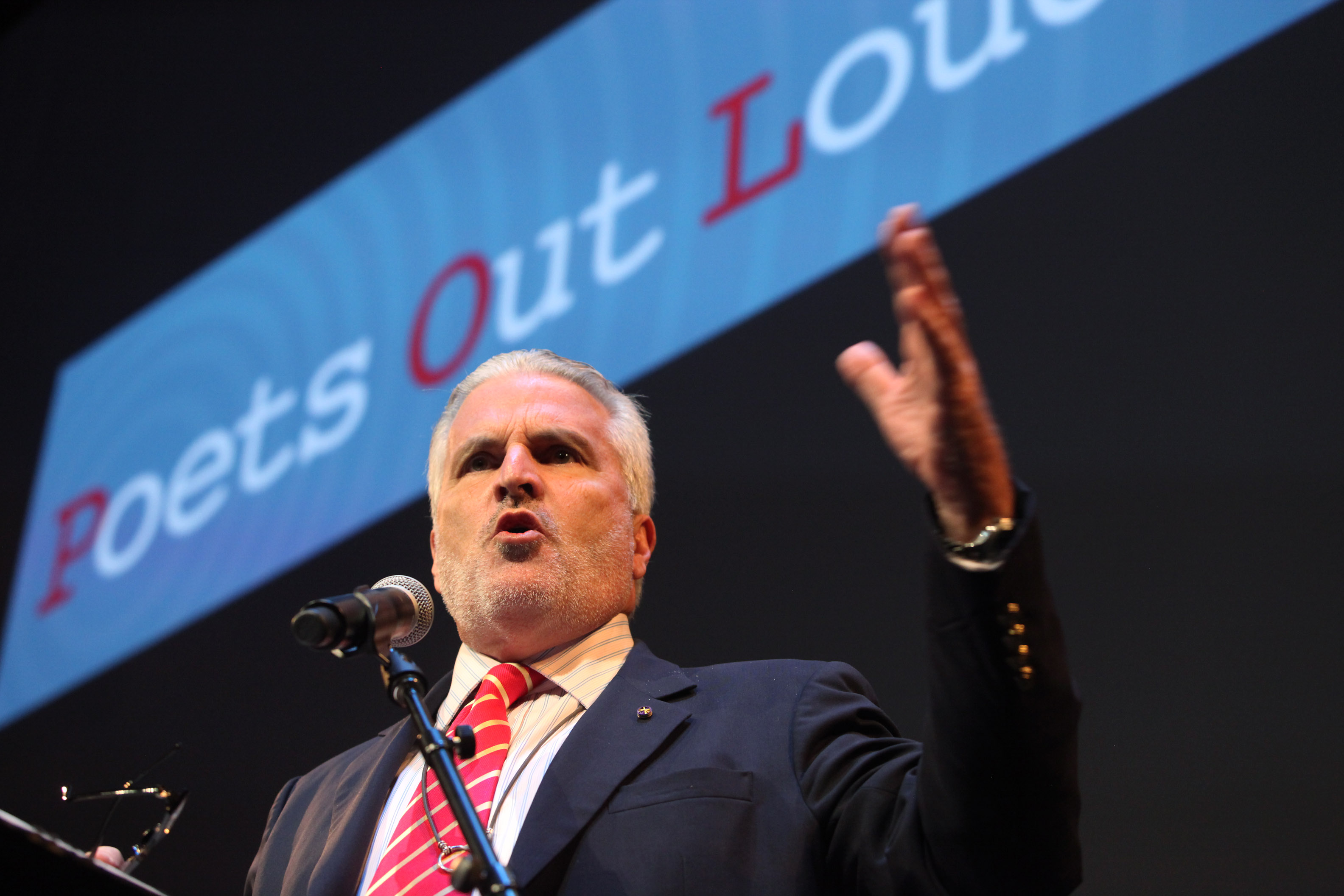
 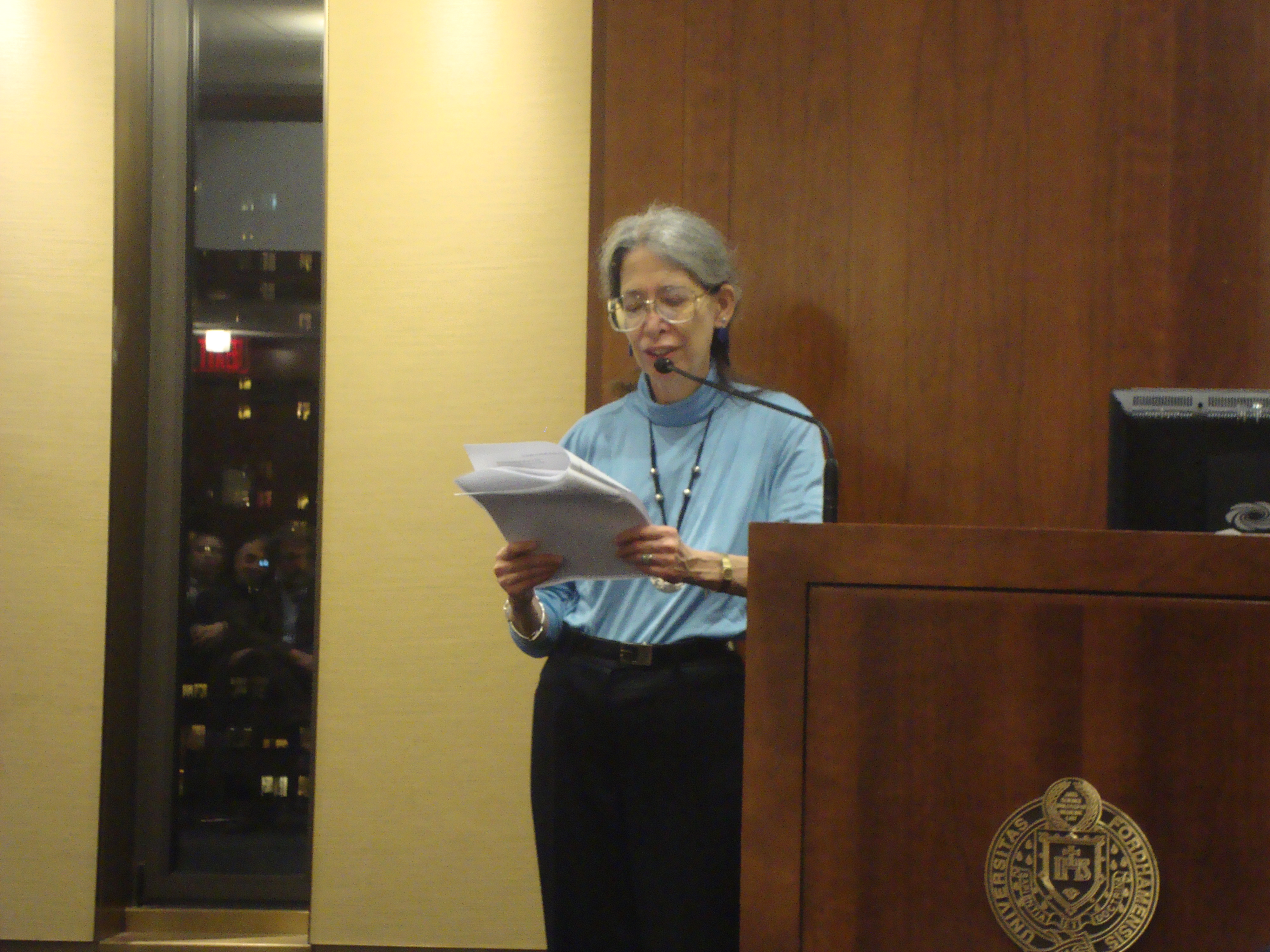 After I’d taught for many years at Carleton College and the University of Wisconsin (and more briefly elsewhere), Fordham University offered me the John D. Boyd SJ, Chair in the Poetic Imagination—an appointment that I might well have accepted for that title alone. When I arrived, Elisabeth Frost was heroically directing both the Poets Out Loud readings and the contest whose winner, the POL Prize book, is published by Fordham University Press. But about a year later Beth decided to focus on the latter portfolio, her work as editor of the Poets Out Loud book series (she shortly afterwards expanded the program to include publishing a second book each year)—and I happily inherited the program of poetry readings.
 Taking over a series that was already going strong opened up possibilities for additional initiatives. Looking inwards to the Fordham community, we now encourage entering students to become familiar with POL from the get-go by connecting our September reading to the themes of First-Year Orientation. Looking outwards, we have an outreach to high school students from underserved communities; our current partners are
  The touchstones for poetry that Emily Dickinson famously identified also aptly describe directing a poetry reading series. “If...it makes my whole body so cold no fire can ever warm me”—yes, that describes running a poetry series when an elaborately planned event like that one is cancelled or when one discovers the day before a reading that another group is widely announcing that it has booked the room assigned to us. On the other hand, Dickinson also declares of poetry, “I feel physically as if the top of my head were taken off”—and the top of my head has been delightfully and delightedly blown off by the readings themselves and by the audience’s responses. Witness comments such as “Fantastic series. Has reignited my love of poetry” and “Much more entertaining than I had ever expected to find poetry” and "Poets Out Loud reminds me how and why I fell in love with poetry and why it will always be a part of me.”
 Anyone flipping through Poets & Writers Magazine will notice a number of ads for writing workshops, all of which sound tasty for one reason or another. Like probably millions of other writers, I’ve participated in different workshops and have benefited from working with some talented writers who have led enriching workshops. Without question, these gatherings are worth their weight in gold. But what if you can’t afford their often hefty price tags? Writers workshops are not the only place for writers to go when wanting to give their writing a boost, especially if they want to pay close to nothing.
 What makes your organization and its programs unique?
 We’ve all heard Thoreau’s declaration, “I went to the woods to live deliberately….” Considering that Walden resulted, maybe he should have written, “I went to the woods to write deliberately….” Thoreau probably wasn’t the first whose writing was fueled by a natural setting, and he certainly wasn’t the last.
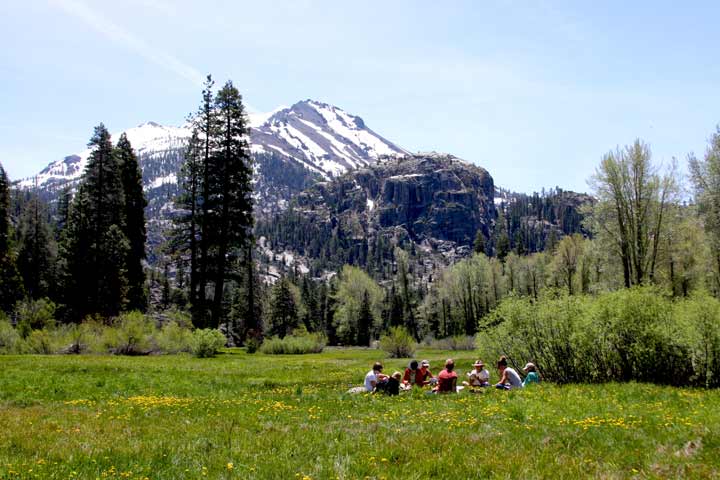 My time in Tahoe led me to teach workshop-based courses at the High Sierra Institute (HSI), a satellite campus of the Yosemite Community College District, at Baker Station, a 1930s field station owned by the U.S. Forest Service. While HSI isn’t in the backcountry, it’s in the middle of the Sierra Nevada far from serious civilization. The remote locale creates a setting devoid of distractions, including cell and internet services. Participants come to HSI and drop anchor, staying there (for free) during the duration of the course. Our lives become suspended as we enter three-day weekends of writing. HSI’s unplugged nature and the absence of personal responsibilities opens up mountains of time. We devote roughly ten hours a day to examining, discussing, producing, and sharing writing, all sprinkled throughout the day. The other time is spent taking siestas, sharing meals together, sitting next to the Stanislaus River or around the campfire, walking, reflecting. This kind of isolation and immersion, something few of us find in our regular lives, fuels our pursuits on the page.
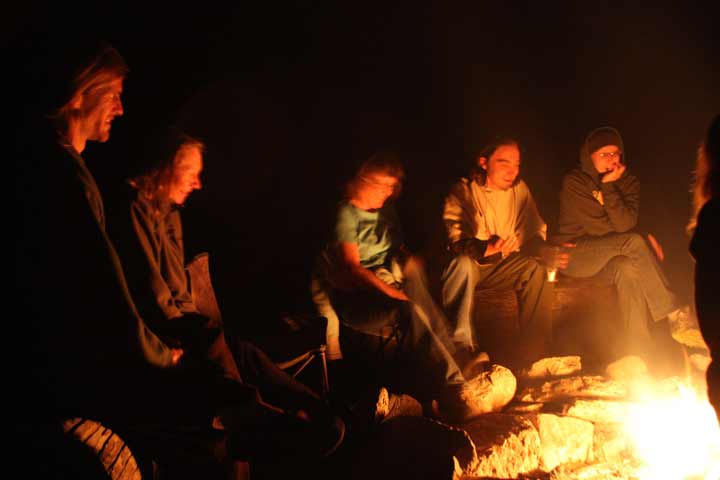 Every summer I see impressive writing emerge like magic. As much as I’d like to take credit for the prose produced, the setting has as much to do with the experience’s successes as anything else. We breathe the alpine air, hear the river’s running water, look up at mountains studded with granite boulders among towering pines, sit in a nearby meadow, and something shifts inside. A calming happens. It’s as if all that beauty takes hold of us and inspires us to be true to our stories, to be true to ourselves. It’s not uncommon for writers to explore narratives about deeply personal events that they’ve wanted to write about for years but have been unable to. And once one writer shares such a piece, which always happens, the others come forward, as if an impediment is dislodged, and important stories flow forth. This process produces a lovely level of trust among the group members, one that tacitly illustrates that this space and time are about creating and respecting our stories. While most share their work, I do not require that everyone do so except at the end for a final reading. My point is that while not required, everyone usually shares willingly because of the trust that results from the relaxed and accepting atmosphere created by the environment.