

Cholla Needles Monthly Poetry Reading

Rich Soos is the editor of Cholla Needles, which publishes a monthly literary magazine and poetry collections by local authors of the Joshua Tree community in California’s San Bernardino County. The Cholla Needles Arts & Literary Library aims to keep people excited about poetry through writing workshops and a monthly reading series. Soos is the author of over twenty poetry collections and was the editor for Seven Stars Poetry from 1973 to 1998.

The name of the magazine, Cholla Needles, came from a poem I wrote after I fell on a cholla cactus and its needles stuck in my hand and foot. When I made the decision to start a new magazine, I used that poem to inspire my mission statement—asking writers to submit poems that would “stick with you” and make the magazine memorable.
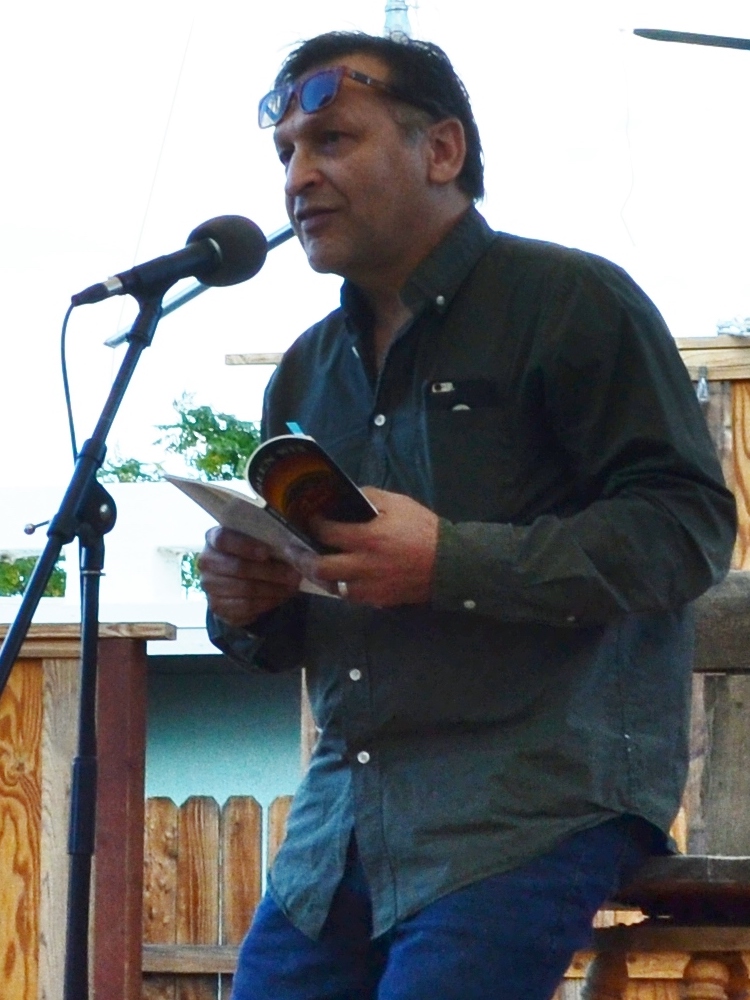
Juan Delgado reading at Cholla NeedlesEach monthly issue of Cholla Needles is celebrated with an open reading and a featured poet. The readings take place outdoors in the beautiful desert of Joshua Tree, California, on the second Sunday of each month.

The audience of forty to fifty neighbors is often joined by visitors from around the world, there to explore Joshua Tree National Park. Readers have come from many countries including Ireland, India, Britain, Italy, Germany, and Brazil. Hardcore locals arrive each month too, no matter what the heat (even at 110 degrees in summer), because it’s simply a joy to celebrate poetry together.

In October, our reading began with a dance performed by youngsters from the community to a new poem by Kim Martin. The party continued with twenty-one other readers, and then the featured reader Juan Delgado, who shared poems from each of his fine collections.

Juan traveled “up the hill” from his home several hours away to delight the audience with early poems that celebrate the joy of youthful discovery, and poems from his newer collections, which celebrate how the passing of old friends enhances our deep understanding of life.

Our featured readers are supported in part by a grant from Poets & Writers’ Readings & Workshops program. This support allows us to have poets visit from outside the area and keep our monthly parties fresh and exciting. There is tremendous appreciation from featured readers and audiences for Poets & Writers’ support. It provides a sense of pride knowing that someone from outside the area cares enough to help out in this way.

The time and location for our monthly readings are announced on our website. Visitors to the area are always welcome to bring their own work to share with us during the open reading portion of the party.

Support for Readings & Workshops in California is provided by the California Arts Council, a state agency, and the National Endowment for the Arts, a federal agency. Additional support comes from the Friends of Poets & Writers.

Photo: Featured reader Juan Delgado at Cholla Needles (Credit: Bob DeLoyd).
Wondrous Women

11.1.18

“Where would we be without the women who plant their feet, who set their chins, who step forward and never fear the dark?” asks Laird Hunt in his Literary Hub essay “In Gratitude for the Fierce Women of the World.” Hunt describes his high school girlfriend and his grandmother, who both served as fierce female inspiration for him and his novels which center on women who “are making their own story, their own names, their own games.” Write a personal essay about a woman who has had a powerful presence in your life, who inspired you to persevere, to overcome obstacles, to not back down. 

All-American Ghost

10.31.18

In her New York Times essay “The Ghost Story Persists in American Literature. Why?,” Parul Sehgal writes about how ghost stories throughout American literature have functioned as social critique, manifestations of protest and redress that reveal “cultural fears and fantasies,” and which understand “how strenuously we run from the past, but always expect it to catch up with us.” Write a story that uses a dark or troubling part of history as the impetus for an appearance of a ghostly presence. How does the ghost serve “as a vessel for collective terror and guilt, for the unspeakable” in your story?

Bared Teeth

10.30.18

Construction workers renovating a building in Valdosta, Georgia, last week discovered approximately one thousand teeth buried in a wall on the second floor. Historical researchers attribute the discovery, and the teeth found in walls in two other cities in Georgia, to the spaces having been occupied by dentists in the early 1900s. Write a poem inspired by the imagery, secrets, and possibilities evoked by these bizarre findings. How do the buildings and architecture that surround us hold and reveal local history? Have there been situations in your life when a buried past became uncovered in mysterious or revelatory ways? 

How Times Have Changed

10.25.18

In the chapter titled “The One Where Two Women Got Married” in the nostalgic retrospective I’ll Be There For You: The One About Friends (Hanover Square Press, 2018), journalist Kelsey Miller writes about the prevalence of homophobic jokes and the depiction of the lesbian couple in the television show Friends. Looking back twenty years later, Miller explores the ways in which the series was a product of its time. Choose a television series that aired ten or twenty years ago that you used to watch, and find a clip or episode to view. Write a personal essay about how your perception of the show has changed with hindsight. Consider what your own opinions of the show were when you watched it the first time around, and then examine how your perspective might have evolved over the years with the culture.

Shoulder Surfer

10.24.18

Have you ever found yourself peering over a nearby stranger’s shoulder to see what’s on the phone’s screen? In a recent study, researchers at the Ludwig Maximilian University of Munich analyzed findings from a survey and found that “shoulder surfing was mostly casual and opportunistic” and was “most common among strangers, in public transport, during commuting times, and involved a smartphone in almost all cases.” Write a short story in which your protagonist peeks over the shoulder of a bystander and catches a glimpse of something unexpected on the person’s phone. Is it something vaguely suspicious that captures your main character’s imagination or is it something downright implicating?

Objectified

10.22.18

“I always feel that I’ve seen a thing after I’ve described it….when I’ve written a thorough physical description of something, then I feel like I’ve seen it and I’ll remember it,” says Barbara Kingsolver in “A Talk in the Woods,” her conversation with Richard Powers in the November/December issue of Poets & Writers Magazine. Choose an object that you have never really given much thought to, but that you see frequently in your home or on your commute, perhaps a houseplant or a mailbox or a street sign. Spend some time intensely observing it, and then jot down a thorough physical description. Afterwards, write a poem about the object. How did your perception of it change, in your mind’s eye, after going through the exercise of articulating it in language?

In the Midst

10.18.18

“As a nonfiction writer I tend to write about things when I am still in the midst of them, when I am too close to the subject matter and there is no possible resolution to the thing I am writing about,” writes Steph Auteri in “Writing Partners: Working Together Through Writing and Life” in the November/December issue of Poets & Writers Magazine. What issues or conflicts are you in the midst of struggling with right now? Begin an essay about a subject that you are dealing with at the moment, writing down all the raw emotions without self-editing. Perhaps in a few weeks or months, you can revisit the piece and decide whether to continue working on it from more of a distance.

Spoken For

10.17.18

Ligaya Mishan’s essay “In Literature, Who Decides When Homage Becomes Theft?” in the New York Times Style Magazine examines instances in which the authors of historical and contemporary literature have been accused of plagiarism or cultural appropriation, and questions the imbalance in response and criticism. Explore your thoughts on the boundaries of theft and homage with your own project. Write a short story that pays tribute to one of your favorite authors and offers a new perspective, such as how Kamel Daoud’s novel, The Meursault Investigation (Other Press, 2015), reimagines Albert Camus’s The Stranger or Preti Taneja’s novel, We That Are Young (Knopf, 2018), sets King Lear in contemporary India.

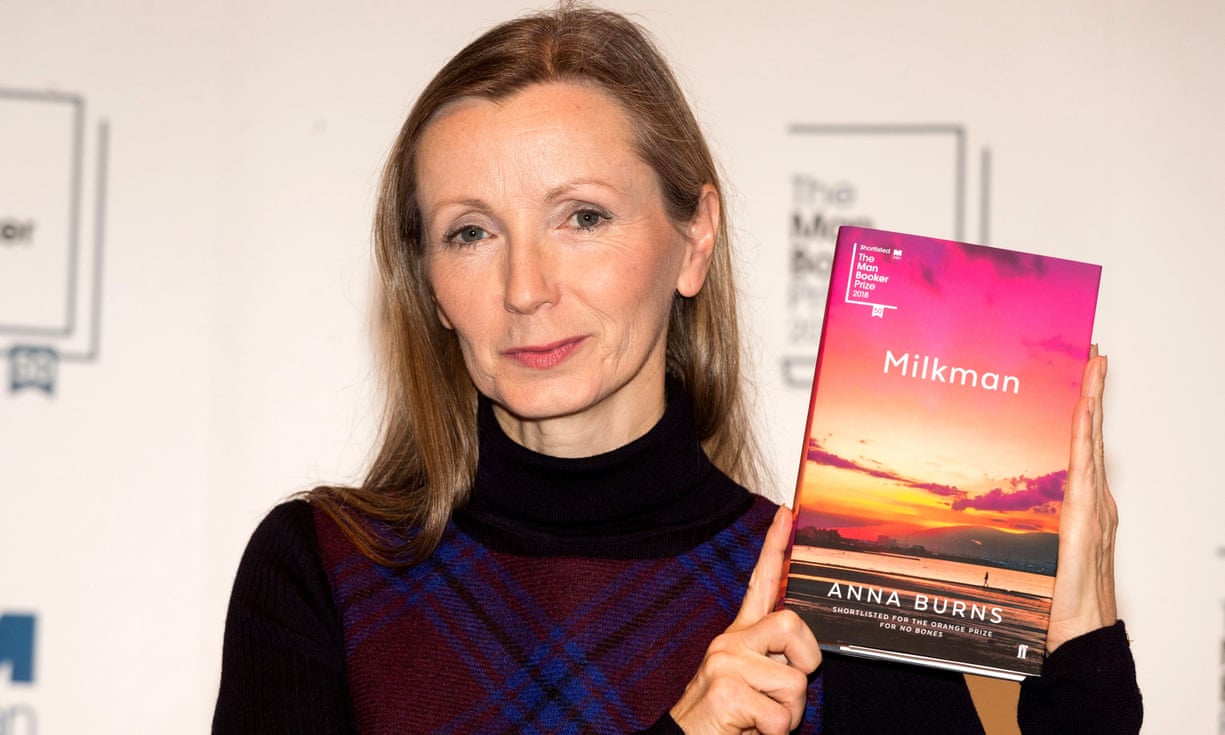
Anna Burns Wins 2018 Booker Prize

Tonight at a ceremony in London, Anna Burns was announced the winner of the 2018 Booker Prize for her third novel, Milkman (Faber & Faber). The annual £50,000 (approximately $66,000) award is given for a novel published in the previous year in the United Kingdom.

“None of us has ever read anything like this before,” said Kwame Anthony Appiah, the chair of judges. “Anna Burns’s utterly distinctive voice challenges conventional thinking and form in surprising and immersive prose. It is a story of brutality, sexual encroachment and resistance threaded with mordant humor.” Along with Appiah, the 2018 judges were Val McDermid, Leo Robson, Jacqueline Rose, and Leanne Shapton.

Burns, the author of three novels, is the first Northern Irish writer to win the prize. Her novel Milkman is a coming-of-age story about a young girl’s affair with an older married man during The Troubles in Northern Ireland. Graywolf Press will publish the novel in the United States on December 11.

The finalists were Esi Edugyan for Washington Black (Serpent’s Tail), Daisy Johnson for Everything Under (Jonathan Cape), Rachel Kushner for The Mars Room (Jonathan Cape), Richard Powers for The Overstory (William Heinemann), and Robin Robertson for The Long Take (Picador). The five finalists and Burns will each receive £2,500 ($3,300).

The Man Booker Prize is one of the most prestigious awards given for a book of fiction written in English. George Saunders won the prize last year for his novel, Lincoln in the Bardo, and Paul Beatty won in 2016 for his novel The Sellout. This year the prize, which is sponsored by the Man Group, celebrated its fiftieth anniversary by hosting a Golden Man Booker Prize, awarded to the best-ever Man Booker Prize–winner. Michael Ondaatje won for his novel The English Patient, which won the Booker Prize in 1992.

Read more on the Man Booker Prize website.

Photo credit: Ray Tang

Pages

Subscribe to RSS - blogs