Submissions Open for PEN/Jean Stein Grants for Literary Oral History

The deadline is approaching for the PEN/Jean Stein Grants for Literary Oral History. Starting this cycle, PEN America will award two writers grants of $15,000 each, expanding the program from a single grant of $10,000. The prizes will support literary works of nonfiction that use oral history to “illuminate an event, individual, place, or movement.” Only unpublished works-in-progress are eligible.

Using only the online submission system, submit a writing sample of 20 to 40 pages, 6 to 10 pages of transcribed interviews, a curriculum vitae, a project outline, a project description, a statement on how and why oral history is being used in the project, and a statement on how the grant would be useful to the project by August 1. There is no entry fee. Visit the website for complete guidelines.

Established in 2017, the PEN/Jean Stein Grants are awarded by PEN America, a nonprofit organization advancing freedom of expression, and are made possible by a donation from Jean Stein, whose is remembered for pioneering the genre of narrative oral history. The inaugural grant recipient was Aleksandar Hemon, who received the grant for How Did You Get Here?: Tales of Displacement, a project to record the experiences of immigrants fleeing genocide in Bosnia.

Creativity in Quarantine

7.16.20

In “What We Found in Writing: Authors on Creativity in Quarantine” in the July/August issue of Poets & Writers Magazine, thirteen authors describe their experiences of writing and not writing during the past several months of quarantine. Ada Limón writes: “What struck me, almost immediately, is that fear was more incapacitating than despair. I could surrender to a hopelessness and still make something. Even if it felt like a last gasp of my own humanity or love or tenderness, I could still write it. However, if I focused on fear, I was always silenced.” Write a personal essay that examines how your own creativity has ebbed and flowed during this time. Are there things that have been easier or more difficult to write about? Where have you found inspiration? What has been unexpected?

Garden Making

7.15.20

“Like other artistic endeavors, garden making can be a response to loss. Creating a garden can be as much a re-creation as a creation; an idea of paradise, something that reconnects us with a landscape we have loved and which compensates us for our separation from nature,” writes Sue Stuart-Smith in The Well-Gardened Mind: The Restorative Power of Nature (Scribner, 2020). Write a short story in which a garden is created in response to a loss. Is the garden a gift? What is the character or community’s connection to nature? Include details of what is grown in the garden and how it is used.

The Virtual Writing Community

I’ve lost track of the days and how many Zoom meetings and events I have attended since the start of this pandemic. All the days are a blur of keyboards and news feeds.

The toll of uncertainty on the body, mind, and spirit is real. I encourage you to unplug some days and find small joys. This pandemic will not be a sprint but a marathon. Pace yourself with quality time, loved ones, and perhaps your favorite ice cream.

One of the things I have enjoyed during quarantine is being able to attend events virtually. I would not have been able to afford or travel the distance to see many of the kind of events I’ve “attended” online. There are some great virtual events that are really giving unprecedented access to talks, writers, workshops, and more. Many are listed in the P&W Literary Events Calendar. Take advantage of them. Allow your mind to think less local and more global. Even if we ever return to a maskless society, technology will be our bedfellow.

I’m happy to say I’ve made some virtual new friends and discovered new writers that I enjoy.

Have you been attending virtual events? Have there been some pleasant surprises? Let me know how literary virtual events are impacting you for the good on Twitter, @NOLApworg.

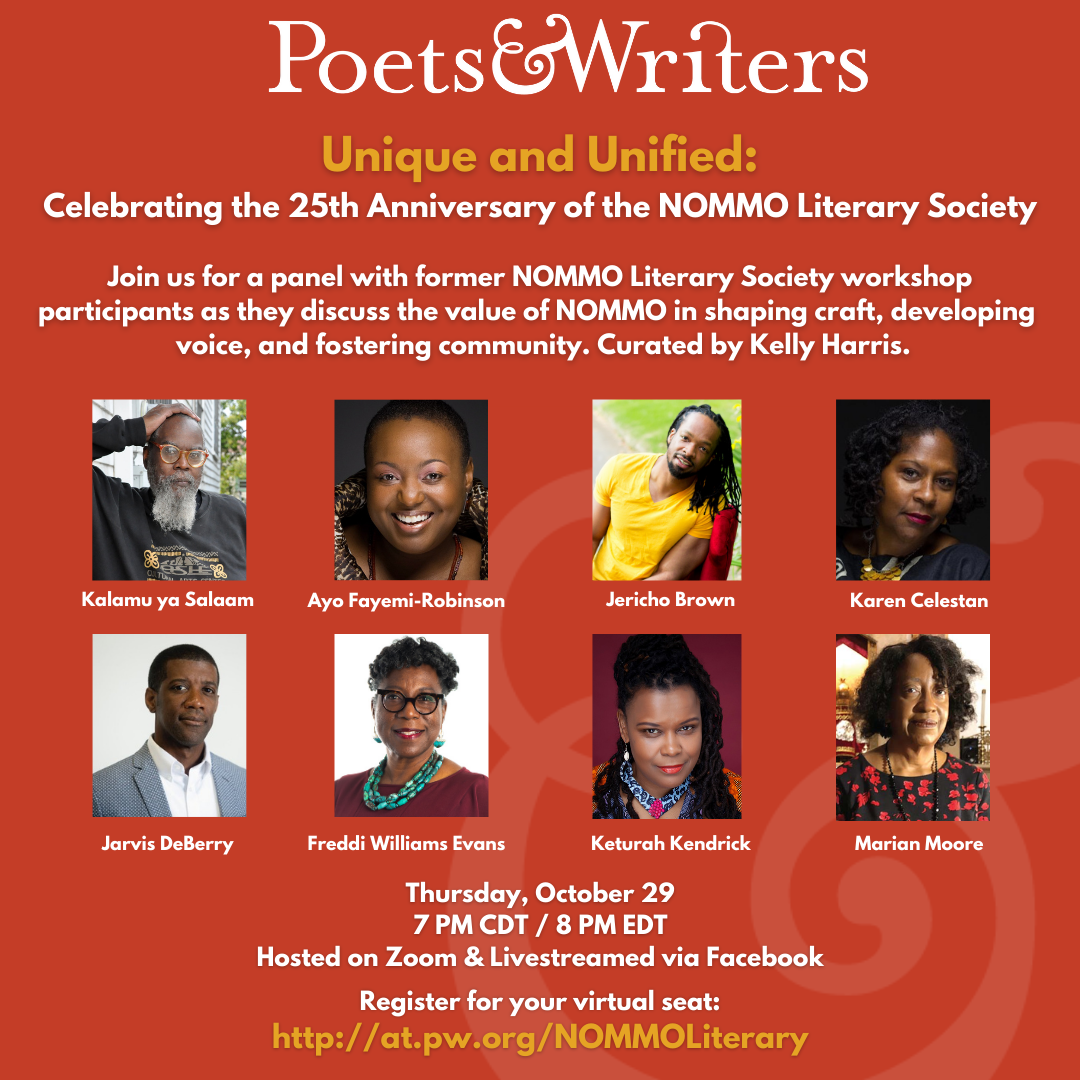
Kelly Harris is the literary outreach coordinator for Poets & Writers in New Orleans. Contact her at NOLA@pw.org or on Twitter, @NOLApworg.

Rituals

7.14.20

“Rituals—or the tasks we perform repeatedly, not for what they accomplish but for what they mean to us—help athletes prepare their minds for the unknowns they’ll face when they perform,” writes psychiatrist Neha Chaudhary in a New York Times article about how rituals—such as “Steph Curry’s sinking a shot from the tunnel before each basketball game” or “Serena Williams’ bouncing her tennis ball five times before her first serve”—can help instate feelings of connectedness and calmness during anxiety-inducing times. Write a poem about a ritual that’s a part of your everyday life, or perhaps one that you performed regularly during a past phase of your life. How can you play with repetition, pacing, sound and rhythm, and white space to mimic the enactment and aftereffects of a ritual?

Upcoming Contest Deadlines

Escape the midsummer heat and spend time in the shade submitting to fiction, poetry, and nonfiction contests. With deadlines of either July 14 or July 15, these contests include several opportunities for writing on a theme, including a prize for writing about health and illness and a prize for travel writing. All offer a cash prize of $1,000 or more.

Bellevue Literary Review Prizes in Poetry and Prose: Three prizes of $1,000 each and publication in Bellevue Literary Review are given annually to a poet, a fiction writer, and a creative nonfiction writer for works about health, healing, illness, the body, and the mind. Jen Bervin will judge in poetry, Dan Chaon will judge in fiction, and Kay Redfield Jamison will judge in creative nonfiction. All entries are considered for publication. Deadline: July 15. Entry fee: $20. 

Cincinnati Review Robert and Adele Schiff Awards: Three prizes of $1,000 each and publication in the Cincinnati Review are given annually for a poem, a short story, and an essay. The editors will judge in nonfiction. All entries are considered for publication. Deadline: July 15. Entry fee: $20 (includes subscription). 

Comstock Review Muriel Craft Bailey Award: A prize of $1,000 and publication in Comstock Review is given annually for a single poem. Patricia Smith will judge. All entries are considered for publication. Deadline: July 15. Entry fee: $27.50 (or $5 per poem via postal mail)

Los Angeles Review Literary Awards: Four prizes of $1,000 each and publication in Los Angeles Review are given annually for a poem, a short story, a short short story, and an essay. Francisco Aragón will judge in poetry, Kristen Millares Young will judge in fiction, Ellen Meeropol will judge in flash fiction, and Aimee Liu will judge in nonfiction. Deadline: July 14. Entry fee: $20. 

Nowhere Travel Writing Contest: A prize of $1,000 and publication in Nowhere is given twice yearly for a poem, a short story, or an essay that “possesses a powerful sense of place.” Unpublished and published pieces that have not previously been chosen as a contest winner are eligible. Porter Fox will judge. All entries are considered for publication. Deadline: July 15. Entry fee: $15. 

Rattle Poetry Prize: A prize of $15,000 and publication in Rattle is given annually for a single poem. A Reader’s Choice Award of $5,000 is also given to one of ten finalists. All entries are considered for publication. Deadline: July 15. Entry fee: $25 (includes subscription).

Regal House Publishing Petrichor Prize for Finely Crafted Fiction: A prize of $1,000 and publication by Regal House Publishing will be given annually for a novel. The editors will judge. Deadline: July 15. Entry fee: $25.

The Story Prize: A prize of $20,000 is given annually for a short story collection written in English and published in the United States in the current year. Two runners-up receive $5,000 each. The $1,000 Story Prize Spotlight Award is also given for an additional short story collection “of exceptional merit.” Larry Dark and Julie Lindsey will select the three finalists and the Spotlight Award winner; three independent judges will choose the Story Prize winner. July 15 is the deadline for books published in the first half of the year. The deadline for books published during the second half of the year is November 15. Entry fee: none. 

Visit the contest websites for complete guidelines, and check out the Grants & Awards database and Submission Calendar for more contests in poetry, fiction, and creative nonfiction.

Writing Space

This week, take a look at a photo essay by Jared A. Brock of one hundred well-known authors in their writing spaces and write a personal essay about a particular spot where you have written a significant amount of work. Perhaps the space is at a desk in the same corner you’ve retreated to for years, or a specific seat on a certain bus during a commute, or a summer cabin you visited a handful of times years ago. What was one writing project you worked on in that space that you remember particularly well? Describe your mindset in that space versus outside of it. Incorporate the sounds, smells, and other details needed to create a sensorial experience of the space.

Change Your Tune

In a recent report in Current Biology, researchers published findings that the white-throated sparrow’s birdsong, which originally sounded like “Old Sam Peabody-Peabody-Peabody,” had evolved over the last fifty years to sound more like “Old Sam Peabuh-Peabuh-Peabuh-Peabuh.” In the New York Times, Ken Otter, a professor at the University of Northern British Columbia, says this unexpected shift related to the migration patterns of the sparrow is “kind of like an Australian person coming to New York, and all the New Yorkers start suddenly deciding to adopt an Australian accent.” Write a story about a character who has moved to a new city, and whose behavior has an outsize influence on the town’s citizens. Does the change happen gradually, going largely unnoticed for a long period of time, or does your character set off a rapid-fire chain reaction of transformations?

COVID Vivid Interview: Daniel Peña

Hey mi gente, wishing you the best in this crazy time we’re living in. Here in Texas, smaller rural spaces and larger metro spaces are in heated battles as to what is appropriate for a “restart” as cities begin to open their businesses back up. Every day is an interesting day here in Houston. Despite the difficulties of this pandemic life, the literary world has been doing brilliant work and touching base with writers in ways it hasn’t done so before. So with this in mind, I wanted to continue conversations with writers here in the city and ask how they have been spending their time during stay-at-home orders. For this series, I reached out to writers and posed one simple question:

What have you been doing since the pandemic started?

This series started off with Katherine Hoerth and this week, we continue with Daniel Peña. A Pushcart Prize–winning writer, Peña is an assistant professor in the Department of English at the University of Houston–Downtown and the author of the novel, Bang (ArtePublico Press, 2018).

Here is what Daniel had to say:

“I’ve been teaching a lot. Transitioning all of my classes online has been time-consuming but I’ve been grateful for the distraction. I record podcasts for all of my classes (Mexican-American Literature, Creative Writing, and Literary Magazine Production) so my students can get to the lessons asynchronously (meaning on their own time).

So many of my students are on the front line of this pandemic: delivery drivers, grocery store workers, EMS medics working twelve-hour shifts. I read them poems, stories, essays and talk about those readings with them, almost like a radio show or something. They can listen to it when they’re driving on their way to work or in those splices of moments between moments. Hit pause, hit play, hit pause again. I try to make each lesson a kind of artifact: heavily produced with bumper music, a monologue, a volta, some trivia, sometimes a rant. I try to mimic class more or less. And mostly, I’m just trying to keep them in the game, correspond with them when they’re free. And that’ll take up about two months of time if you get carried away with it (and I do).

I go to my home office in the morning, I record my lessons, I read the readings for the next class in the evenings, I write out the podcast longhand, and then I record that lesson the next day. I try to stay about two weeks ahead in case I get sick.

I get a little writing done when I can. I can’t wait to get back into my own writing this summer.”

Check back next week for the next writer!

Photo: Daniel Peña. (Credit: Paula N. Luu)
 
Lupe Mendez is the literary outreach coordinator for Poets & Writers in Houston. Contact him at Houston@pw.org or on Twitter, @houstonpworg.

Different Choices

In “The Untranslatable” published on the Paris Review website, the translators of poems featured in the magazine’s summer issue write short essays about their processes. Patricio Ferrari and Susan Margaret Brown, who translated António Osório’s poems from the Portuguese, write about choosing between words in the English language that have Latin versus Germanic origins: “Most words representing abstract ideas stem from the Latin while the majority of words exemplifying concrete ideas come from the Saxon. In a newspaper article, the choice may be irrelevant; in a poem, the choice matters.” Rewrite or draft a new version of a poem you’ve written in the past, switching out some of the Latinate words for those with Germanic roots, and vice versa. How does this change the sound, tone, and other nuances of your poem?

Pages

Subscribe to RSS - blogs