Who Are You?

5.26.20

The first 858 lines of Geoffrey Chaucer’s fourteenth-century masterpiece The Canterbury Tales is the focus of a new web and mobile phone app that allows users to listen to the text read aloud in Middle English. Developed by a team at the University of Saskatchewan, General Prologue pairs a digitized version of the original manuscript with explanations and a new line-by-line modern translation by the late Monty Python actor Terry Jones, who wrote two books on Chaucer. The lively stories of the group of pilgrims traveling from London to Canterbury, which are notable for being written in the common vernacular, are told from different viewpoints and form a humorously critical portrait of social classes of the time. Write a series of poems that celebrates the everyday people in your life, perhaps drawing inspiration from Chaucer’s characters, such as the Cook, the Man of Law, the Wife of Bath, the Clerk, and the Merchant. What humor do you find in the mundane affairs of quotidian life?

Let’s Talk: Funding for Detroit Literary Events

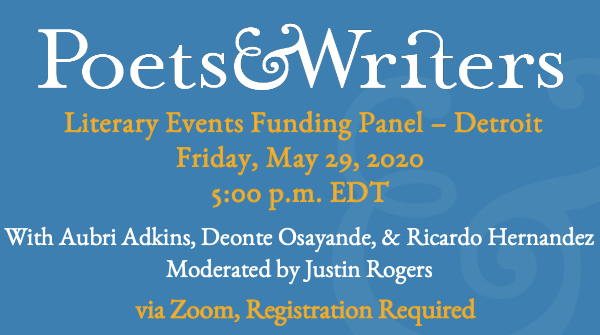
As May comes to a close and the temperature continues to rise leading into a long-awaited summer, in Michigan we are waiting to hear if stay-at-home orders will be extended beyond this month. Despite our limitations, literary events continue online and I am happy to announce that this Friday, May 29, we will be holding a panel to discuss funding opportunities from the Readings & Workshops program to help support these events.

I am excited to moderate this panel which will include Readings & Workshops program associate Ricardo Hernandez, and two guest authors, Aubri Adkins and Deonte Osayande, who will be speaking about their experiences securing funds for literary events in Detroit through the Readings & Workshops program.

Adkins is a writer and the founder of the East Side Reading Series, a Detroit literary series featuring original work from writers of all genres. I am interested to hear about her motivations behind establishing the series, and how these readings have made an impact on the literary community of the city.

Osayande is a widely published writer from Detroit, a poet recognized in many slam communities, and currently a professor of English at Wayne County Community College District. I look forward to speaking with him as he offers a variety of perspectives on intersecting literary communities.

I am looking forward to this conversation! I am expecting it to be rich with information not only about Readings & Workshops mini-grants but also about how the Detroit literary community is doing and how we can further connect with other communities.

The panel will be on Friday, May 29 at 5:00 PM EDT. Registration is required and space is limited, so register here. The meeting will also be recorded and made available to the public if you’re not able to make it, but I do hope to see you there!

Justin Rogers is the literary outreach coordinator for Poets & Writers in Detroit. Contact him at Detroit@pw.org or on Twitter, @Detroitpworg.

Upcoming Contest Deadlines

The end of May has a wealth of contests for poets and fiction writers alike. With deadlines of either May 30 or May 31, these awards include several opportunities to publish book-length work. All offer a prize of $1,000 or more.

Anhinga Press Anhinga–Robert Dana Prize for Poetry: A prize of $2,000, publication by Anhinga Press, and 25 author copies is given annually for a poetry collection. Major Jackson will judge. Deadline: May 31. Entry fee: $25 entry fee ($28 for electronic submissions).

BOA Editions Short Fiction Prize: A prize of $1,000 and publication by BOA Editions is given annually for a short story collection. Peter Conners will judge. Deadline: May 31. Entry fee: $25.

Bridport Arts Centre Bridport Prizes: Two prizes of £5,000 (approximately $6,450) each and publication in the Bridport Prize anthology are given annually for a poem and a short story. Two second-place prizes of £1,000 (approximately $1,290) each and publication are given in each category. A prize of £1,000 (approximately $1,290) and publication is also given for a work of flash fiction. Mimi Khalvati will judge in poetry and Nell Leyshon will judge in fiction and flash fiction. Deadline: May 31. Entry fee: £10 (approximately $13) for poetry, £12 (approximately $15) for fiction, and £9 (approximately $12) for flash fiction.

Elixir Press Fiction Award: A prize of $2,000, publication by Elixir Press, and 25 author copies is given annually for a short story collection or a novel. Christy Stillwell will judge. Deadline: May 31. Entry fee: $40.

Gival Press Novel Award: A prize of $3,000 and publication by Gival Press is given biennially for a novel. Deadline: May 31. Entry fee: $50.

Milkweed Editions Max Ritvo Poetry Prize: A prize of $10,000 and publication by Milkweed Editions is given annually to a U.S. poet for a debut poetry collection. Henri Cole will judge. Deadline: May 31. Entry fee: $25.

Oversound Chapbook Prize: A prize of $1,000, publication by Oversound, and 25 author copies is given annually for a poetry chapbook. francine j. harris will judge. Deadline: May 31. Entry fee: $18 (subscription included).

Southern Poetry Review Guy Owen Prize: A prize of $1,000 and publication in Southern Poetry Review is given annually for a single poem. Deadline: May 31. Entry fee: $20 (subscription included).

University of Georgia Press Flannery O’Connor Award for Short Fiction: A prize of $1,000 and publication by University of Georgia Press is given annually for a collection of short fiction. Roxane Gay will judge. Deadline: May 31. Entry fee: $30.

Visit the contest websites for complete guidelines, and check out the Grants & Awards database and Submission Calendar for more contests in poetry, fiction, and creative nonfiction.

The Joy of...

5.21.20

“I reached toward the mask, toward my friend, trying to keep away from her at the same time—both of us a little bit nervous, a little bit scared (I’ve never before noticed that “scared” and “sacred” are so close),” writes Ross Gay in “The Joy of Caring for Others,” one of fourteen New York Times pieces in which writers describe what is currently bringing them joy. In the series, Aminatou Sow writes about “The Joy of Perfecting the Sexy Selfie,” Max Read writes about “The Joy of Consuming an Obscene Number of Calories Before Noon,” and Jenna Wortham writes about “The Joy of Regrowing My Scallions—Yes, Regrowing My Scallions.” Write your own “Joy of…” essay, zeroing in on joy found in unexpectedly mundane or previously suspect corners. What is simple and what is complex about this pleasure?

Writer’s Notes From COVID NOLA: Carolyn Hembree

Today I’m continuing my series of interviews during the quarantine with poet Carolyn Hembree. Hembree’s debut poetry collection, Skinny, was published by Kore Press in 2012. In 2016, Trio House Books published her second collection, Rigging a Chevy Into a Time Machine and Other Ways to Escape a Plague, winner of the 2015 Trio Award and the 2015 Rochelle Ratner Memorial Award. Hembree’s work has appeared in Colorado Review, Gulf Coast, Poetry Daily, West Branch, and other publications. She received a 2016-2017 ATLAS grant from the Louisiana Board of Regents and has also received grants and fellowships from PEN America, the Louisiana Division of the Arts, and the Southern Arts Federation. Hembree is an associate professor at the University of New Orleans and serves as poetry editor of Bayou Magazine.

How has this pandemic impacted you personally and professionally?
I’m a tenured associate professor, so while migrating brick-and-mortar classes online has been kind of awful, I have a job and health insurance, whereas many of my friends and students rely on our gig economy. An introvert who feels exhausted rather than invigorated by social events, I’m good nesting with my family. My mother is in a retirement facility, and a close friend has Stage 4 cancer: I worry about them.

What books are you reading while quarantined?
With the semester going, I primarily read MFA theses and workshop poems, as well as undergraduate writing in all genres. I’ve been reading Toi Derricotte and Kalamu ya Salaam in preparation for their upcoming visits to our MFA program. I’ve been rereading the General Prologue of The Canterbury Tales to think about plagues of the past, what it means to tell (or post) our stories, and what a pilgrimage would look like now. I’m also settling into the newest issue of one of my favorite literary magazines, West Branch.

If you knew five months ago what you know now, how would you have prepared for this moment?
Gone to see my mother before they closed the home to guests.

Have you attended or participated in any virtual readings? Do you think they’re here to stay or do you prefer to return to in-person readings?
Yes, I have attended and participated in virtual readings, thesis defenses, faculty meetings, and workshops. Full disclosure: I’m a Luddite with a flip phone, so virtual anything makes my list of “hateful things,” à la Sei Shōnagon’s list in The Pillow Book. As a vain person and a control freak, I like a filter that peels off ten years, a control panel to diminish or enlarge others, and an “End Meeting” button. I like that I can wear makeup, a fancy blouse, and PJ bottoms. I like being able to mute myself and black out my screen, so no one can see that I walked off during a meeting. In sum, I think it encourages me to be phony—yes, more comfortable, but comfortable comes at a price. It’s too curated. Andy Warhol said, “I want to be a machine.” Me too, but then what: How do we machine together? Will we go back to in-person readings? I think so. People need each other. Will in-person gatherings be “zoomed” or what have you? Sure. Now that we have a taste, folks will want that synchronous, “participatory” experience you don’t get from a recording.

What’s your hope for New Orleans during and after this pandemic?
My hope for New Orleans is the same as before the pandemic: equal access to education for all kids. As a teaching artist in grammar, middle, and high schools and the mother of a ten-year-old, I’ve noticed that funding, class sizes, and quality of education vary significantly from school to school. In general, I see white kids getting better stuff. I believe that doing away with admissions tests and lotteries, and opening enrollment to all students would advance our community.

Carolyn Hembree.
 
Kelly Harris is the literary outreach coordinator for Poets & Writers in New Orleans. Contact her at NOLA@pw.org or on Twitter, @NOLApworg.

Floodgates

5.20.20

A recent headline on the Cornell Lab of Ornithology’s discussion site announced “Migration Alert: northeastern North America flood gates open, 14–18 May 2020,” reporting high-intensity concentrations of migratory birds, which “coincides with a significant warming trend and also the potential for precipitation.” Write a short story that launches with the opening of floodgates—something that has been restrained or kept in containment which now bursts free. What confluence of forces had to combine to create the circumstances that would allow this to happen? Focus on the impact this release has on characters’ emotions, and how they deal with the fallout.

Lit in the Age of COVID: Casa Ramirez Folkart Gallery

Last week I started off a series of posts featuring some of the ways the Houston literary world has been rising to the occasion with innovation and community in mind during the pandemic. I covered University of Houston’s CoogSlam, and this week I want to give some love to Casa Ramirez Folkart Gallery.

I’ve mentioned Casa Ramirez before which makes them being on this list maybe a little overindulgent but if you are like me, you celebrate your elders when they keep things fresh. Casa Ramirez is doing just that. For the most part, Casa Ramirez is like any staple small business here in Houston, but what makes this space unique is that the couple in charge, Macario Ramirez and Chrissie Dickerson Ramirez, are good luck charms for every Latino in the city.

If you are an artist or writer, fan or hobbyist, Casa Ramirez is like a shrine. If you have a literary event there, having your book in their shop makes it destined for success. I have seen it with my own two eyes. It might be a “folk art” gallery, but don’t let the Ramirezes fool you—they are book lovers and carry an extensive bookstore inside the shop with all the texts to build up an ethnic studies library in Latinx lit.

That said, the stay-at-home orders in Houston have been devastating to businesses and now that Texas has chosen to slowly open up this month, so has Casa Ramirez—but with new safety measures. The shop has created a “retail-to-go” shopping experience: Patrons get to peruse all the art and books with a “curator” by their side to answer questions and make recommendations. Only one person, one couple, or one family is allowed in the shop at a time and you must wear a mask (employees also wear masks). You have access to the whole bookstore and gallery area for thirty to forty minutes, buy what you want and then, boom, you are out the door. The shop has limited hours from noon to 4:00 PM every day.

From what I have heard, they’ve had a line a block long every day. Leave it to Casa Ramirez to lead the way. Check out their Facebook page and their Instagram, @casaramirezfolkartgallery, to see what they have going on.

Lupe Mendez is the literary outreach coordinator for Poets & Writers in Houston. Contact him at Houston@pw.org or on Twitter, @houstonpworg.

The Albatross

5.19.20

“The journey runs right through the eye of desolation. The murdered albatross is a bottomless symbol: It stands for everything you greedily grabbed at, everything you squandered or spurned, every ornament of the ego, every plastic water bottle, every corrosive pleasure, every idle meanness,” writes James Parker in “The 1798 Poem That Was Made for 2020,” his essay at the Atlantic about the “Ancient Mariner” Big Read, a collective online reading of Samuel Taylor Coleridge’s epic curated and produced by the University of Plymouth. Write a poem that revolves around a bottomless symbol—perhaps an animal, a plant, or everyday object—inspired by the ancient mariner who “is condemned to tell his tale, to recite his rhyme, over and over again.” 

Slam at Home With End Prejudice

On May 9, I had the pleasure of joining End Prejudice, a diverse Metro Detroit collective united by a common dream of a future without prejudice, as the featured poet for their virtual series Slam at Home. This series is hosted by LaShaun Phoenix Moore and features one poet and one musical artist each week.

Prior to Michigan’s stay-at-home order, End Prejudice put on several events such as the Storytellers Slam that took place this past winter. Phoenix told me a bit about how End Prejudice had to shift gears for their 2020 programming due to the pandemic: “Once the pandemic hit, we had a team call in late March to determine what we should do, now that much of our programming would be suspended. H. (the founder) decided that we should follow suit with a lot of other folks in the country and do Instagram Live events.” The group has been hosting virtual events for nearly two months and do their best to get their featured artists paid by offering donations directly to the artists. They’ve supported fourteen Detroit artists so far.

You can follow @endprejudice on Instagram and tune in to their Slam at Home live events at 8:00 PM on Saturdays. End Prejudice also provides more information on their blog about what they do. This collective has a clear, dedicated focus to not only address prejudice, but also support local artists and their community.

End Prejudice’s Slam at Home poster.
 
Justin Rogers is the literary outreach coordinator for Poets & Writers in Detroit. Contact him at Detroit@pw.org or on Twitter, @Detroitpworg.

Value Judgment

5.14.20

“The tendency in western cultures is to value finished objects, to put a price on them and to preserve them. In other cultures, such as in the islands of Vanuatu in the South Pacific, value lies not in the physical object, but in knowing what it means and how it is made.” In Gossamer Days: Spiders, Humans, and Their Threads (Strange Attractor Press, 2016), Eleanor Morgan writes about how cultural attitudes about spiders and their silk is dependent on how those cultures value objects and their making. Think about an object you’ve made in the past—a meal, a birthday card, a piece of furniture, an article of clothing, a poem. Write a personal essay that excavates and examines the value of not the physical object, but the process of its making. 

Pages

Subscribe to RSS - blogs