




Ferlinghetti Turns Down Hungarian Poetry Prize
The San Francisco-based City Lights Booksellers and Publishers announced last week that its founder, Lawrence Ferlinghetti, who had been selected as the recipient of the inaugural Pannonius Prize, would decline the award.
The prize, which was announced in September, is funded by the Hungarian government and the Hungarian chapter of PEN International, and offers an award of 50,000 euros.
In a press release, City Lights stated: “While honored to be chosen and recognized, Lawrence Ferlinghetti has been a resolute supporter of freedom of expression his entire life. Given that the Hungarian government is widely accused of officially and unofficially stifling free speech and civil liberties, Ferlinghetti has decided to decline the award.”
On the same day that City Lights released their statement, the MFA program in writing at the University of San Francisco announced the inaugural Lawrence Ferlinghetti Poetry Fellowship. Established in honor of the poet, activist, and City Lights founder, the biennial fellowship—which provides full tuition funding to the MFA program—will be given to a poet “whose work embodies a concern for social justice and freedom of expression, interpreted in the broadest possible way.”
Ferlinghetti, whose most recent book is Americus, Book 1 (New Directions, 2005), is a longtime proponent of the “wide-open poetry” movement; he published Allen Ginsberg’s Howl & Other Poems in 1956, and was subsequently arrested, tried, and eventually acquitted on obscenity charges in what became a historic first amendment case. Poet D. A. Powell, a professor of poetry at the University of San Francisco, said in a university press release, “The Howl trial changed the culture of American poetry overnight and paved the way for a more open, expansive poetics—for poetry that confronted American hypocrisies and political institutions, willing to put its proverbial heart on the line.”
To learn more about the life and work of Lawrence Ferlinghetti, visit the City Lights website. For more information and complete application guidelines for the Lawrence Ferlinghetti Poetry Fellowship, visit the University of San Francisco MFA program website.

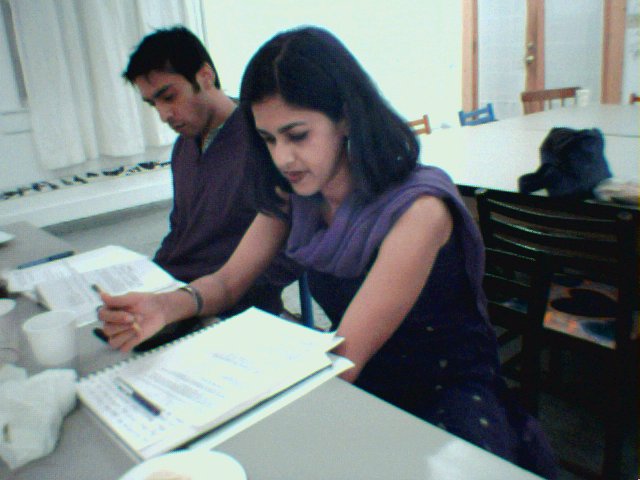 th teenagers, I wanted to work more with adults. So Shaista and I began planning a workshop that spoke to the rootless-ness we both felt, whether we were in Karachi, Houston, or somewhere else. Shaista and I dedicated much thought to our workshop title—just as VBB co-founders and I had spent time honing in on the right title for “our” organization three years earlier. We finally agreed on “Voices of the Displaced,” a title that rang true for us. It also attracted a pool of Houston-based writers who were born in other countries or elsewhere in the United States, who had come from communities of color, or identified themselves as GLBT/queer. Project Row Houses offered us a meeting space and co-sponsored the series. We sent out emails inviting people to join—VBB didn’t even have a website at that time. Our first group was intimate with only six participants, but over time, the group expanded. We always brought food and drinks and our gatherings offered formal writing but also a sense of community.
 In Sanskrit, “dakshina” means “offering.” Beyond performing both bharata natyam and modern dance, Dakshina/Daniel Phoenix Singh Dance Company offers the community events that celebrate important figures in South Asian history through other art forms.
 In Pakistan, September 21, 2012, was marked as a day of remembrance for Prophet Mohammad in response to a film that went viral and sparked violence in parts of North Africa, the Middle East, and South Asia. Knowing that the time difference between Houston and Pakistan was ten hours, I began checking online Pakistani newspapers as soon as I awoke. By the end of twenty-four hours, more than twenty people had been killed and six cinema houses had been burned. Meanwhile, progressive and secular communities that formed Pakistan’s majority were posting comments asking why extremists weren’t using their energies to offer help to the southern part of the country, where floods once again disrupted lives.