Genre: Poetry

Headless, Chicken, Monster

11.13.18

The headless chicken monster: the stuff of nightmares or a real scientific oddity? It’s actually the nickname for a deep-sea swimming cucumber recently captured on camera for the first time in the Southern Ocean between Australia and Antarctica, and caught on film only once before in the Gulf of Mexico. Write a poem inspired by this reddish-pink finned creature, taking inspiration from its scientific name Enypniastes eximia, and its other nicknames, such as the headless chicken fish, the Spanish dancer, and the swimming sea cucumber. Take a look at photos and videos to see this unusual creature’s bulbous, transparent body and webbed, veil-like appendages and tentacles moving across the ocean floor.

Deadline Approaches for BMI & Believer Fellowships

Applications are currently open for the Black Mountain Institute & the Believer fellowships, open to emerging and established poets, fiction writers, and creative nonfiction writers. Fellows will reside in Las Vegas for the 2019–2020 academic year, where they will join a thriving community of writers and scholars on the UNLV campus. Fellows will also receive a stipend and contribute to the Black Mountain Institute (BMI) and/or the Believer magazine.

The Shearing Fellowships for Emerging Writers, which offer an honorarium of $18,000 each, are open to writers who have published at least one book with a trade or literary press. The Shearing Fellowships for Distinguished Writers, which offer an honorarium of $25,000 each, are open to writers who have published at least three books.

The deadline for both fellowships is November 14 at 12:59 PM Pacific Standard Time. Using the online submission system, submit a writing sample of 10 to 20 pages, a cover letter, and a proposal (totaling no more than two pages) with suggested contributions to the Believer and/or BMI. Finalists will be asked to send copies of their books.

Applications will be reviewed by an advisory committee of UNLV graduate students, staff, and community stakeholders. Recipients will be notified in Spring 2019.

Based in Las Vegas, Nevada, the Beverly Rogers, Carol C. Harter Black Mountain Institute aims to bring “writers and the literary imagination into the heart of public life through events, fellowships, publications, and student engagement opportunities.” The Believer, a five-time National Magazine Award finalist, is a bimonthly literature, arts, and culture magazine based at the Black Mountain Institute. The 2018–2019 fellows include Hanif Abdurraqib, Lesley Nneka Arimah, Amanda Fortini, Derek Palacio, and Claire Vaye Watkins.

American Arithmetic

Caption: 

“I am begging: Let me be lonely but not invisible.” This Motionpoems film directed by Mohammed Hammad features Natalie Diaz’s poem “American Arithmetic,” which appeared in the anthology Tales of Two Americas: Stories of Inequality in a Divided Nation (Penguin Books, 2017) edited by John Freeman.

Genre: 

The Image Is: A Poetry Workshop

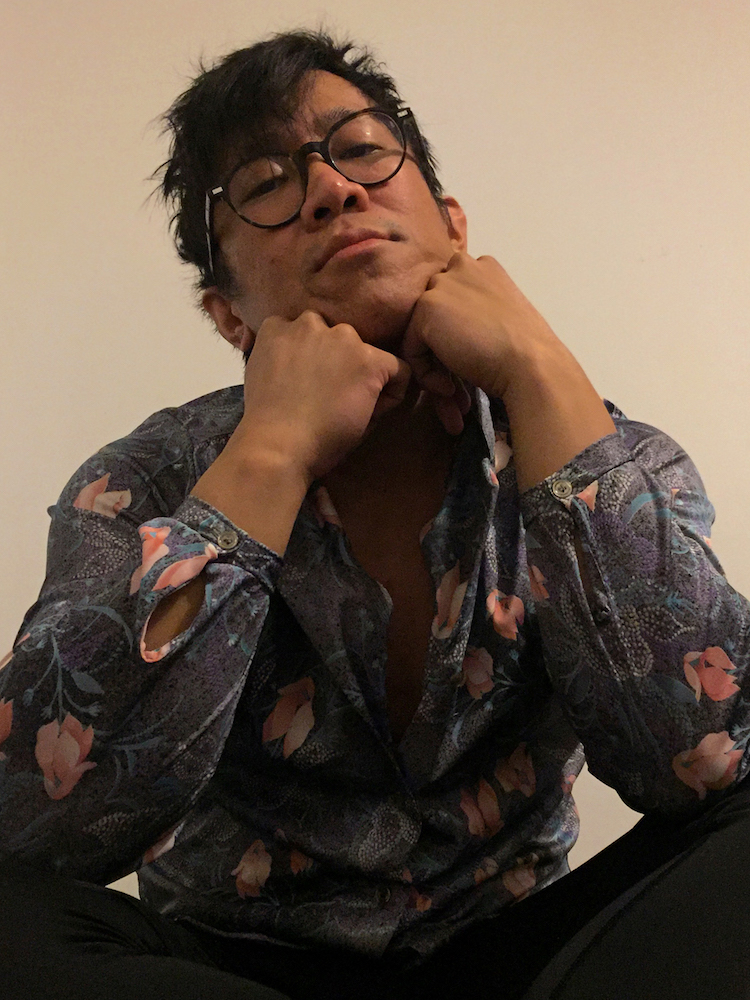
Aldrin Valdez is a Pinoy artist and the author of ESL or You Weren’t Here (Nightboat Books, 2018). Their poetry and visual art has appeared in the Felt, Femmescapes, Nat. Brut, Poor Claudia, and the Recluse. They have presented work at Dixon Place, the Metropolitan Museum of Art, and the Poetry Project, and been awarded fellowships from Queer/Art/Mentorship and Poets House. Currently Valdez curates the Segue Reading Series with fellow poet Joël Díaz.
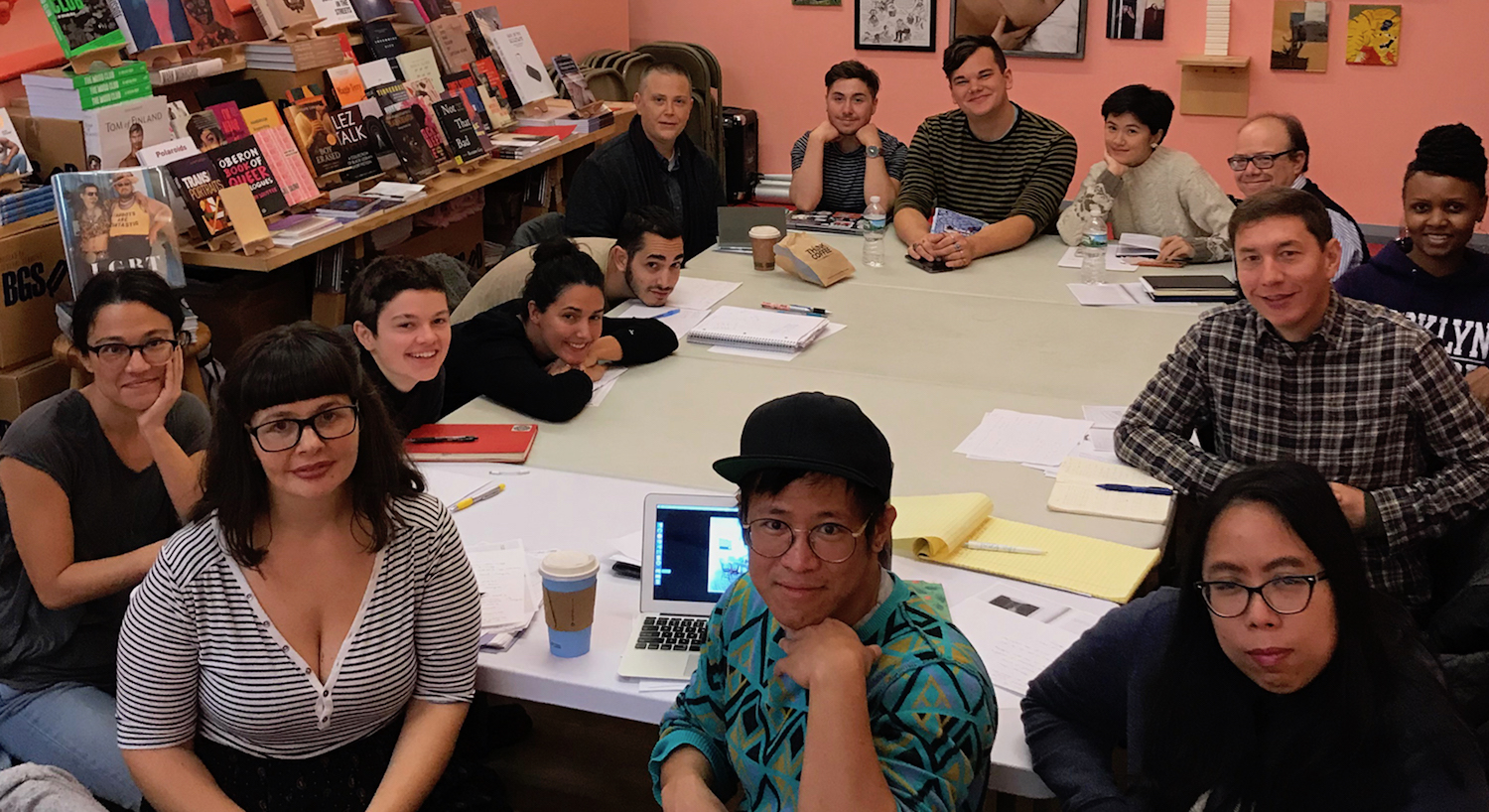
On October 27 I led a workshop at the Bureau of General Services–Queer Division (BGSQD), currently hosted by the Lesbian, Gay, Bisexual & Transgender Community Center in New York City. The workshop was organized by Sarah Sala, founder of the Office Hours poetry workshop, with support from Poets & Writers’ Readings & Workshops program. I haven’t led many workshops before, so this was an experiment of sorts. I called the craft class “The Image Is _____” and its focus, of course, was the image. A series of questions motivated this workshop:

  • What is an image?
  • Where and how do we encounter images today?
  • As prose writers, poets, and artists who use text, how do we each relate to images?
  • Do images factor into our individual works?
  • How can we use images to surprise our writing?
  • Is there an image that haunts/grips/inspires you, will not leave you, or one that you invoke often?
  • What does the image contain?
  • Is the image a dam we choose to break? What language emerges if we do?
  • Does the language trickle out? Or is it a torrent, flooding us/out of us into writing?
  • Are we prepared to write through this flood?

To guide the workshop, I shared poems by Derrick Austin, Anne Carson, Rio Cortez, Rachel Eliza Griffiths, Lara Mimosa Montes, and Justin Phillip Reed. I see their work as having complex, dynamic relationships with images. They’re aware of how we are surrounded by, and surround ourselves with, images and the tools with which to make them. And they acknowledge and question images as historical, political, and personal. What can we learn from their works in thinking about our own creative processes?

In a series of exercises I asked the class to interact with images—those around them (the BGSQD bookshop and the Center are filled with art) and those on their phones (if they had phones)—as catalysts for writing. One particular exercise, inspired by poems from Justin Phillip Reed’s Indecency (Coffee House Press, 2018) and Lara Mimosa Montes’s The Somnambulist (Horse Less Press, 2016), encouraged the class to think of the page—either as the screen of phones and computers or as a sheet of paper in their notebooks or a printed book—as constituting in itself a visual, physical, and material experience. Do we consider the white space, for instance, as blankness, silence, emptiness, a pause, or a held breath? Does a poem require that you move the book about in your hand? Is the poem concerned with legibility? What happens when a photograph precedes the text or a text precedes an image—how does that affect the experience of reading and our subjective ways of making meaning?

As a visual artist and writer, I enjoyed sharing these questions and activities with the class. It was thrilling to be writing together for a few hours, immersed in poetry—a collectivity I’ve been missing lately. I left the space feeling uplifted by the vulnerability and tenderness with which the group thoughtfully engaged and shared with each other.
Support for the Readings & Workshops Program in New York City is provided, in part, by public funds from the New York State Council on the Arts, and the New York City Department of Cultural Affairs, with additional support from the Frances Abbey Endowment, the Cowles Charitable Trust, and the Friends of Poets & Writers.

Photos: (top) Adlrin Valdez (Credit: Aldrin Valdez), (bottom) Workshop participants (Credit: Sarah Sala).

Help Yourself

11.6.18

Struggling to stay motivated? Researchers at the University of Chicago Booth School of Business recently found that people having trouble achieving their goals benefit from the very act of giving advice to others. This week, try offering some advice to someone in a poem. Write a list of suggestions for handling a challenge, perhaps something you know very little about to add some levity. It can be specific, like what to do when your car breaks down on the side of the highway during a thunderstorm, or something more general like how to resolve an argument. Using an idea from your list, write a humorous poem addressed to someone who may or may not appreciate your guidance.

Cholla Needles Monthly Poetry Reading

Rich Soos is the editor of Cholla Needles, which publishes a monthly literary magazine and poetry collections by local authors of the Joshua Tree community in California’s San Bernardino County. The Cholla Needles Arts & Literary Library aims to keep people excited about poetry through writing workshops and a monthly reading series. Soos is the author of over twenty poetry collections and was the editor for Seven Stars Poetry from 1973 to 1998.

The name of the magazine, Cholla Needles, came from a poem I wrote after I fell on a cholla cactus and its needles stuck in my hand and foot. When I made the decision to start a new magazine, I used that poem to inspire my mission statement—asking writers to submit poems that would “stick with you” and make the magazine memorable.

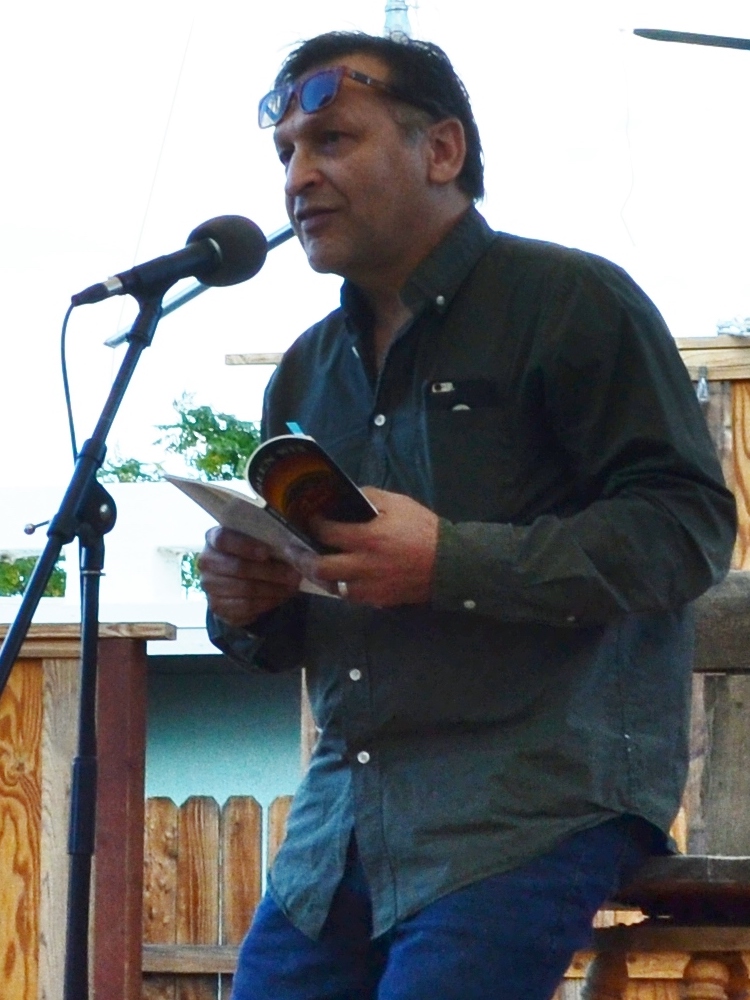
Juan Delgado reading at Cholla NeedlesEach monthly issue of Cholla Needles is celebrated with an open reading and a featured poet. The readings take place outdoors in the beautiful desert of Joshua Tree, California, on the second Sunday of each month.
The audience of forty to fifty neighbors is often joined by visitors from around the world, there to explore Joshua Tree National Park. Readers have come from many countries including Ireland, India, Britain, Italy, Germany, and Brazil. Hardcore locals arrive each month too, no matter what the heat (even at 110 degrees in summer), because it’s simply a joy to celebrate poetry together.

In October, our reading began with a dance performed by youngsters from the community to a new poem by Kim Martin. The party continued with twenty-one other readers, and then the featured reader Juan Delgado, who shared poems from each of his fine collections.

Juan traveled “up the hill” from his home several hours away to delight the audience with early poems that celebrate the joy of youthful discovery, and poems from his newer collections, which celebrate how the passing of old friends enhances our deep understanding of life.

Our featured readers are supported in part by a grant from Poets & Writers’ Readings & Workshops program. This support allows us to have poets visit from outside the area and keep our monthly parties fresh and exciting. There is tremendous appreciation from featured readers and audiences for Poets & Writers’ support. It provides a sense of pride knowing that someone from outside the area cares enough to help out in this way.

The time and location for our monthly readings are announced on our website. Visitors to the area are always welcome to bring their own work to share with us during the open reading portion of the party.

Support for Readings & Workshops in California is provided by the California Arts Council, a state agency, and the National Endowment for the Arts, a federal agency. Additional support comes from the Friends of Poets & Writers.

Photo: Featured reader Juan Delgado at Cholla Needles (Credit: Bob DeLoyd).

Ntozake Shange

Caption: 

“I was a happy young woman and I just happened to write poetry…” Ntozake Shange speaks about her surprise at the impact of her poetry and the film adaptation of her choreopoem “For Colored Girls Who Have Considered Suicide/When the Rainbow is Enuf” in this interview with Reelblack at the Art Sanctuary of Philadelphia in 2010. The poet, novelist, and playwright died on October 27, 2018 at the age of seventy.

Genre: 

Bared Teeth

10.30.18

Construction workers renovating a building in Valdosta, Georgia, last week discovered approximately one thousand teeth buried in a wall on the second floor. Historical researchers attribute the discovery, and the teeth found in walls in two other cities in Georgia, to the spaces having been occupied by dentists in the early 1900s. Write a poem inspired by the imagery, secrets, and possibilities evoked by these bizarre findings. How do the buildings and architecture that surround us hold and reveal local history? Have there been situations in your life when a buried past became uncovered in mysterious or revelatory ways? 

Ten Questions for Sherwin Bitsui

by
Staff
10.30.18

“I move between language, history, and worldviews—it’s always place between that gives me the most insight into my creative process.” —Sherwin Bitsui, author of Dissolve

Pages

Subscribe to Poetry