This week’s installment of Ten Questions features Brittany Perham, whose memoir, Executrix, is out today from the University of Georgia Press. “I’m trying to sell my father’s house because he’s dead and I’m the executrix and it’s my job. I’m trying to figure out some things about housing markets because I’ve never bought or sold a house before. I’m also trying to figure out some things about my father,” Perham writes in Executrix. By the time her father died from alcoholism-related causes, she had been estranged from him for a decade. So she was surprised to learn shortly thereafter that he had changed his will to make her the executor of his estate just weeks before his death. In Executrix, Perham wades through her father’s medical records and tax audits, and also through the mess of memories she has of him and of her childhood, to produce a meditation on what it means to attempt to tell stories about ourselves in the first place. In a starred review for Booklist, Amanda Dee writes that “it may be impossible to read this book without being changed by it.” And Cheryl Strayed called Executrix “a moving, wise, innovative memoir that captures the experience of loving and losing a complicated parent with such precision and power it lands like a truth bomb on the heart.” Brittany Perham is the author of Double Portrait (Norton, 2017), which received the Barnard Women Poets Prize; The Curiosities (Parlor Press, 2012); and, with Kim Addonizio, the collaborative chapbook The Night Could Go in Either Direction (Slapering Hol Press, 2016). Her poetry, fiction, and nonfiction have appeared in publications including Prarie Schooner, Gulf Coast, and Poetry, and she has received support from the Civitella Ranieri Foundation, the Hemingway House, the Wallace Stegner Fellowship Program, and other organizations. She teaches at Endicott College and lives in San Francisco and Massachusetts.
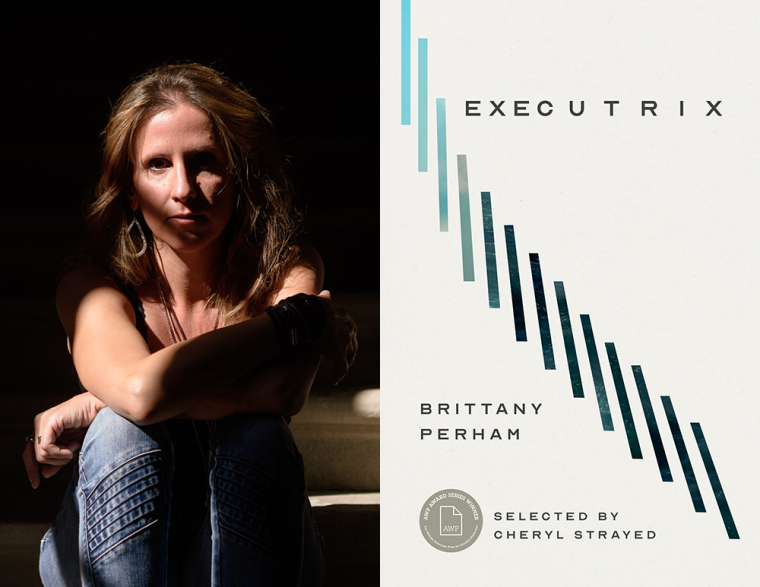
Brittany Perham, author of Executrix. (Credit: Marco Giugliarelli)
1. How long did it take you to write Executrix?
I started writing the book in 2014, so I was working on it for about ten years, sometimes more intensely and sometimes less so, especially in the last years when I was sending it out for publication. When I began, I didn’t think I was writing a book. I thought I was writing some sentences about my estrangement from my dad and his death from alcoholic cirrhosis, sentences that would never see the light of day. I was also writing another book at the time, a book of poems called Double Portrait, which came out in 2017. So Executrix was, at first, a side project. I’m a poet, so what was I doing writing sentences anyway? It was like cheating on the book I was supposed to be writing. It’s good for me to have several projects going at once, so when one project’s a misery, there’s something else to do that’s more exciting. Or at least more possible.
2. What was the most challenging thing about writing the book?
I’d never written a book of prose before, so I had to teach myself to do it. That’s a challenge, but it’s a good one. The best thing about being a writer is that you’re always learning to do new things. If you [aren’t], you write the same thing over and over. It’s a terrible feeling when your brain is stuck in one way of seeing and doing; it’s like you’re binging the same Netflix episode every night. With Executrix I got interested in writing sentences, in seeing what the sentence could do as opposed to the line, and I knew I’d have to figure out the rest as I went.
3. Where, when, and how often do you write?
It depends, it depends, and it depends. I don’t keep a schedule. Sometimes I write all day, I don’t eat, I barely get out of my chair (which doctors say is Very Bad for one’s back and wrists), and then at night I get in bed, I can’t sleep, I’m lying there writing on my phone or in a notebook in the dark (also Very Bad according to the authorities). Other times I’m not writing much at all. I’m teaching and reading student work and doing the miserable business of submissions and, with any luck, having a glass of wine with friends.
4. What are you reading right now?
I always go back to the writers who make me feel generative and awed, and [take me] outside my own brain. These are usually writers who are formally inventive and imaginative, including, in no particular order, Fleur Jaeggy, Dorthe Nors, Jean Rhys, Alison Bechdel, Deborah Eisenberg, Edna St. Vincent Millay, Elizabeth Bishop, and Emily Dickinson. I keep them near me so that when I need help, they’re there. It’s like having friends hovering over my shoulder. There’s always something to steal.
5. Which author, in your opinion, deserves wider recognition?
Katie Peterson for poetry. Go read her (brilliant) poems and then read her (brilliant) essays on poetry and then read her poems again. Elizabeth H. Winthrop for prose: Why isn’t everyone talking about her novels?
6. What, if anything, will you miss most about working on the book?
It’s nice to be in the middle of something. It’s hard to be at the beginning, and it’s hard to be at the end. Executrix is about cheerful things: my difficult relationship with my dad, my family, estrangement, divorce, death—theoretically, hard material to work with. I often get asked if I was retraumatized or triggered as I revisited some of my memories in writing. But I wasn’t. In fact, the opposite was true. When the writing was going well, I was behaving as a writer—I was interested in the essay, in the story, in the idea—rather than behaving as a person interested only in my own feelings. Writing nonfiction can feel like a kind of freedom because it gives you power, which you didn’t have when you first lived through your experiences. Now you’re the one in control.
7. What is one thing that your agent or editor told you during the process of publishing this book that stuck with you?
I was told by several agents and editors as they were rejecting the book that it was “experimental.” It was never a compliment. What they meant by “experimental” was “unsellable.” They didn’t think they’d make any money. I always laughed because in some ways I didn’t think the book was particularly experimental—it’s a regular story of a father and daughter, and the many difficult things that can happen in a family, especially when alcoholism is involved. But the description is apt because Executrix is, finally, an experiment. It’s interested in narrative primarily as a concept: One of the central projects of the book is to think about the ways memory and storytelling are related, and to explore philosophies of memoir. Executrix also uses formal strategies, and syntactical and sonic patterning, in ways that might separate it from more traditional memoir. Anyway, I take the label as a compliment: I think art is, and should be, experimental.
8. If you could go back in time and talk to the earlier you, before you started Executrix, what would you say?
You can learn to write anything if you read enough. I started teaching nonfiction at Stanford University fifteen years ago, and if I hadn’t spent the intervening years reading nonfiction with the voraciousness that comes from the feeling of not knowing what you’re doing, I wouldn’t have been able to write Executrix. I didn’t know any of that when I started. I didn’t even know I’d be interested in writing nonfiction. Reading made me interested and made me capable.
9. Outside of writing, what other forms of work were essential to the creation of Executrix?
Paintings made by the second-generation abstract expressionists, particularly Joan Mitchell and Elaine de Kooning. I was interested in what these artists had to say about their relationship to process and subject matter, and how (and if) their work made these ideas visible. I spent a lot of time looking at their work; reading their interviews, reviews, and essays; listening to oral histories; and reading the philosophies of art that came into being around and because of these artists. This was helpful to me because I was interested in articulating some conceptual and philosophical ideas about writing memoir. Specifically, I was interested in memoir as a process that could capture the action of the mind, in real time, as it relates to memory and experience, as opposed to memoir that seeks to illustrate a set of memories or experiences. This is a subtle but generative distinction: In writing Executrix I was after a process that was active and illuminative, rather than illustrative, so I had to invent new forms to capture that action. (Tellingly, the abstract expressionists are also called “action painters.”)
10. What’s the best piece of writing advice you’ve ever heard?
My first poetry teacher, Barbara Helfgott Hyett, told me that she called herself “Barbara Bravado” in her head every time she had to do something hard: revising a poem, teaching a class, submitting for publication. She told me I should call myself “Brittany Bravado” whenever I needed her courage, and this idea was (and is) great advice: a way to separate the part of you who can get shit done from the part of you who feels scared. It also turned out to be great advice for nonfiction writers: Our job, after all, is to invent a narrator—through the creation of a voice and a stance—who can act as a superhero, capable of revealing things to the reader that we could not.