This week’s installment of Ten Questions features Amanda Peters, whose novel The Birthing Tree is out today from Catapult. “It isn’t a particularly nice tree, the one where my mother died and where I was born,” Peters’ protagonist Aliet Paul remarks in The Birthing Tree’s opening pages. “There are no golden leaves, no burning red in the autumn. It gives no sap for syrup. But none of that matters, Kiju told me, because this tree holds our stories.” After her teenage mother died during childbirth, Aliet was raised in 1960s Nova Scotia by her grandmother Kiju, herself a tribal midwife, who made sure to offer an education in the traditions of the Mi’kmaq. The Birthing Tree alternates between Aliet’s stories of her childhood and her experience of returning to where she grew up decades later after Kiju has passed away to reclaim her connection to home. Publishers Weekly called the book “a tender story of self-discovery and the power of generations of women.” And Kirkus Reviews said The Birthing Tree is a “quietly compelling portrait of a young woman finding her truth.” Amanda Peters is a writer of Mi’kmaq and settler ancestry. Her debut novel, The Berry Pickers (Catapult, 2023), was the winner of the Andrew Carnegie Medal for Excellence in Fiction and the 2023 Barnes & Noble Discover Prize. Peters is a graduate of the MFA program at the Institute of American Indian Arts in Santa Fe and has a certificate in creative writing from the University of Toronto. She lives and writes in the Annapolis Valley in Nova Scotia where she is an associate professor in English and theatre at Acadia University.
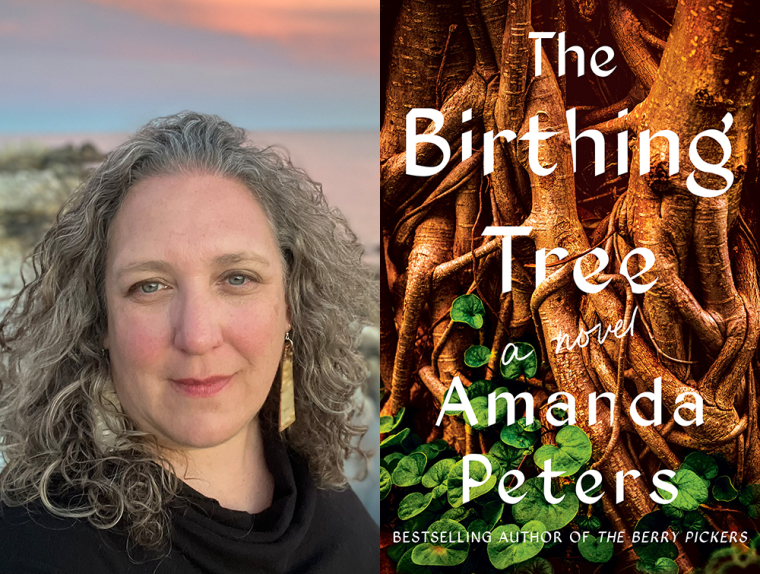
Amanda Peters, author of The Birthing Tree.
1. How long did it take you to write The Birthing Tree?
That’s a complicated question because I wrote the short story ages ago, perhaps in 2018 to 2019. At first, I didn’t know it would become a novel. That idea started swirling around in my mind soon after I finished writing The Berry Pickers. [Once] I decided to sit down and see if there was a novel there, [it took] about four years.
2. What was the most challenging thing about writing the book?
I think it was self doubt. I never anticipated that The Berry Pickers would do as well as it did. So when I sat down to write this one, I felt that I had to create something special and I worried I would not be able to. As soon as I stopped worrying about what others would think and wrote how I wanted, it seemed to come a little easier.
3. Where, when, and how often do you write?
Generally at home or at my office. I teach full time at Acadia University in Nova Scotia so I find it a bit more difficult to write from September to April, but I try to find time on the weekends and during the summer months. I also like to sometimes get away. There are too many distractions at home, like playing with my adorable pup or doing laundry. I like to write in long spells, hours at a time. I am learning to write in short spurts but still prefer having an entire day or weekend.
4. What are you reading right now?
I just finished John of John (Grove Atlantic, 2026) by Douglas Stuart, and it was brilliant! I am currently reading Empty Spaces (Yale University Press, 2024) by Jordan Abel.
5. What, if anything, will you miss most about working on the book?
I don’t think I will miss not working on it since I have already started writing another. That story will start to consume me any moment now.
6. Which author, in your opinion, deserves wider recognition?
Tough question, but some local Nova Scotia writers are doing brilliant things. Robert de la Chevotière is writing important and beautiful stories, and so is Jaime Burnet.
7. What is the earliest memory that you associate with books?
If I am honest, it is a book called I Wish That I Had Duck Feet (Random House Books for Young Readers, 1965). My grandmother had it at her house for us grandkids and my cousin Jamie and I would make her read it to us a lot. What really got me into reading was Kristy’s Big Day (Scholastic, 1988) from the Babysitters Club and my introduction to literature came from Of Mice and Men (Covici Friede Publishers, 1937).
8. If you could go back in time and talk to the earlier you, before you started The Birthing Tree, what would you say?
Calm down and write what you want to write and not what you think other people want. This would have saved me a lot of time and anxiety.
9. Outside of writing, what other forms of work were essential to the creation of The Birthing Tree?
I had to do a little research on Mi’kmaw traditional medicines. I also sought out information to confirm my memories of midwifery care. Years ago, I worked for the government on the midwifery files, working to regulate the care here in Nova Scotia, and met a lot of amazing people and learned so much. I am grateful to those remarkable women.
10. What’s the best piece of writing advice you’ve ever heard?
Keep writing. And it’s the advice I give. Even when it seems like you are getting nowhere, keep going because there will be a nugget of brilliance eventually.