This week’s installment of Ten Questions features Catherine Jagoe, whose memoir, Unbelonging: A Life in Search of Home, is out today from the University of Wisconsin Press. Born in England, raised partly in Nigeria, and having lived as an adult in France and Spain before settling, eventually, in Wisconsin, Jagoe writes that she has spent her life feeling “perpetually in-between.” But as an acquaintance once pointed out to her, “not belonging has its advantages. A chameleon has magic powers.” Unbelonging, a memoir in essays, traces Jagoe’s childhood, her path to becoming a translator and interpreter, and her journey towards finding a place for herself in the world. Throughout, language serves as a throughline as she explores the ways that the words we use shape our feelings of being in a place and our assumptions about where other people come from. Booklist wrote that Jagoe’s “outsider view offers some keen insights into each of [her] cultures as well as the universal longing for a place called home.” And author Meghan O’Gieblyn praised Jagoe for “deftly interrogat[ing] the complexities of origins and alienation, reminding us that home is less a geographical locus than a necessary habit of mind, a willingness to pay attention to how we are all radically connected to other people, to ecosystems, and to history.” Catherine Jagoe is a poet, essayist, and translator based in Madison, Wisconsin. Her collection Bloodroot (Settlement House Books, 2016) won the Settlement House American Poetry Prize and the Council for Wisconsin Writers’ Edna Meudt Award, and Praying to the God of Small Things (Kelsay Books, 2024) was named an Outstanding Work of Poetry by the Wisconsin Library Association. She has received a Pushcart Prize and published nine full-length books and four chapbooks across genres.
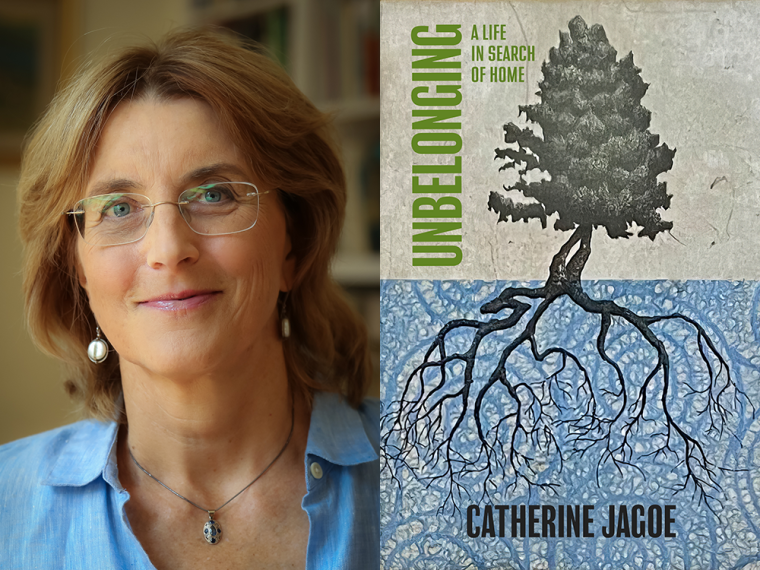
Catherine Jagoe, author of Unbelonging. (Credit: Andrew Dryer)
1. How long did it take you to write Unbelonging?
The beginning of one of the essays was first drafted as a prose poem about twenty years ago and completed in essay form twelve years ago. Most of the rest were written over the last ten years, in between writing my poetry chapbooks and books and translating Uruguayan and Spanish authors.
2. What was the most challenging thing about writing the book?
The fact that I never set out to write a memoir. I wrote individual essays, but over time I noticed a core set of themes and questions recurring across both my poetry and nonfiction. About five years ago, I began to consider creating a memoir in essays that incorporated previously published pieces along with new ones. Creating the structure was crucial to deciding what needed to stay and what needed to go. It’s not simply a collection of every personal essay I happened to publish in the last ten years. Only when the order was finalized could I work on tightening connections, weaving themes through, and eliminating repetition.
3. Where, when, and how often do you write?
I try to fit in several hours for writerly work every weekday in my study, usually in the afternoon. When I’m in the thick of a project or under deadline, I write most of the day—but never at night, and never super early in the morning. I aspire to write longhand in my journal whenever I can create quiet time, but I’m inconsistent, even though I know that all my ideas, in poetry and in nonfiction, surface in my notebook first. When I’m not reading, note-taking, and journaling, I’m not actively creating new work. I feel lost and unmoored when I don’t record what I notice both in the external world and in my own head every day. It’s a way of priming the pump.
4. What are you reading right now?
I’ve just finished a slew of extraordinary books—John of John (Grove Atlantic, 2026) by Douglas Stuart, Land (Knopf, 2026) by Maggie O’Farrell, Ghost Stories (Simon & Schuster, 2026) by Siri Hustvedt, The Book of Birds: A Field Guide to Wonder and Loss (Norton, 2026) by Jackie Morris and Robert Macfarlane, America, América (Penguin Press, 2026) by Greg Grandin, and the audiobook of The Odyssey in Emily Wilson’s marvelous translation from 2017, the first translation by a woman, read by the actor Claire Danes. I feel so grateful to have been successively immersed in one superb, mind-expanding book after another this summer.
5. Which author, in your opinion, deserves wider recognition?
The poet Cecilia Woloch. Her work is extraordinary. In fiction, it saddens me that the trifecta of great nineteenth-century Spanish novelists—Benito Pérez Galdós, Leopoldo Alas, and Emilia Pardo Bazán—are virtually unread in the Anglophone world. Imagine not knowing of the existence of Dickens, Austen, Hawthorne, Melville, Balzac, or Zola. Their Spanish peers are just as gifted.
6. What is the biggest impediment to your writing life?
Tending to the body. In order to manage two chronic health challenges, I need at least two hours of exercise, preferably outdoors, every day. I’m also temperamentally averse to fixed schedules. But I love and need to move just as much as I need to sit and think and write. I’m always juggling those competing needs.
7. What is one thing that surprised you during the writing of Unbelonging?
I think it was discovering, towards the end, that the self I was writing about—the unbelonging self that characterized so much of my life—was no longer entirely the current I [who I am] now.
8. If you could go back in time and talk to the earlier you, before you started Unbelonging, what would you say?
Honestly, nothing. The person and the writer I am now is who she is because of the long process of wrestling with my subject over many years in my mind and on the page. Joan Didion said, “I write entirely to find out what I’m thinking, what I’m looking at, what I see, and what it means.” The writing was its own process of apprenticeship and clarification. There are no short cuts or “should have dones.”
9. Outside of writing, what other forms of work were essential to the creation of Unbelonging?
Translating, because that experience of inhabiting other languages and cultures is part of my subject. Alongside that, reading as much creative nonfiction as possible, critiquing others’ work, and taking workshops on different essay forms.
10. What’s the best piece of writing advice you’ve ever heard?
When you are stuck or struggling, use the Pomodoro Method. Set a timer for twenty-five minutes and just write, with no stopping and no self-judgment. Then take a five-minute break, stand up, stretch, pace around, and do it again. It’s seen me through many an impasse.