This week’s installment of Ten Questions features Téa Mutonji, whose novel, My Person, is out today from G. P. Putnam’s Sons. “I was aiming for a clean separation without any complications,” Mutonji writes in the book’s opening pages. Her protagonist, Tania, has decided that her relationship with her best friend of twenty years, Margot, has run its course. “There was a void I couldn’t quite explain and this voice in my head kept saying: It’s time to go.” The two friends are too codependent, overinvolved, beholden to each other. At the same time, the differences between them are creating a power imbalance that is growing hard for Tania to ignore. Margot is white and affluent; Tania is Black and struggling to make ends meet while she finishes writing her second book. They live together in an apartment Margot’s parents own, and their lives seem destined to head in different directions. The question is whether they can stay close while also giving each other the space to grow apart. Publishers Weekly called the book “a clear-eyed take on the formative power of female friendships.” And author Katie Yee praised Mutonji for “manag[ing] to take some of the ugliest thoughts and worst moments and turn [them] into a sparkling novel about reclaiming your sense of self.” Téa Mutonji is a poet and fiction writer based in Toronto. Her debut short story collection, Shut Up You’re Pretty (Arsenal Pulp Press, 2019), won the Edmund White Award for Debut Fiction and the Trillium Book Award. She was a recipient of the Writers’ Trust Rising Stars Award and received the Jill Davis Fellowship at New York University, where she completed her MFA in fiction.
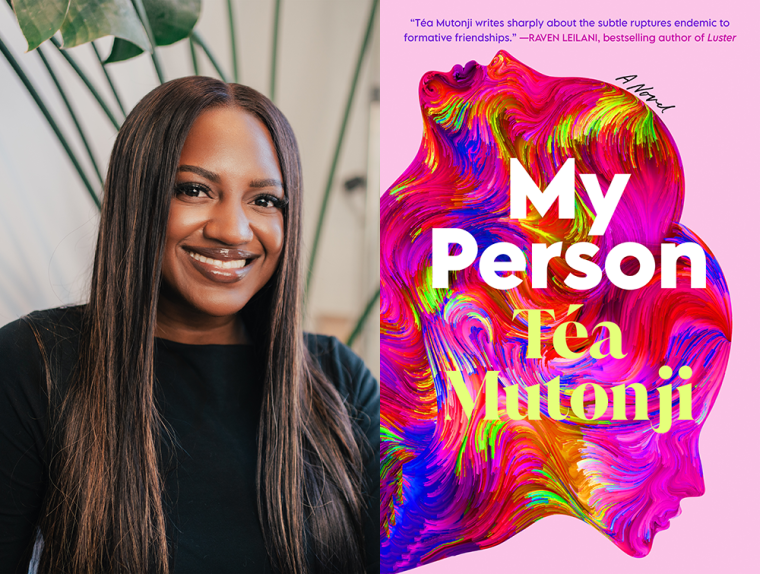
Téa Mutonji, author of My Person. (Credit: Yoni Mutonji)
1. How long did it take you to write My Person?
It took a year to arrive at my first draft in 2021. My final copy was submitted in 2025. I think it took four years to get the book to a place of true completion, but the bones came together in one feverish year.
2. What was the most challenging thing about writing the book?
It’s difficult to make art when the world is such an open wound. I had to turn off the TV and stop going online for a while. The hardest part for me was spending time in the real world and then convincing myself that it was okay to return to the page. I was surprised at how much mental pep talk goes into writing a novel.
3. Where, when, and how often do you write?
It’s been different with every major project. Because I was in my MFA during the majority of my big writing sprints with this novel, I wrote sometimes in cafés in Paris in Quartier Latin during the day, and often overnight, on the floor in my hotel room into the morning. I mostly wrote overnight and then the sun would mysteriously come up. Now, I usually write in bed from nine to five, Monday to Thursday. I try to spend at least one day completely free from characters and also from people.
4. What are you reading right now?
I’m just a girl so I’m currently reading Yesteryear (Knopf, 2026) by Caro Claire Burke.
5. Which author, in your opinion, deserves wider recognition?
I think Morgan Parker deserves more recognition. Her poetry is so good but her essays, her fiction? Someone needs to give this lady a bouquet of flowers immediately.
6. What is the biggest impediment to your writing life?
Most days my mind and my body because I often get sick, and other days my rent (yuck). I’m lucky in the sense that I never don’t want to write, but I am unlucky in the sense that I have a ton of chronic issues that take me away from my desk.
7. What, if anything, will you miss most about working on the book?
The thing I’ll miss more than anything is writing this book in Paris. When I wasn’t working, I used whatever free time I had to get out of my own head in my dream city. I felt like a cultural explorer. I loved reading books, watching TV, listening to music, walking around, and eating at restaurants, all in the name of research. Writing this book made me feel like an artist.
8. If you could go back in time and talk to the earlier you, before you started My Person, what would you say?
One of my advisors at NYU, Leigh Newman, said this to me when I was working on the final edits of my thesis: “Stop trying to be a good writer when you’re already a good writer.” Something clicked for me then. If I could go back to the start, I would tell myself exactly this.
9. Outside of writing, what other forms of work were essential to the creation of My Person?
I was a full-time bartender and an MFA student while working on this book. I was doing a lot of panels for my first book. This is why I often wrote in the middle of the night and into the afternoons. After my shifts, after my panels, after my workshops. I did these three things with such intensity I didn’t do anything else. I was a student, and I was a bartender, and when the world was asleep, I was a writer. It was all essential.
10. What’s the best piece of writing advice you’ve ever heard?
Don’t stop writing.