This week’s installment of Ten Questions features Andrea Uptmor, whose novel The New People is out today from Little, Brown. The story begins in 2008. The housing bubble has burst, Obama is in the White House, an effective ban on same-sex marriage is on the ballot in California and making waves across the country, and newlyweds Emma and Rachel have just moved from Chicago to the conservative college town of Riverbend, Indiana. Rachel, a feminist scholar, is enjoying the success of her recent novel and the demands of her new tenure-track position, while Emma struggles privately with her own languishing writing career and the emotional aftermath of her recent miscarriage. And then there’s the problem of their new house, whose “metaphorical ghosts were undeniable” the first time Emma walked through the door. “There was something about flipped houses that reminded Emma of a surgeon’s scrubs: no matter how clean they were, you knew that at one point someone else’s life had stained them.” In her case, those ghosts materialize, unexpectedly and in the flesh, when it turns out that the house’s former owners are living in a hidden attic above the garage, angry about having been the victims of a scammy foreclosure. In a starred review, Kirkus Reviews called The New People an “ambitious first novel,” adding that Uptmor “confounds expectations to expose the darker realities of American life.” And Bruce Holsinger said the book is “a riveting story of precarity and privilege, told with great tenderness and imagination by a master storyteller.” Andrea Uptmor received her MFA in fiction from the University of Minnesota. Her short fiction has been published in McSweeney’s, PANK, the Masters Review, and elsewhere. She lives in the Chicago area with her family.
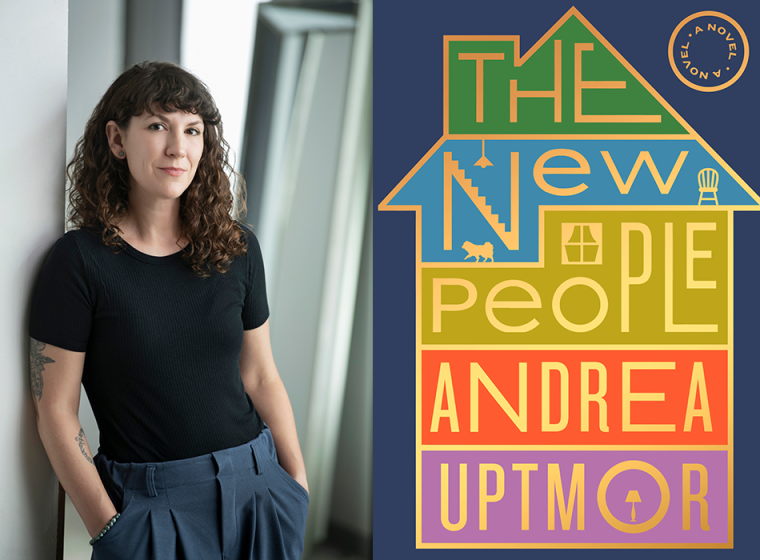
Andrea Uptmor, author of The New People. (Credit: Paige Peterson)
1. How long did it take you to write The New People?
From writing the first sentence to selling it? Three years. But I spent long periods wandering away from the project, until I committed to waking early to write every day. Most of the novel was written in those early mornings, over a period of about nine months.
2. What was the most challenging thing about writing the book?
I’ve never been a master at crafting a propulsive plot. I’m very much a sentence-level writer and can lose track of the overall momentum of the story. But a novel about phrogging [the crime of individuals secretly living in someone’s home] has some baked-in tension that calls for narrative urgency. I had to cut a lot of scenes I loved, because they just didn’t move things forward quickly enough.
3. Where, when, and how often do you write?
I try to write every day, in the early morning before my kids wake up. A painter once told me that creativity is a faucet you always have to keep on, even if it’s just a trickle. I remember that when I have days when I’m only able to get a sentence or two out.
4. What are you reading right now?
I’m so stressed out by the impossible number of books I want to read in my short lifetime! A recent favorite is Stag Dance (Random House, 2025) by Torrey Peters. The language in the title story is so Victorian in its melodrama and precision. Turns out I need more psychologically dialed-in, gender-fluid lumberjacks in my life.
I also loved The Anthropologists (Bloomsbury, 2024) by Aysegül Savas. Now there’s an example of a book that’s both propulsive and plotless. I’ve always been drawn to stories that savor the mundanity of life—the foods people are eating as they talk, the items laid out on their desks—and this book is meticulous in rendering those ordinary moments.
5. What is the earliest memory that you associate with the book?
The idea of writing a foreclosure story got into my brain and nestled there about thirteen years ago, when my wife and I bought our first home. It was a flipped foreclosure with new fixtures, new carpeting, the works. The only evidence of the previous owners was a sticker that a child had stuck to the front door that wouldn’t come off. I was newly married, feeling like I was at the beginning of this new life, but every time I walked through the door I remembered that to someone else, this house represented loss.
6. What is the biggest impediment to your writing life?
Time. There are simply not enough hours in a day to do all the reading and writing I want to do. But I try to remember that all the other stuff in life—my family, my job—isn’t in competition with my writing life. Everything can be fuel for those early mornings at my laptop.
7. Which author, in your opinion, deserves wider recognition?
In general, I think short story collections don’t get enough love. Some of my favorite masters of the short form are Joan Silber, Deborah Eisenberg, ZZ Packer, and Jhumpa Lahiri.
8. If you could go back in time and talk to the earlier you, before you started The New People, what would you say?
Lady, you need to start getting up at 5:30 in the morning. It’s the only way this is going to happen.
9. Outside of writing, what other forms of work were essential to the creation of The New People?
Reading stories about foreclosure, prowling Reddit for people’s experiences with phrogging, digging through the New York Times archives for articles about Proposition 8 and the 2008 financial crisis. I also spent a lot of time on Google Street View and Zillow to build the fictional Indiana city of Riverbend.
10. What’s the best piece of writing advice you’ve ever heard?
During my MFA, an undergraduate history major took one of our graduate writing workshops. When critiquing a classmate’s story, most of us gave really specific, really niche feedback, like “You’ve strayed from a close third in this scene,” or “If you opened the temporal space of the story, you’d have more space for flashback.”
And when it was the undergrad’s turn, he suggested, “Maybe just try harder and do better.”
We laughed, and he blushed, but over the course of the day his comment concretized into something very true in my mind. I think about it all the time. Sometimes pushing through a project really is that simple: Try harder and do better.