This week’s installment of Ten Questions features Prudence Bussey-Chamberlain, whose novel, Bone Horn, is out today from Soft Skull. “If you had a horn, where would you keep it? Where in your life would someone find a record of it? An email to a plastic surgeon? In a message to a friend?” These are the questions the narrator, a newly registered private investigator in dire straits, must ask herself. She has just received a mysterious call from an anonymous client who is convinced that Alice B. Toklas, the longtime partner of modernist icon Gertrude Stein, had a horn growing from her forehead. The person on the end of the line is desperate to track down the secret horn and wants our protagonist’s help doing so. Though she is skeptical of the enterprise, she agrees to take it on, and over the course of her investigation discovers that she and Toklas may have a thing or two in common with each other. “There’s much to admire in this well-paced queer detective novel,” Publishers Weekly writes. And in 4Columns, Julie Phillips calls the book a “sexy, fun, exquisitely odd mystery.” Prudence Bussey-Chamberlain is a senior lecturer in creative writing at Royal Holloway University. She has published four books of poetry, most recently Grief Is the Thing in Pleather (Osmosis, 2025), and two academic books on feminism and queer flippancy. Bone Horn is her first novel.
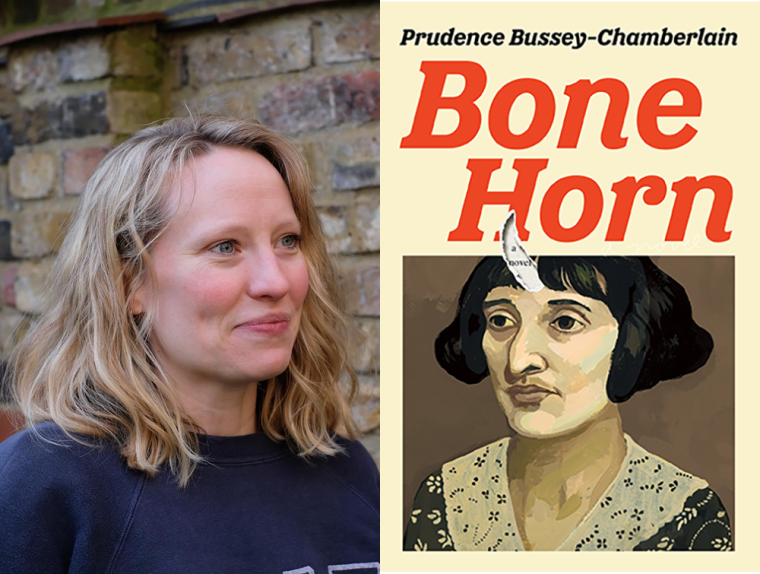
Prudence Bussey-Chamberlain, author of Bone Horn (Credit: Elke Bussey)
1. How long did it take you to write Bone Horn?
It took about ten months to write Bone Horn. I had a sabbatical and so dedicated three solid months to the early chapters, writing every day. I finished the latter half through the university summer holidays and a term of teaching, moving at a much slower pace.
2. What was the most challenging thing about writing the book?
The book began with a ridiculous premise, which gave me a fun momentum for the first few chapters. As the novel progressed, however, the need for a proper plot became increasingly apparent. I knew that I wanted to write into and out of a detective fiction formula, using typical plot points with an acceleration in the action before ultimate resolution. I also knew the genre dictated the bad guy had to be someone the reader had encountered earlier in the plot but I was struggling with who that might be and why they would be interested in Alice B. Toklas’s horn.
The other issue I had was deciding how to present Alice B. Toklas’s horn to the reader. I didn’t want to sensationalize horns, or the having of horns. I wanted it to work as a threshold for the ideas I really wanted to get at around queer history. Simultaneous to writing, I was also looking into the existence of the horn itself, which I had believed to be spiteful gossip originating from Picasso. So, I also needed to decide how much of the book had to be historically and biographically accurate, and the extent to which this might extend to the fabled horn.
3. Where, when, and how often do you write?
I write anywhere I can, although in the early stages of the book I would go to a particular café, order coffee, and not get up from my seat until I’d finished a few thousand words. I am most productive in the morning—that’s when I’m able to write a substantial amount—but I’ve always got a notebook or laptop open in case I have an idea when I’m doing something else. I practice dialogue in my head, whispering to myself while doing mundane domestic tasks, so I make sure to write that down as I go so as not to lose the idea.
4. What are you reading right now?
I’m always reading about three books simultaneously, one or two for work and then another for pure joy. I’ve just finished Feminism Against Cisness (Duke University Press, 2024), which is a radical and exquisite call to reimagine feminist and trans futures through a dismantling of cisness. I started Tales of the Suburbs: LGBTQ+ Lives Behind Net Curtains (Faber & Faber, 2026) this week. I’ve read some brilliant books about recent histories of queer experience in the UK, The Log Books (Faber & Faber, 2026) and Thank You for Calling the Lesbian Line (Legacy Lit, 2025), both of which include archival research and interviews, and so an exploration of queer lives in the suburbs seems like an interesting extension. Someone recently recommended the Aud Torvingen series so I’m reading The Blue Place (Picador, 2025). She’s a Norwegian ex-police officer turned detective who is apparently equally comfortable in a ball gown and full spy gear.
5. What is the earliest memory that you associate with the book?
I have two early memories associated with the book. The first was reading Dryland (2021), which was published in the UK by Cipher Press. It was the third or fourth Cipher book I had read, and not only did I love it, but I started to imagine how I would shape Bone Horn with that specific publisher in mind. The second was standing over the sink brushing my teeth next to my wife. I started to wonder how such domestic moments might make their way into the formula of a crime or mystery book, where the detectives are so often isolated and lacking in stable domesticity or familial ties. Often, it’s the loneliness of the detective that propels them into the work or allows them to take the risks fundamental to the propulsion of the plot.
6. What is one thing that surprised you during the writing of Bone Horn?
In a surface-level sense, I was surprised by all the historical facts and the amount of information that we’re able to access online. Certainly, for authors with quite famous estates and well-preserved or catalogued material, there’s a wealth of material that has been digitized for wider access. I was able to dig through material on Stein and Toklas using the “zoom in” button in ways that I had not anticipated.
The bigger surprise, however, was the challenge of writing about motherhood. I wanted to work with how interruptive and all-consuming being a parent is, while holding on to a narrative that still accelerates towards resolution. I knew—and was hoping—that the presence of a child might destabilize the plot slightly, but it felt like managing a tension between the pace and responsibilities that can seem outside of the time of work.
7. What, if anything, will you miss most about working on the book?
I think I will miss inhabiting the detective’s world. It afforded me reflections on motherhood that took me out of the immediacy of doing the work of motherhood. Given that the investigation was based on real-life Modernist figures, I was also thrown into an investigative role that directly mirrored that of my character. Sadly, I lacked the anonymous client willing to pay for travel to archives, so we diverged when she boarded the plane to New Haven. I also really enjoyed taking on the role of a researcher without preparing my findings for an academic monograph. I could move through the resources like a magpie, pulling out the shiniest pieces of information and gossip without having to justify my methods or contextualize further.
8. If you could go back in time and talk to the earlier you, before you started Bone Horn, what would you say?
I never thought that I would write a novel—I was intimidated by the length of sentences. This was my only idea, and I hadn’t committed to the writing because the premise felt so ridiculous. So, I would tell myself that novels do not need gravitas. That it might be the silliness or flippancy that creates delight in the writing.
9. Outside of writing, what other forms of work were essential to the creation of Bone Horn?
I watched absolutely loads of quite formulaic and long-running crime shows. I was interested, especially, in shows that centered a single genius who often had a more mundane or average sidekick as they moved their way through investigation and crime-solving. This was certainly the case in Bones, where genius forensic anthropologist Temperance Brennan begins to work collaboratively with an all-American ex-military sniper FBI agent on what appear to be unsolvable cases. Harrow was [about] a rogue forensic pathologist whose brilliant insights made his personal indiscretions forgivable. He was also an absent father who was trying to compensate for years of immersing himself in the violence of other people instead of parenting.
I also listened to [the podcast] Bad Gays plenty and felt some calm in the campaign of visiting historic queerness without needing to redeem or rehabilitate the figures in the name of pride.
10. What’s the best piece of writing advice you’ve ever heard?
I was talking to a friend recently about how to balance care commitments with writing, and she said that she was writing more than ever because she had finally learned to write with her method rather than against it. I think writers can spend a lot of time attempting a reorganization of their day or their natural writing inclinations to be more productive, but actually that shifts us away from how we instinctively approach the work. It becomes a block or stopping point for writing. If I spend too long thinking about or planning a book, then I never start writing. I’m not going to lament my thoughtlessness anymore, but write, and then rewrite, and then edit so the ideas can emerge as I go.