This week’s installment of Ten Questions features Kate Christensen, whose novel Good Company is out today from Harper. “I’ve been feeling, in recent years, a slowdown in my writing career, a sense of gradually becoming less and less relevant,” Julia Heimdahl, the novel’s protagonist, muses to herself in the opening pages. She is back at Baldwin College, her alma mater, for a literary festival where she is promoting her new memoir, an accounting of some of the fraught relationships that have punctuated her life. Over the course of the weekend, Heimdahl encounters an erstwhile flame, a literary nemesis, an editor, a mentor, and a former student investigating allegations against her aggressive yet charming co-panelist. In between, excerpts from her memoir shed light on how she came to be such good company. Kirkus Reviews called Good Company “an astute addition to a decade of discussions about consent and predation.” And Marisa Silver praised Christensen for “deconstruct[ing] female desire and ambition and the ways in which those twin drives can be manipulated by men and women alike. The result is a novel that is emotionally raw, bracingly honest, and filled with compassion.” Kate Christensen is the author of nine novels, including The Great Man (Anchor, 2008), for which she won the PEN/Faulkner Award. She has also published two food-centric memoirs and writes the Jo Bailen detective series as Sydney Graves. She lives in northern New Mexico with her husband and two dogs.
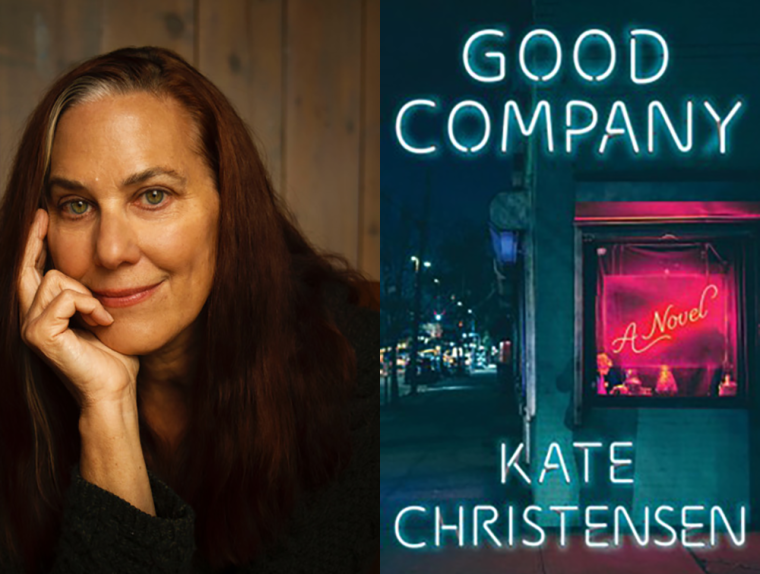
Kate Christensen, author of Good Company. (Credit: Cheryl Nichols)
1. How long did it take you to write Good Company?
Nine months for the first draft, another nine months until the final revision.
2. What was the most challenging thing about writing the book?
Getting the architecture right, the book’s skeleton. It was tricky. I alternated present-day, first-person chapters with selections from the narrator’s memoir, and each excerpt had to comment on the preceding and subsequent chapters and come just at the right time to both satisfy curiosity and propel the reader into the next real-time chapter. I worked so hard to get those right. I did a lot of cutting. And I did a lot of thinking about what I wanted to accomplish with this novel at the deepest level. I had to invent this formal structure in order to write it the way it demanded to be written.
3. Where, when, and how often do you write?
The simplest and truest answer is that I’m always writing and have been all my life. My brain cycles through its settings on a long loop: observe; listen; obsess; percolate; write a sentence; write another one; keep going until I have a raw, rough first draft; revise until it’s a book. And repeat, until I die.
The more literal answer is that I write in the afternoons, following my morning ritual of doing word puzzles and drinking tea, taking a hike with my dogs, letting a certain amount of nervous energy build up until it fizzes over into work. I write until it’s time to feed the dogs and start cooking dinner.
Between books, my brain seems to lie fallow but is actually resetting its loop: observe, listen, obsess, percolate. And so another book is generated.
4. What are you reading right now?
I like to read several books at once so there’s always something I’m in the mood for. Today, I’m rereading The Bone People (Spiral, 1984) by Keri Hulme—I read it after it won the Booker Prize in the mid-1980s. It called to me again the way favorite books do: “Come back, it’s time to reread me!” This novel is astonishing—so humane, so richly sad and beautiful. My husband and I recently designed and built and moved into a house in the mountains of northern New Mexico; I now have a tower room to write in with long views of mountains on three sides and tall locust trees behind the house to the north, filled with singing birds, growing along an acequia rushing with snowmelt. And a strong wind blows almost constantly. I think of Kerewin Holmes in her own tower by the New Zealand Sea, way on the other side of the world, and feel a kinship with her.
5. Which author, in your opinion, deserves wider recognition?
All of us! “There is no frigate like a book”—nothing engages heart, mind, and soul like the experience of reading. Novels used to be cultural events, touchstones, topics of general discussion, the loci of storytelling. The intensely intimate act of reading a book, the meeting of writer and reader, can’t be replicated by any other art form. Now, movies and TV series and social media and all sorts of other distractions are supplanting books in the public attention, and this is something I regret deeply. When a population collectively stops reading books, it loses something powerful and fundamental and shared.
6. What is the biggest impediment to your writing life?
It used to be fear of writing badly, back when I was younger. I overcame that fear in middle age, along with all my other perfectionistic tendencies. I don’t think I have any impediments to writing anymore. It’s the necessary center of my life, the thing I’ve built my days around. Writing is like any other bodily function for me—necessary, rhythmic, and almost involuntary.
7. What is one thing that your agent or editor told you during the process of publishing this book that stuck with you?
My editor, Sara Nelson at HarperCollins, read an early draft and said, “There are too many bad men in this book.” She was right: I needed to choose my “bad men” more carefully, differentiate them, be more discerning and spare so each one packed more of an individual punch, so to speak. So I killed a few anti-darlings, and the book became stronger and shorter.
8. If you could go back in time and talk to the earlier you, before you started Good Company, what would you say?
I would tell myself that it’s always worth the risk of truth-telling, self-exposure, and writing the things you think you’re not supposed to write. I would add to my past self that this book wasn’t going to be for everyone, to put it mildly, but its true readership would respond to it with gratifying understanding and identification.
9. Outside of writing, what other forms of work were essential to the creation of Good Company?
I listened to a lot of music while I wrote this book. I found inspiration in jazz especially—the free-form, complex structures; the combination of intellectual and visceral intelligence in the improvised lines; the sheer, ecstatic, brain-exploding joy of it all.
10. What’s the best piece of writing advice you’ve ever heard?
I’ve always loved the image of seeing just as far as the headlights illuminate—I have no idea who originated this advice, because so many writers have reiterated it in various forms, but basically, it means that all you need to be able to see to keep going with a book is what’s immediately ahead of you. Like driving at night—you don’t see the entire road stretching out in front of you, you’re just continually rushing into the patch of space lit up by the lights of the car.