This week’s installment of Ten Questions features Gregory Orr, whose poetry collection We Interrupt This Broadcast is out today from W. W. Norton. Near the close of the book, Orr asks how it is that a body “wizened” and “made chaste” by the passage of time can still feel “Eros at the heart of it.” Such moments of temporal acceleration and sensory standstill reverberate throughout We Interrupt This Broadcast, from Orpheus recalling his first experience of song in his mother’s womb to the poet relishing the taste of a beloved’s words repeated in one’s own mouth. Orr offers a fitting parable: “Love” and “loss” are “present and past / Of the same verb // Which is ‘to live.’” Ada Limón praised the poems of We Interrupt This Broadcast as “profound lyrical lessons in staying alive despite chaos and cruelty,” while Patricia Smith called the collection “a starkly contemplative nod to time’s incessant habit of passing while sparking wonder and inflicting wound along the way.” Gregory Orr is the author of fourteen collections of poetry, most recently Selected Books of the Beloved (Copper Canyon Press, 2023), and several books of prose, including A Primer for Poets and Readers of Poetry (Norton, 2018). He is professor emeritus at the University of Virginia, where he founded the MFA Program in Writing. Orr lives in Charlottesville, Virginia.
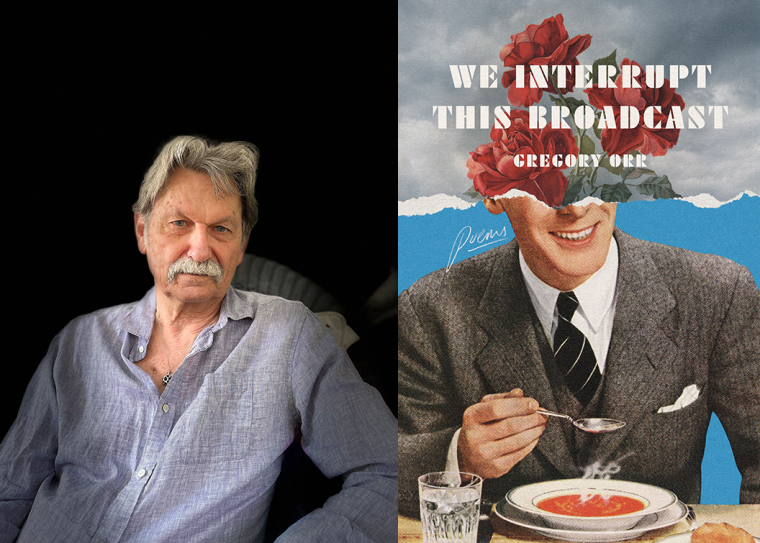
Gregory Orr, author of We Interrupt This Broadcast (Credit: Trisha Orr)
1. How long did it take you to write We Interrupt This Broadcast?
Probably about seven years for most of it, but it’s hard to calculate with my writing because I rewrite so much (maybe thirty to a hundred drafts of a poem) and so can find myself reaching back to a thirty-year-old failed poem in order to snatch a living passage or image and build something vital around it or integrate it into something I’m currently struggling with.
2. What was the most challenging thing about writing the book?
To be in this moment of my own mortal life and our tormented historical moment (COVID, political chaos and malignancy, economic turmoil and ecological crisis) and not end up with a book too dark or bleak. This was mostly achieved through the good graces of my editor Jill Bialosky and my wife—both of whom encouraged me to exclude those poems that offered the least solace and hope. One result: seven COVID-themed villanelles cut back to four.
3. Where, when, and how often do you write?
I write in my study from an hour after wake-up and [with] a quart of coffee. I write or rewrite and journal and think about poetry from about seven in the morning until one or two in the afternoon. I have done this schedule for sixty years—it’s more difficult for me to take a day off than it is to hold to this (sustaining) routine.
4. What are you reading right now?
Nicholas Humphrey’s Soul Dust (Princeton University Press, 2011) and the original 1855 version of Whitman’s Leaves of Grass (a reread every few years, along with Dickinson’s letters and poems and Keats’s letters).
5. Which poet, in your opinion, deserves wider recognition?
Hard question. I guess I feel that Theodore Roethke’s “greenhouse” poems and the early poems of the “Lost Son” sequences are remarkably rich in sensuous language, precision, and difficult but positive spiritual force. There’s lots of joy and energy in them, and genuine darkness also.
6. What is the earliest memory that you associate with the book?
I wrote a book-length lyric sequence called Orpheus and Eurydice (Copper Canyon Press) back in 2000 in which Orpheus, a mythic, archetypal figure for the lyric poet, is the main speaker in a number of the poems as the story of Orpheus and Eurydice unfolds. In “Orpheus Grown Old,” the opening sequence of the new book, that original myth isn’t part of the story, but Orpheus returns as a poet-speaker who is confronting not only his personal mortality and anguish, but also the environmental degradation and species extinction that mark our own historical moment.
7. What is one thing that surprised you during the writing of We Interrupt This Broadcast?
I think the two poems “Inner Monologue Addressed to My Alternate Self” and “Two Brief Notes to My Alternate Self.” I’ve often felt like two different and divergent people, but I didn’t know that dramatizing that feeling would be so oddly gratifying to me.
8. If you could go back in time and talk to the earlier you, before you started We Interrupt This Broadcast, what would you say?
I might say: The visionary lyric affirmation that is central to your hopes for your work (especially the poems that make up Selected Books of the Beloved from 2022)—this visionary affirmation will not for the most part be available for your next book (We Interrupt This Broadcast). The new work will collide with and try to cope with and dramatize crises that you share with our whole society (the pandemic, the rending of the civic fabric, the ecological and climate crises)—your love for and commitment to the consolations and truths of lyric transcendence will have to return to an Earth-bound and deeply damaged cultural moment and find (and sing) what’s there.
9. Outside of writing, what other forms of work were essential to the creation of the poems?
I’d have to say listening for phrases and images to appear in my brain is a kind of work. I’ve retired from teaching, a kind of work I loved (“They Came To Learn” is my hymn to my students of the past forty-five years). I work in my garden, walk my dog, exercise—ways of getting out of my head and away from words so that I can hope to be refreshed and ready to engage language and imagination the next morning.
10. What’s the best piece of writing advice you’ve ever heard?
Since it’s clear I’m a creature of habit (the habit of writing), I’d have to say Rodin’s advice to the young Rilke: “Work always!” Which I take to mean: Work continuously and discipline yourself for this art that you love. The more you work, the more you learn and discover—lyric poetry and its possibilities are inexhaustible but you will only realize that through a steady and disciplined commitment.