This week’s installment of Ten Questions features Tom Lin, whose novel Babylon, South Dakota is out today from Little, Brown. When Hsiu Keng and Lee Mei arrive in a new country to claim the parcel of the American West bequeathed to them by a mysterious relative, they bring with them a knapsack of ancestral treasures, including three lumpy taels of gold and a bag of chrysanthemum seeds that survived the torching of the revolution. After surviving a harsh winter, this new crop of flowers will prove indestructible, and the gold too propagates; other strange phenomena abound, including ambient radio signals throughout the house that teach the couple’s not-yet-two-year-old daughter to babble in French and Mei’s sudden ability to divine the future in the flight paths of birds. When the US military tests what appears to be a nuclear missile on their land, the family emerges from the ashfall “remarkably prosperous.” Survival in this new place can only be the product of miracles—or perhaps something stranger. In a starred review, Kirkus Reviews called Babylon, South Dakota a “thoughtfully written, genre-crossing novel of great ingenuity.” And Kaveh Akbar praised Lin for building “this wildly ambitious, deeply strange world with its own ecology and physics and sociology that is also, importantly, our world in all times past, present, and future.” Tom Lin was born in China and immigrated to the United States when he was four. A graduate of Pomona College, he also holds a PhD from the University of California in Davis. Lin’s first novel, The Thousand Crimes of Ming Tsu (Little, Brown, 2021), won the Andrew Carnegie Medal for Excellence in Fiction. He teaches English and creative writing at the University of Iowa.
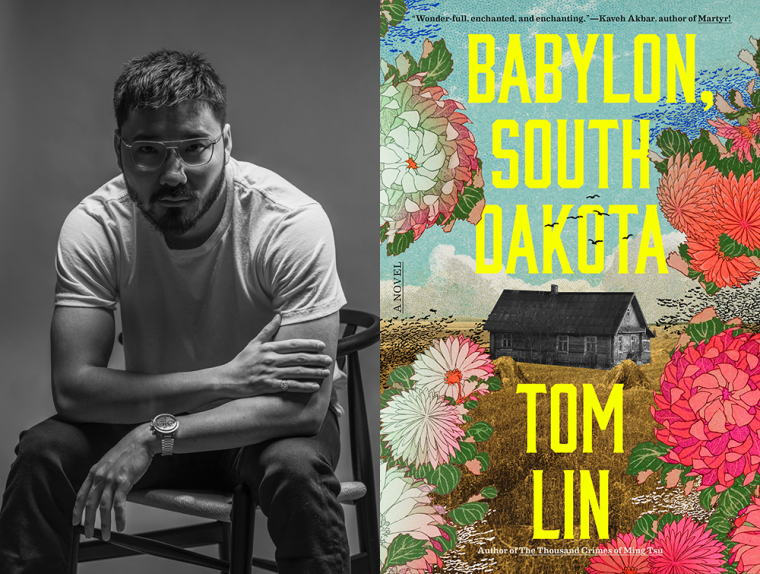
Tom Lin, author of Babylon, South Dakota. (Credit: Riel Sturchio)
1. How long did it take you to write Babylon, South Dakota?
Just over three years. I started writing it when I was still a doctoral student at UC Davis working on my dissertation about science fiction and nuclear missiles. I had all this research and fieldwork rattling around my head—nuclear weapons, ballistic missiles, space history—and I came to realize that the dissertation was tiring me out because there were things in which I was interested but which I could not capture in my scholarly work. So I did what all writers do: started a new project to avoid working on an ongoing one.
2. What was the most challenging thing about writing the book?
I wanted to do justice to a place like South Dakota, but I grew up in Flushing, New York, which offered a somewhat different set of lived experiences than if I had grown up in South Dakota. I’ve long had a deep fascination with the scale and scope of the Great Plains; I first visited the Badlands many years ago, on one of the dozen or so formative road trips of my youth. The Great Plains feel like a place with a history terraformed by the exercise of power at some great distance. Nuclear missiles sit in the ground, mine tailings mark exhausted sites of extraction, farms grow crops determined and priced by geopolitical maneuvering. When it came time to write the book, I was most concerned with getting the feeling right—the feeling of things happening here that came from elsewhere, the majesty of the land, the caprice of power.
3. Where, when, and how often do you write?
I collect fragments of language as they occur to me. I keep it all in a single Notes app document on my phone. In this way I write all the time; my actual book-writing practice looks very different. I have learned that I will not write reliably or consistently unless I am staring down the barrel of a non-negotiable deadline. Then, I write at my desk, in my office, every day, working for as long as I can until I am finished with the manuscript. Sometimes this means thirteen- or fourteen-hour days for weeks straight. I do not think this is a good way to write, but it’s how I write.
4. What are you reading right now?
I’ve just read Paige Lewis’s Canon (Viking, 2026), which came out on May 19 and features, among other things, a newt, a talking whale, and a God who is trying His best. It’s a vast, hilarious, and magisterial work. Chris Jenning’s End of Days (Little, Brown, 2026) tells the story of Ruby Ridge and in so doing provides a revealing history of how a particular form of apocalyptic thought came to be at the heart of American political life. And I recently reread Kate Crawford’s Atlas of AI (Yale University Press, 2021), which—despite antedating the rise of modern transformer-based LLMs—still offers many excellent critical perspectives on the sundry systems we are asked to call artificial intelligence.
5. What is the earliest memory that you associate with the book?
I was driving across the country with my then-girlfriend, now-wife Pia. We stopped at a military surplus store in Sioux Falls to pick up a box of MREs to serve as camp food in the Badlands. After only a few miles on the 90 there came a thunderstorm so intense that we thought the roof of the car was going to cave in. It was completely dark and the headlights were no help. We could hardly see the road ahead of us. After half an hour of white-knuckled driving the rain suddenly stopped; we had punched through the squall line and emerged blinking into the afternoon sun. I thought: I want to get that down in writing.
6. What, if anything, will you miss about working on the book?
I love the whole Hsiu family, but I especially love Mei Lee, the matriarch, whose no-nonsense pragmatism finds a worthy match in this world that keeps offering her foolish and remarkable things.
7. What is the biggest impediment to your writing life?
I am my own worst enemy when it comes to impeding my writing life. I am always able to find something to distract me. Sometimes, in fits of existential panic, I think that—were I left to my own devices—I would never have written anything at all. Recently I have started to use my own laziness as a tool, as though I were the Nemean lion of procrastination: My office is in the attic and I hate going up and down stairs, so when I need to work I’ll leave my phone in the basement.
8. If you could go back in time and talk to the earlier you, before you started Babylon, South Dakota, what would you say?
Keep going!
9. Outside of writing, what other forms of work were essential to the creation of Babylon, South Dakota?
One thing that’s different between this book and my first is that I now exercise regularly. What’s changed is that I no longer think of my body as merely my brain’s support equipment—since the pandemic, more or less, I’ve tried to treat my body like the co-equal participant in thinking that it really is. Experiencing the world, for me, is the ultimate font of ideas and inspiration, and I now try to remember what a privilege and a duty it is to have a body that can bring me to those places, show me those things, and drink in the experience of being around.
10. What’s the best piece of writing advice you’ve ever heard?
Don’t wait for inspiration—just write. Whether you feel inspired on any given day has almost zero effect on the quality of the writing you produce.