This week’s installment of Ten Questions features Deb Olin Unferth, whose novel Earth 7 is out today from Graywolf Press. In an acrylic undersea pod pumped with purified air, a child grows restless. Her reclusive scientist mother, only too happy to leave behind an already mostly depopulated Earth, researches DNA by day and consciousness by night. She trains the child to be silent. There isn’t even companionship in the ocean outside: Fish have gone extinct. The child, who adopts the name Dylan, longs to live in her natural biome. Though her attempt to recruit a Martian to rescue her fails, she will eventually make it to the surface and to a molecular collections lab where scientists compile what they refer to as “an Earth backup” for every contingency. But Dylan is drawn to the planet that already exists, falling in love with the ever-mutating desert sand and a woman whose face is implanted with so much fiberglass she is routinely mistaken for a robot. In a starred review, Kirkus Reviews called Earth 7 “a quirky, bold, and endearing masterpiece of climate fiction,” while in another starred review in Booklist, Donna Seaman wrote, “Every moment is enrapturing, every twist heart-seizing in this keenly imagined, ravishing, and profound celebration of life in extremis.” Deb Olin Unferth is the author of seven books, including the novel Barn 8 (Graywolf Press, 2020) and the story collection Wait Till You See Me Dance (Graywolf Press, 2017). She has received a Guggenheim Fellowship and four Pushcart Prizes. Her work has appeared in Harper’s, the Paris Review, Granta, and McSweeney’s.
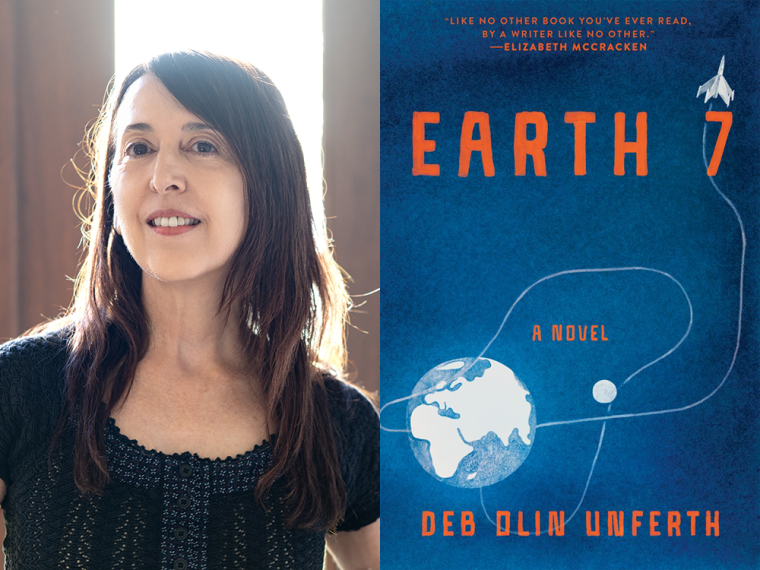
Deb Olin Unferth, author of Earth 7 (Credit: Nick Berard)
1. How long did it take you to write Earth 7?
I started it in 2020 [then] quit a few times. It didn’t start to come together until 2023, and then it came quickly and took about eighteen months. Then I revised it with my agent and editor for another few months. So, six years or eighteen months.
2. What was the most challenging thing about writing the book?
The first forty pages. I rewrote the first few chapters over and over from different perspectives and in different styles. In the end I was happy with how they turned out, but it was rough getting there. I always struggle with the opening pages, getting the characters in place, the voice and situation on the page. Some writers struggle with endings. I am at my most confident writing the ending; it’s always the beginning that kills me.
3. Where, when, and how often do you write?
When I’m writing, I write every day first thing in the morning. I used to write every single day without fail, even at my busiest times of year. Now I take long breaks and then write more ferociously in the period of writing.
4. What are you reading right now?
I just finished Avigayl Sharp’s Offseason (Astra House, 2026), which is fantastic. I recently read A Mother in History (Farrar, Straus and Giroux, 1966) by Jean Stafford. It may be one of my favorite books of all time now. I reread The Beautiful Struggle (Spiegel & Grau, 2008) by Ta-Nehisi Coates last month. It’s such an amazing, brilliant book, a quest, really. I also can’t stop talking about Afternoon Hours of a Hermit (Ecco, 2026) by Patrick Cottrell. Also Mudlark (Ballantine) by Mary Helen Specht is coming out in July and I read it recently. [It’s] a rock-and-roll feminist apocalyptic adventure—highly recommended, so good.
5. What is the earliest memory that you associate with the book?
I have a photo cut out of a newspaper and taped to my wall. It’s of a man in swim trunks in deep blue water staring out at me. I can’t look at it and not wonder what he’s staring at and [then] realiz[e] it’s me. The book maybe began there, but quickly a million other images roared in, most having to do with the various technological band-aids we are inventing to try to keep our civilization going in the face of climate change.
6. What, if anything, will you miss about working on the book?
The research; it was so mind-opening to think about sand and light waves and tardigrades and the history of the earth and beginning of the universe. I learned things about the Big Bang I hadn’t known, I learned about microscopic life and about the movement of dunes across the planet. I learned about where we are today, the damage solar panels are doing, about carbon technologies, fracking.
7. What is the biggest impediment to your writing life?
My nonwriting life! But I don’t think of it like that anymore. There was a time when I would have called my nonwriting life an impediment, but these days I see it more like I need to be a whole person, I need balance. I need my friends and family and husband and students, and I love to be in places I’ve never been. I need animals.
8. If you could go back in time and talk to the earlier you, before you started Earth 7, what would you say?
I don’t know if anything I could have said would have been helpful. I needed to follow the path I took. Maybe that’s what I would say: Follow the path.
9. Outside of writing, what other forms of work were essential to the creation of Earth 7?
Running, walking, reading books about sand and the Arctic, traveling vast distances to look at sand and ice, having deep conversations with my friend Lucy Corin, and watching complicated movies.
10. What’s the best piece of writing advice you’ve ever heard?
When I was writing my first novel, I was struggling with the transition from writing short stories to writing a novel. Sam Lipsyte said to me, “Approach the novel with the same daring and disregard for the norm as you do your stories.” I asked him to write it on a napkin for me and he did and I kept it on my desk for years.