This week’s installment of Ten Questions features Paul Yoon, whose novel Etna is out today from Scribner. Etna is just another shepherd mix living on a coastal farm when, one day, a woman named Soojin enlists him to come fight in their unnamed country’s war. Years later, after his country emerges ravaged but victorious, he sets out on a journey back to the place he called home as a puppy. “I just want to go back,” he says. “To see and to smell the place where I was born and used to live. To fall asleep and wake up where I was born and used to live. To remember there was a place before all this where I used to live. To remember there was a place where there were days that passed into other days peacefully.” But journeying back proves no easy feat. As he makes his way across his war-torn country, dodging danger left and right, Etna is forced to think about what it would even mean to find or to be at home. In a starred review, Publishers Weekly writes that Yoon “offers subtle and resonant insights on the nature of faith, which might not always provide salvation but can be enough to keep people (and dogs) going.” And Kirkus Reviews called Etna “spare, lyrical, often moving.” Paul Yoon is the author of five previous works of fiction, most recently The Hive and the Honey (Scribner, 2024), which won the Twentieth Annual Story Prize and was longlisted for the Joyce Carol Oates Prize. He has received a Guggenheim Fellowship and an Award in Literature from the American Academy of Arts and Letters, and his stories have appeared in the New Yorker, the Atlantic, Harper’s, and The Best American Short Stories. He lives in the Hudson Valley, New York, with his wife and dog.
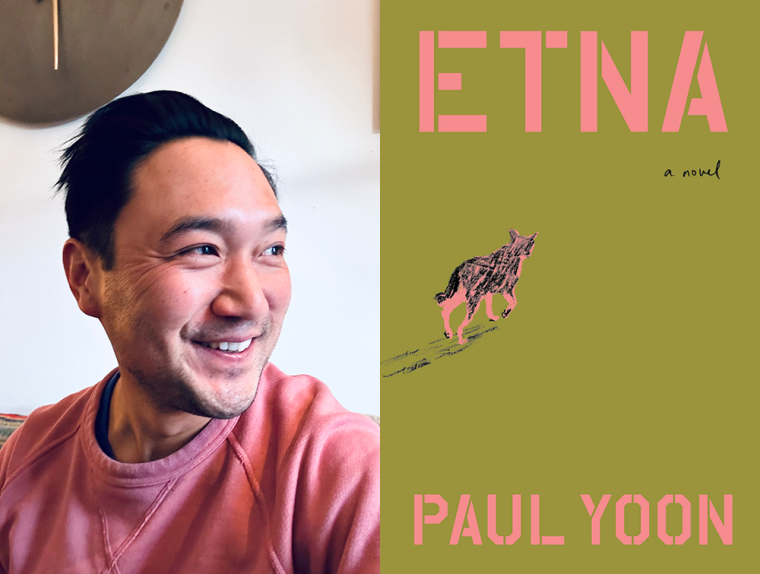
Paul Yoon, author of Etna. (Credit: Paul Yoon)
1. How long did it take you to write Etna?
Maybe two years? It’s hard to say because for the past few years, I’ve been writing a lot in my head before I actually sit down to write.
2. What was the most challenging thing about writing the book?
The most challenging thing was building and creating sentences that not only captured “dog,” but also created a bridge for the reader to experience this world.
3. Where, when, and how often do you write?
I don’t write often, and I don’t write every day, but if I do, it’s late in the afternoon, with the laptop on the couch [and] my dog also on the couch beside me, taking a nap.
4. What are you reading right now?
I’m catching up on my Fitzcarraldo Editions and NYRB Classics. I just finished One Boat (Fitzcarraldo Editions, 2025) by Jonathan Buckley, and I’m reading The Lord (NYRB Classics, 2025) by Soraya Antonius. Both are absolutely amazing.
5. Which author, in your opinion, deserves wider recognition?
I dream of a world where everyone has in their hands the works of Anuk Arudpragasam and Nadeem Aslam.
6. What is the biggest impediment to your writing life?
Life.
7. What is the earliest memory that you associate with the book?
This was a decade ago, and not directly related to the book, but I do think some seed was planted the first time my dog slept beside me in my bed—my hand on his side, feeling the rise and fall of his chest as he slept and I fell asleep.
8. If you could go back in time and talk to the earlier you, before you started Etna, what would you say?
You are scared to write this book, but you will write it.
9. Outside of writing, what other forms of work were essential to the creation of Etna?
Spending time at museums; walking my dog; running; lifting weights.
10. What’s the best piece of writing advice you’ve ever heard?
Amy Hempel once told me that if I’m ever stuck on something, look back at what I’ve written and find another way forward. I love that, and I love her.