This week’s installment of Ten Questions features Drew Buxton, whose debut novel, Daytona Teddy Riggs, is out today from Hub City Press. When readers first meet him, protagonist Teddy Riggs sure seems like he’s down on his luck. It’s 1996 and the 24-year-old former high school football star—otherwise known as “Daytona”—has been cut off from his trust fund and is living with his Granny in Corpus Christi, Texas, getting banned from the gyms in town and terrorizing people at his old high school. But make no mistake: Teddy has his sights set on an epic next act. When he’s not listening to self-help guru Pat Dupree on tape or housing a dozen scrambled eggs in one go, he’s pumping iron relentlessly to prepare for the World’s Strongest Man competition, a contest he is fiercely determined to win, consequences be damned. “One of my goals used to be to find the girl of my dreams, but now I know that’s just an excuse to waste time,” Teddy explains early in the book. “It’s self-sabotage. If I was with someone, my training would suffer, and that would be an excuse not to win.” So when he meets a female bodybuilder named Tammy, things don’t exactly go according to plan. “Buxton gets readers to root for [Teddy] even as the novel skewers the excesses of hypermasculine gym culture,” Publishers Weekly wrote in a starred review. And in another starred write-up, Kirkus Reviews called Daytona Teddy Riggs “part satire, part wake-up call, and all openhearted perspective.” Drew Buxton is a writer from Texas. His short story collection So Much Heart (With an X, 2023) won the 2024 Sergio Troncoso Award for First Book of Fiction. His work has been featured in Southwest Review, Joyland, the Drift, Vice, and elsewhere.
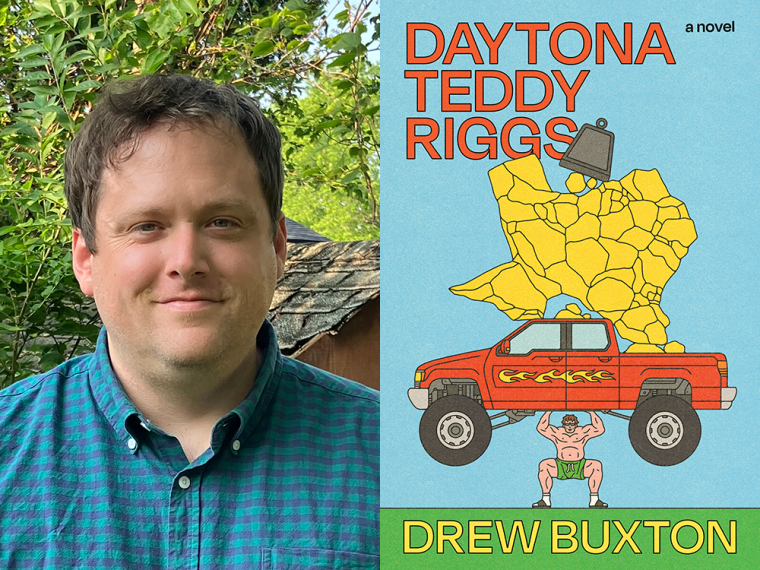
Drew Buxton, author of Daytona Teddy Riggs. (Credit: Claire Christoff)
1. How long did it take you to write Daytona Teddy Riggs?
About a year altogether. I wrote the first draft in about six months and spent the next six months revising it.
2. What was the most challenging thing about writing the book?
This is my first novel, so I had to have blind faith that it would amount to something, that I wasn’t wasting my time. Coming from writing short fiction, it’s a little tough to be working on something and not have the end in sight.
3. Where, when, and how often do you write?
I am working on a new novel, and I write every day in the morning with coffee. I try to hit five hundred words per day. It’s not a lot, but I just have to keep the momentum going. I write at home in my office, sitting on a recliner with my laptop in my lap.
4. What are you reading right now?
I’m having a blast right now reading Charles Portis. I’m nearly finished with Dog of the South (Knopf, 1979) and I plan on reading True Grit (Simon & Schuster, 1968) next. He might be the funniest writer ever.
5. What, if anything, will you miss most about working on the book?
Not a lot, to be honest. It feels great to be done, but as I was writing it, I started to see Teddy as a real person that I was hanging out with. I enjoy ridiculous people and have known many in my lifetime. Teddy is a card!
6. What is the earliest memory that you associate with the book?
I’m not sure how the idea came about, but I wrote a flash piece for Apocalypse Confidential about an adult sneaking into a middle school team’s practice and dominating them. I liked the voice, and I thought more about what kind of person would do something like that. I wanted to stay with him longer and follow him home. That’s how Teddy started.
7. What is one thing that surprised you during the writing of Daytona Teddy Riggs?
Maybe how easily one thing led to the next. I could just feel when a training scene was needed, when comedy was needed. I rarely felt stuck.
8. If you could go back in time and talk to the earlier you, before you started Daytona Teddy Riggs, what would you say?
Just reminding myself it can’t be written all at once. Just be consistent and show up every day, and it’ll get done eventually. I’ll get excited about an idea and get manic about it. I’ll feel a sense of urgency, like it has to be done immediately. I can do that with short fiction, go on a several days’ writing binge, but with a novel I have to be more measured and patient.
9. Outside of writing, what other forms of work were essential to the creation of Daytona Teddy Riggs?
I’ve done a good amount of weightlifting, so I have a decent understanding of that world. I got really into the strongman stuff. I watched a ton of the old competitions. I even tried to do some of that kind of lifting, but it didn’t go so well. The truth is I’m no strongman.
10. What’s the best piece of writing advice you’ve ever heard?
My first creative writing professor told us to write every day. It’s not sexy, and I ignored it for the longest time, but it goes back to what I said earlier. Especially when writing a novel, it’s so much more efficient to keep it fresh in your mind. You don’t waste time getting reoriented to where you are in the story. I like to leave save a little for the next day, too, so I can jump right back into it.