This week’s installment of Ten Questions features Paisley Rekdal, whose poetry collection Heritance is out today from Copper Canyon Press. “[L]ike all daughters, I / have spent a life / looking for which mother is mine,” Rekdal writes in one of the book’s early poems. Across Heritance, she revisits memories of her past and the people who populated it, all set against the landscape of the American West and the knotted history of racialized violence therein. But these verses are very much in the present tense, a testament to the way that our families and histories live within us, for better and for worse. “This is the inheritance from which I trace out / all my origins,” Rekdal reflects, “father to father, / back to the beginnings of fatherhood itself.” Rebecca Morgan Frank praised the poems of Heritance for “morphing and moving with the mind in fearless acts of investigation of difficult subjects, mining liminal spaces.” And Craig Morgan Teicher added that Rekdal “has always been a breathtakingly ambitious poet...excavat[ing] an American shame that has yet to be reckoned with.” Paisley Rekdal is the author of five books of nonfiction and seven collections of poetry, including Nightingale (Copper Canyon Press, 2019) and West: A Translation (Copper Canyon Press, 2023), which was longlisted for the 2023 National Book Award in Poetry. She has received a Guggenheim Fellowship, a Fulbright Fellowship, a National Endowment for the Arts Fellowship, Pushcart Prizes in 2009 and 2013, and more. She is a distinguished professor at the University of Utah, where she teaches in the creative writing program and directs the American West Center. She currently serves as poetry editor for High Country News and as co-chair of PEN America’s Utah Chapter.
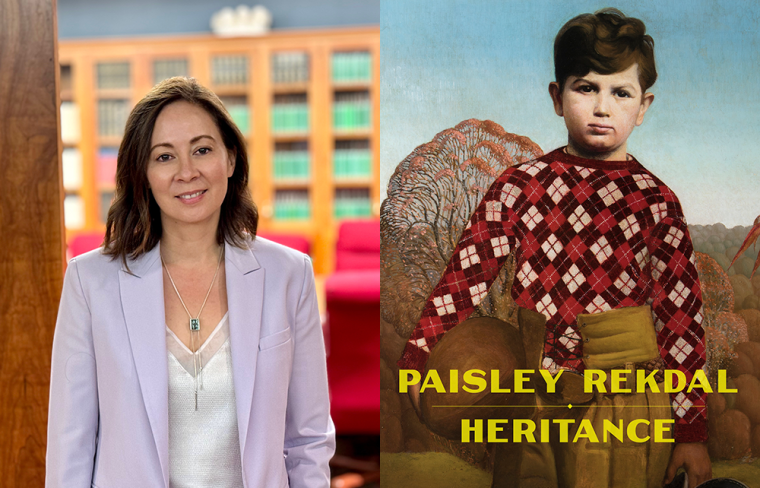
Paisley Rekdal, author of Heritance. (Credit: Simmons Buntin)
1. How long did it take you to write Heritance?
The book came shockingly quickly: [Writing it took] about three years. But considering I’d spent six years writing documentary poems about other people’s lives and in other people’s language for West: A Translation, I think it was probably a release to write as myself again.
2. What was the most challenging thing about writing the book?
Getting so personal about myself and my family, including some of its secrets. I used to joke that this is the book you write when the main players in it are dead, but then my father died. Then the difficulty became telling the truth as lovingly and as fairly as possible.
3. Where, when, and how often do you write?
I used to write for an hour each day, but now that work and family caregiving duties have become more intense, I write anytime I can steal a moment. I’ve even written during faculty meetings, which—I must say—makes the time pass more quickly.
4. What are you reading right now?
I’m reading a number of books simultaneously. First is War and Peace (Oxford University Press, 1922) [translated by Louise and Aylmer Maude] because I’m following a “Mop-Up Reading Year” program I’ve created to tackle all those books I didn’t read in college. Second is Double Exposure: Resurveying the West With Timothy O’Sullivan, America’s Most Mysterious War Photographer (Farrar, Straus and Giroux, 2024) by Robert Sullivan, which I’m rereading as research for a long poem about (among other things) violence and the nineteenth century photographic surveys of the American West. Third is Wago Ryoichi’s heartbreaking book of poems, Since Fukushima (Vagabond Press, 2023), and the fourth is a terrible romantasy novel (that shall go unnamed) because life is so stressful I have to take an occasional break.
5. Would you recommend writers pursue an MFA?
Why not! If they pay you to attend and they have a good library and good teachers, it’s an investment in your writing.
6. What is the biggest impediment to your writing life?
My life. The last couple of years I’ve been the caregiver for my parents while also working full-time as a teacher and the director of the American West Center. I’m glad I’m a poet since otherwise I wouldn’t write at all. That said, I wish I wrote shorter poems.
7. What was your strategy for organizing the poems in this collection?
Honestly, I couldn’t come up with one. I changed my mind constantly. I settled on the organization only after reading them aloud against each other at random: Whatever felt like a fit got grouped together.
8. If you could go back in time and talk to the earlier you, before you started Heritance, what would you say?
The same thing I say now: Write all the truth of your life that you can. So few people read poetry that the stakes of honesty are blessedly low.
9. Outside of writing, what other forms of work were essential to the creation of Heritance?
[Engaging with] oral histories and archives. The center I direct has produced an enormous archive that includes many wonderful, but also some problematic, documents. What does it mean to represent and protect a collection like that? What does it mean to be part of an institution whose values are increasingly not your own? It’s not unlike the questions you ask yourself about your own family over time.
10. What’s the best piece of writing advice you’ve ever heard?
Stay curious. No one else does.