

Genre: Poetry

Lilly Fellowships to Nearly Double Next Year

Emerging poets got some good news yesterday: The Ruth Lilly Fellowships, given annually by the Poetry Foundation to five poets, ages thirty-one and younger, will nearly double in value next year thanks to a $1.2 million gift from the Dorothy Sargent Rosenberg Memorial Fund.

The new endowment, announced yesterday, will be put directly toward the fellowship prizes, which currently offer $15,000 to each recipient. The awards, the first round of which will be given next year, will also bear a new name: the Ruth Lilly and Dorothy Sargent Rosenberg Fellowships.

The Dorothy Sargent Rosenberg Memorial Fund, which gives a host of monetary awards to young poets each year—including the annual Dorothy Prizes, whose next deadline is October 5—is named in honor of poet Dorothy Sargent Fraser and her husband, Marvin Rosenberg, who met during the Depression while studying at the University of California in Berkeley. Fraser wrote and published poems under the name Dorothy Sargent; Rosenberg, a Shakespeare scholar, bequeathed his estate as a memorial to his late wife “as a means of giving a financial lift to deserving young poets.”

In Tuesday’s announcement, fund administrators Mary and Barr Rosenberg wrote on the Memorial Fund website that while they’ve been able to administer the prizes themselves the past nine years, “now it is time for the balance of Marvin’s bequest to be deployed in a long lasting way for the benefit of promising young poets….We are delighted to make this gift on Marvin’s behalf to the Poetry Foundation, so that the funds can continue to be entirely dedicated to the poets themselves. This is exactly what Marvin would have wished to bring about in Dorothy’s memory.”

The pair—Rosenberg’s son and second wife—is also hoping to find new administration for the Dorothy Prizes. Interested individuals and organizations are invited to contact Mary Rosenberg at marvinr@berkeley.edu.

For more information on the Ruth Lilly Fellowships, and to keep an eye out for submissions guidelines for the new prize, visit the Poetry Foundation website.


Flowers of Evil

6.25.13

On June 25, 1857, French poet Charles Baudelaire published his book Les Fleurs du Mal (Flowers of Evil), which led to his conviction on charges of blasphemy and obscenity. Here's a sample: "Huddled, teeming, like gut-worms by the million, a clutch of Demons make whoopee in our brain and, when we breath, Death floods our lungs, an invisible torrent, muffled in groans." Get good and dark: Read a bit from Flowers of Evil then write a short poem. Unleash the gut-worms!

Eileen Myles and Sheila Heti to Judge Montreal’s Lit Pop Awards

The Montreal–based Matrix Magazine and POP Montreal International Music Festival have teamed up to create the Lit Pop Awards—an annual literary competition for poets and fiction writers whose work “exemplifies a spirit of innovation and verve with rockstar attitude.”

Two winners will each receive a round-trip ticket and VIP pass to the POP Montreal Festival (September 25–29), accommodation at a bed and breakfast, fall publication in Matrix Magazine, a one-hundred-dollar honorarium, and a presentation at a Matrix Lit POP event during the festival. The deadline for entry is June 30. 


Eileen Myles
, whose most recent collection is Snowflake/different streets (Wave Books, 2012), will judge in poetry; Sheila Heti, whose most recent novel is How Should a Person Be? (Holt, 2012), will judge in fiction.

The contest is open to residents of the United States and Canada. Poets may submit up to five poems and fiction writers may submit stories of up to 3,000 words with a $25 entry fee. Entries may submitted via Submittable, by e-mail at litpop2013@gmail.com, or by postal mail to Matrix Publications, 1400 de Maisonneuve Blvd W., LB 658, Montreal QC, H3G 1M8. Visit the website for complete submission guidelines and payment options.

Founded in Lennoxville, Ontario, in 1975, Matrix Magazine has been published as part of the creative writing program at Concordia University in Montreal since 1994. The POP Montreal Festival, held annually since 2002, is a festival of music, visual art, and literature that “champions independence in the arts by presenting emerging and celebrated artistic talents from around the world.”

How's the Weather?

6.18.13

"I know Midwesterners are accused of talking too much about the weather, but that criticism must surely come from people who don't have weather like ours," novelist David Rhodes once wrote to his editor at Milkweed Editions, Ben Barnhart. "These last few weeks have been filled with the bright, indolent humidity of summer, offset by sudden, tyrannical darkness and booming threats of supernatural violence. Not mentioning such revolutionary experiences would be inhuman." Go Midwestern and write a poem about today's weather. And if you're interested, read "After the Flood: A Profile of David Rhodes," from the September/October 2008 issue of Poets & Writers Magazine.

Larry Colker on Expanding a Writer's Consciousness

P&W–supported Larry Colker blogs about the triumphs and struggles of poetry workshops. He has cohosted the weekly Redondo Poets reading series for about fifteen years. In 2006 he won the California Writers Exchange Award, sponsored by Poets & Writers, Inc. His first book-length collection, Amnesia and Wings, was published by Tebot Bach in May 2013. By day Larry develops and delivers systems training for Kaiser Permanente. He lives in Burbank, California.

Billy Collins’s poem “Workshop” is a send-up of certain kinds of feedback and poems typically encountered in poetry workshops. As a veteran of dozens of workshops with many different leaders, and as the leader of a few, I both laugh at the parody and cringe for the targeted workshop attendees (myself among them). But I believe Collins is also implicitly implicating workshop leaders, who, after all, set the example.
Why—and when—take a poem to a workshop? How to participate most effectively? How to lead a productive workshop? I have a few opinions to offer in this small space. Take them with as much salt as you wish.

Everyone assumes your poem is a draft. If you think a poem is finished and you just want acknowledgment of how good and finished it is and will be indignant at suggestions for changes (this is not unheard of), don't take it to a workshop. Likewise, don't bring it in if you honestly (secretly) think no else can appreciate your work! There's nothing wrong with having your own standards. But don't expect that others will relish being viewed as nincompoops.

The best participants (and leaders) ask themselves first: What can you tell about what the writer is trying to do from the piece itself? What strategies have been used and what choices have been made? Then: What is successful and what detracts? It is not unusual in regular workshops for poets to bring several reworkings of a poem back to the group. Familiarity with earlier versions is not necessarily useful. In the end the poem must work for readers who know nothing of its evolution. (However, those who have seen the difficult birth process of a marvelous poem do have a special kind of “midwife's” regard for the final product.)

Over time, one learns how to “do” a workshop as a participant. One picks up the etiquette. In most workshops that use the Iowa Writers' Workshop model, the author may not speak until discussion by the other participants and the leader is done—and the discussion is not directed toward the author. The author may ask questions after the discussion—about alternatives, for example—but explaining (defending) the poem is considered bad form. Take the feedback to your own counsel, where you can call certain comments misguided or idiotic, if you wish.

Leading a workshop is not a native skill either. And different experienced leaders settle on different approaches. But one of the most useful (and hard-earned) skills is referring to (or reading, or quoting) other poems that either illustrate a point of craft, or provide an example of a particular “maneuver,” or expand the writer's view of how a subject could be treated. I think that this both strengthens one's consciousness of belonging to a truly remarkable community and, frankly, raises humble awareness that one is not uniquely endowed in solving artistic problems in writing. But the satisfaction of solving those problems on my own terms—as the song says, “they can't take that away from me.”

Photo: Larry Colker. Credit: Fred Turko.
Major support for Readings/Workshops in California is provided by The James Irvine Foundation. Additional support comes from the Friends of Poets & Writers.

Griffin Poetry Prize Winners Announced

Last night in Toronto, the 2013 Griffin Poetry Prizes were given for the collections Like a Straw Bird It Follows Me (Yale University Press), written by Palestinian poet Ghassan Zaqtan and translated from the Arabic by Fady Joudah, and What's the Score (Mansfield Press) by Canadian poet David W. McFadden. Each winner received $65,000

The finalists, who each gave a reading along with the winners, were Jennifer Maiden for Liquid Nitrogen (Giramondo Publishing), James Pollock for Sailing to Babylon (Able Muse Press) Alan Shapiro for Night of the Republic (Houghton Mifflin Harcourt), Brenda Shaughnessy forOur Andromeda (Copper Canyon Press), and Ian Williams for Personals (Freehand Books).

Founded in 2000, the Griffin Poetry Prize is given annually for books of poetry written in or translated into English and published anywhere in the world. One prize is given to a living Canadian poet or translator; a second is given to a living poet or translator from any country.

This year’s judges were Suzanne Buffam of Canada, Mark Doty of the United States, and Wang Ping of China. Each read 509 books of poetry, which were submitted from forty countries, and included fifteen translations. The trustees of the Toronto–based Griffin Trust For Excellence In Poetry, which administers the prize select the judges annually.

Scott Griffin and trustees Margaret Atwood, Robert Hass, Michael Ondaatje, and David Young hosted the event. Trustee Carolyn Forché presented each shortlisted poet with a leather-bound edition of their book and a $10,000 honorarium.

For the 2014 prizes, publishers may submit books published between January 1 and December 31, 2013. Only publishers can submit books for consideration; self-published titles are not eligible. The deadline for submissions is December 31. Visit the website for complete submission guidelines.

Cincinnati Review Contest Open for Submissions

The Cincinnati Review is currently accepting entries for its 2013 Robert and Adele Schiff Awards in Poetry and Prose. Two winners will each receive one thousand dollars and publication in the Cincinnati Review.

Using the online submission manager, poets, fiction writers, and creative nonfiction writers may submit up to eight pages of poetry or up to forty pages of prose with a twenty-dollar entry fee, which includes a year-long subscription to the magazine, by July 15. Simultaneous submissions are welcome, and all entries are considered for publication. 

Winners will be announced October 1, and the winning work will be published in the Summer 2014 issue of the magazine. Visit the website for complete guidelines.

Established in 2003 and published twice yearly at the University of Cincinnati, the Cincinnati Review is a print journal that publishes both emerging and established writers. General submissions of poetry, fiction, creative nonfiction, translation, and visual art are accepted online and by mail between August 15 and April 15 annually.

Story of a Street Poet

Caption: 

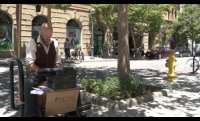
"Human beings are always going to want to create beautiful things. Language is one medium in which to do that. You can do it with paint, you can do it with clay, you can do it with words. It's all coming from the same fountain," says Kevin Devaney, a street poet in Santa Cruz, California.

Genre: 

Taming the Unruly

6.11.13

In a profile of Natasha Trethewey in the September/October 2012 issue of Poets & Writers Magazine, contributing editor Kevin Nance quotes the poet laureate (who was elected to a second term on Monday) about her use of poetic form. "I never set out to write in a particular form, but usually something in the early drafting process suggests to me the possibility of a form I might follow that might help take the poem in a better direction than I might have sent it without following that impulse,” Trethewey says. “I find that it helps me with poems that have seemed unruly for some reason—maybe the story is too big, or the emotion of it is overwhelming for me, and the form helps bring shape to it." Choose a poem that has been giving you trouble—an unruly poem of your own—and try to rewrite it as a sonnet, a villanelle, a pantoum, or another form. (Consult the Academy of American Poets website for help with poetic forms.)

Pages

Subscribe to Poetry