Cati Porter is a poet, editor, and community arts facilitator. She is the author of Seven Floors Up (Mayapple Press, 2008), as well as several chapbooks, most recently The Way Things Move The Dark (dancing girl press, 2013). Her work is included in the anthologies Women Write Resistance, White Ink, Letters to the World, and Bedside Guide to No Tell Motel–Second Floor. The recipient of poetry awards from So To Speak: A Feminist Journal of Language and Art, Crab Creek Review, and Gravity & Light, she is founder and editor of the online journals Poemeleon: A Journal of Poetry and Inlandia: A Literary Journey. She is executive director of the Inlandia Institute. For many years, P&W has supported Porter's events as both a poet and presenter.
 What makes your organization and its programs unique?
Based in Riverside, California, and beginning in partnership with the City of Riverside and Heyday Books, the Inlandia Institute as a regionally focused independent literary nonprofit is unique. Of course, we do everything that you might expect: We publish books, host author events and book signings, and offer writing workshops and other related programs. What it is that sets us apart is our dedication to Inland Southern California, defined as much by the people as by the geography, and the broad range of programs that we offer.
In addition to literature and literacy, we also take on cultural and environmental projects that are of significance to our region. One example of this is Women Making Waves. This project recorded the oral histories of women activists who were integral to the preservation of our region’s open spaces, like Sycamore Canyon Park and Santa Rosa Plateau. The project was later integrated into our website as an interactive permanent exhibit and resource. Another is an upcoming publication of memoirs centered around the burning of Lowell School and the subsequent desegregation of the Riverside Unified School District, the first large school district to voluntarily do so, and which will include interviews with former Lowell students, community leaders, and others who had insight into that tumultuous period.
What recent project and/or program have you been especially proud of and why?
We’re proud of all of our programs and projects, but we were thrilled this past fall when Inlandia had the opportunity to partner with Poets & Writers to present Sal y Muerte, a day-long workshop and reading project held at the Salton Sea—such a heartbreakingly beautiful and desolate location, but completely ripe for creating art. The project included workshops in poetry and prose with Sandra Alcosser, Brandon Cesmat, and desert natives and inveterate Inlandians Maureen Alsop and Ruth Nolan. The workshops culminated in a reading by campfire accompanied by Cesmat’s guitar. This is the sort of workshop that embodies what Inlandia is all about—bringing people together where language and landscape intersect.
And I would be remiss to not mention that we are also extremely proud of our new Inlandia Literary Journeys project, in partnership with the Riverside Press–Enterprise. ILJ includes a weekly literary column, video interview series, and affiliated blog.
How has literary presenting informed your own writing and/or life?
The first literary event I ever hosted—eight years ago, back in 2006—I was petrified. Above all, I am a writer, and I have an affinity for hiding behind a monitor or a book. But now, through the Inlandia Institute, I host events on average of once per week, so while I do still get butterflies, it has become much easier. I admit that I began presenting literary events out of the largely selfish motivation of wanting to attend more readings closer to home. It has enriched my own sense of what is possible, both in literature and life.
What do you consider to be the value of literary programs for your community?
I have watched as the Inlandia Institute has built a solid community of creative thinkers, writers, and readers, rising up out of common interests—in this case, language, self-expression, and an appreciation for this place that we call home. In the last few years, other groups have risen up here too—I'm thinking specifically of PoetrIE and the Wild Lemon Project, whose missions are similar to our own. Organizations like these and the cadre of literary-minded folks that run them are what help to forge this region’s literary identity and put it on the map, so to speak. Literary programs encourage engagement with our humanity and with other human beings, something as necessary as air, but not necessarily as easy to come by. The Inlandia Institute is helping to change that.
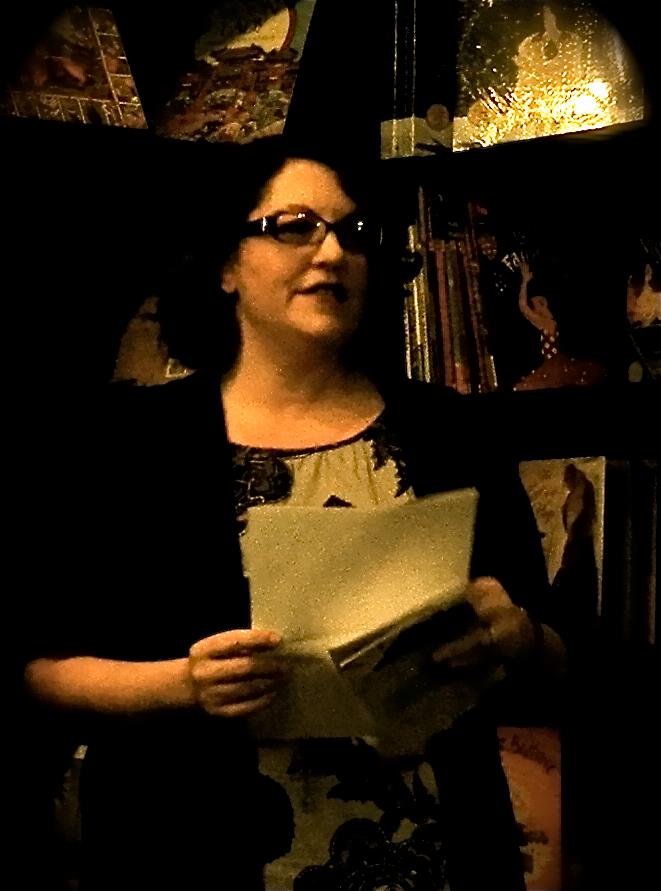
Photo: Cati Porter at an event at Cellar Door Books. Credit: Matt Nadelson.
Major support for Readings/Workshops in California is provided by the James Irvine Foundation. Additional support comes from the Friends of Poets & Writers.