Mary Karr on the Art of Memoir, T. S. Eliot's Love Life, and More
Blackstone Audio launches print imprint; the ethics of cultural appropriation in literature; Patti Smith’s new memoir; and other news.
Jump to navigation Skip to content
Blackstone Audio launches print imprint; the ethics of cultural appropriation in literature; Patti Smith’s new memoir; and other news.
October begins today. Pick a memory, moment, image, object, or idea that holds the essence of the month in your mind. Explore this entity from multiple angles: the visual, literal, historical, and metaphorical. Perhaps it is rooted in nature or childhood, in a color or flavor. Examine your associations with the month and how your perceptions have changed over the years.
The MacArthur Foundation announced today that poet Ellen Bryant Voigt, poet and novelist Ben Lerner, and journalist and nonfiction writer Ta-Nehisi Coates are among the recipients of 2015 MacArthur Fellowships. They will each receive $625,000 over the course of five years. The no-strings-attached fellowships, also known as “genius grants,” are awarded annually to “talented individuals who have shown extraordinary originality and dedication in their creative pursuits and a marked capacity for self-direction.”
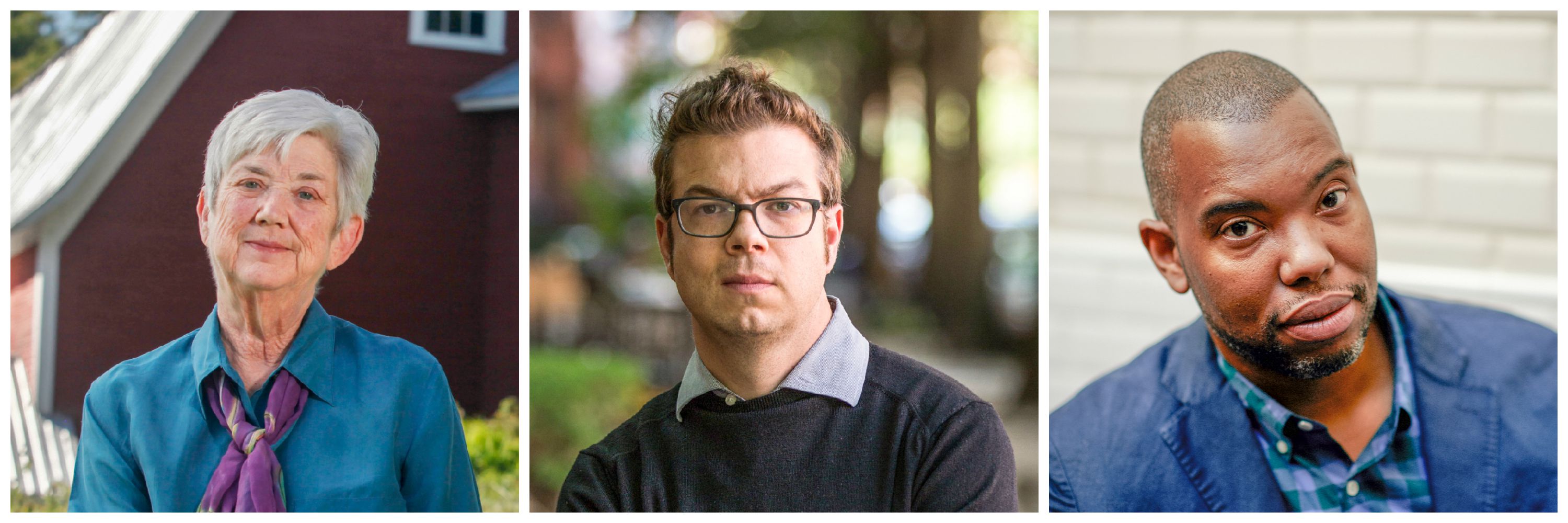
Ellen Bryant Voigt, 72, is the author of eight poetry collections, most recently Headwaters (Norton, 2013), and two books on the writer’s craft, most recently The Art of Syntax: Rhythm of Thought, Rhythm of Song (Graywolf Press, 2009). The MacArthur Foundation states that her poetry “meditates on will and fate and the life cycles of the natural world while exploring the expressive potential of both lyric and narrative elements…. A poet of sustained excellence and emotional depth, Voigt continues to advance American literary culture through her ongoing experimentation with form and technique.” Voigt also started the first low-residency MFA Program at Goddard College in 1976; the program later moved to Warren Wilson College in 1981. Voigt lives in Cabot, Vermont.
Ben Lerner, 36, is the author of two novels, most recently 10:04 (Faber & Faber, 2014), and three poetry collections, most recently Mean Free Path (Copper Canyon Press, 2010). Lerner has also published an art book with Thomas Demand, Blossom (Mack Books, 2015). The MacArthur Foundation says: “Bringing to the novel a poet’s relentless engagement with language and a critic’s analytical incisiveness, Lerner makes seamless shifts between fiction and nonfiction, prose and lyric verse, memoir and cultural criticism, conveying the way in which politics, art, and economics intertwine with everyday experience.” Lerner lives in New York City where he teaches at Brooklyn College.
Ta-Nehisi Coates, 39, is a national correspondent for the Atlantic, and the author of the memoir The Beautiful Struggle (Penguin, 2008), and the book-length essay Between the World and Me (Penguin, 2015), which was recently longlisted for the National Book Award in nonfiction. “A highly distinctive voice, Coates is emerging as a leading interpreter of American concerns to a new generation of media-savvy audiences and having a profound impact on the discussion of race and racism in this country,” states the MacArthur Foundation. Coates lives in Washington, D.C.
Established in 1970, the Chicago-based MacArthur Foundation has awarded over nine hundred fellowships since its inception, including the twenty-four awarded this year. The grants are given to professionals in a variety of fields, including science, history, visual art, music, journalism, literature, and public service. Recent literature recipients include graphic memoirist Alison Bechdel and poets Terrance Hayes and Khaled Mattawa in 2014; fiction writers Karen Russell and Donald Antrim in 2013; and fiction writers Junot Díaz and Dinaw Mengestu in 2012.
Photos from left to right: Voigt, Lerner, Coates (Credit: John D. & Catherine T. MacArthur Foundation)
"There are two kinds of writing: One is very passionate and impulsive, and it can be extremely emotional. Then the other writing is more cool and maybe classical and more carefully shaped.” Joyce Carol Oates, whose memoir The Lost Landscape was published this month by Ecco, describes the different states of mind that have inspired her work.
This week, think of a television commercial you saw recently, or one that you recall vividly from your childhood. Write an essay exploring why this particular advertisement is still stuck in your head. Did you covet the product being sold? Was there an actress or tagline that evoked a certain feeling or emotion? Does the commercial bring you back to a familiar time or place?
This week, the National Book Foundation announced the longlists for the 2015 National Book Awards. Annual awards of $10,000 each honor the best book of the year published in the United States in the categories of fiction, nonfiction, poetry, and young people’s literature. The shortlists will be announced on October 14, and the winners will be named during the foundation’s National Book Award Ceremony and Benefit Dinner in New York City on November 18.
The ten finalists in fiction are Jesse Ball, A Cure for Suicide (Pantheon Books); Karen E. Bender, Refund (Soft Skull); Bill Clegg, Did You Ever Have a Family (Scout Press); Angela Flournoy, The Turner House (Houghton Mifflin Harcourt); Lauren Groff, Fates and Furies (Riverhead); Adam Johnson, Fortune Smiles (Random House); T. Geronimo Johnson, Welcome to Braggsville (William Morrow); Edith Pearlman, Honeydew (Little, Brown); Hanya Yanagihara, A Little Life (Doubleday); and Nell Zink, Mislaid (Ecco).
Fiction judges Daniel Alarcón, Jeffery Renard Allen, Sarah Bagby, Laura Lippman, and David L. Ulin selected the titles from a list of 419 books.
The ten finalists in nonfiction are Cynthia Barnett, Rain (Crown Publishing Group); Ta-Nehisi Coates, Between the World and Me (Spiegel & Grau); Martha Hodes, Mourning Lincoln (Yale University Press); Sally Mann, Hold Still (Little, Brown); Sy Montgomery, The Soul of an Octopus (Atria); Susanna Moore, Paradise of the Pacific (Farrar, Straus and Giroux); Michael Paterniti, Love and Other Ways of Dying: Essays (The Dial Press); Carla Power, If the Oceans Were Ink: An Unlikely Friendship and a Journey to the Heart of the Quran (Henry Holt and Company); Tracy K. Smith, Ordinary Light (Alfred A. Knopf); and Michael White, Travels in Vermeer: A Memoir (Persea Books).
Diane Ackerman, Patricia Hill Collins, John D’Agata, Paul Holdengräber, and Adrienne Mayor judged.
The finalists in poetry are Ross Gay, Catalog of Unabashed Gratitude (University of Pittsburgh Press); Amy Gerstler, Scattered at Sea (Penguin); Marilyn Hacker, A Stranger’s Mirror (W. W. Norton & Company); Terrance Hayes, How to Be Drawn (Penguin); Jane Hirshfield, The Beauty (Alfred A. Knopf); Robin Coste Lewis, Voyage of the Sable Venus (Alfred A. Knopf); Ada Limón, Bright Dead Things (Milkweed Editions); Patrick Phillips, Elegy for a Broken Machine (Alfred A. Knopf); Rowan Ricardo Phillips, Heaven (Farrar, Straus and Giroux); and Lawrence Raab, Mistaking Each Other for Ghosts (Tupelo Press).
Poetry judges Sherman Alexie, Willie Perdomo, Katha Pollitt, Tim Seibles, and Jan Weissmiller selected the longlisted titles from 221 books.
First conferred to poet William Carlos Williams in 1950, the National Book Award is one of the country’s most prestigious prizes in literature. Other notable winners include Sherman Alexie, Jonathan Franzen, Joyce Carol Oates, and Adrienne Rich.
To learn more about the finalists and judges of this year’s awards, visit the National Book Foundation website. The foundation recently announced that author Don DeLillo will be honored with the 2015 Medal for Distinguished Contribution to American Letters during the awards ceremony on November 18.
This week, look to the name of your street for inspiration. Or if you prefer, choose the name of a previous street you lived on, or a particularly fascinating street name in your city or town. Is the street designated for a famous person, a defining local feature, or a natural landmark? Are there Dutch, Spanish, or Native American roots to the name? Write an essay about the street’s origin, and how the name might be fitting or outdated. Reflect on the ways you connect with where you live, and how your own history intertwines with the streets names that surround you.
This week, think back to your childhood, and the teachers who taught you through elementary and middle school. Choose one of your former teachers and write a list of his most distinctive characteristics—maybe a bizarre hairstyle, his old blue car, or a rumor you remember about him. Write an essay reflecting on what makes this teacher memorable and significant in your life, what you might say if you bumped into him today. Would either of you have any regrets to discuss?
Novels about the immigrant experience; Erica Jong and Roxane Gay’s feminism dispute; the best books about work; and other news.