Genre: Creative Nonfiction

PEN Announces Literary Award Winners

This morning, PEN American Center announced the winners of the 2015 PEN Literary Awards. The annual awards, which total more than $150,000, honor emerging and established writers in seventeen categories including poetry, debut fiction, science writing, translation, biography, and drama. On June 8, the winners will be honored in a ceremony at the New School in New York City. The shortlists and complete list of winners can be found on PEN’s website. Below are the winners for a select few prizes:
Saeed Jones won the $5,000 PEN/Joyce Osterweil Award for Poetry for his collection Prelude to Bruise (Coffee House). Marie Howe, Mary Szybist, and Craig Morgan Teicher judged. The biennial award recognizes the work of an emerging American poet who shows promise of further literary achievement.

Joshua Horwitz won the $10,000 PEN/E. O. Wilson Literary Science Writing Award for his book War of the Whales: A True Story (Simon & Schuster). Sue Halpern, Marie Myung-Ok Lee, and Carl Zimmer judged. The annual prize is given for a book of literary nonfiction on the subject of the physical or biological sciences published in the previous year.

Sheri Fink won the $10,000 PEN/John Kenneth Galbraith Award for Nonfiction for her book Five Days at Memorial: Life and Death in a Storm-Ravaged Hospital (Crown). Andrew Blechman, Paul Elie, Azadeh Moaveni, Rahna Reiko Rizzuto, and Paul Reyes judged. The biennial award is given to an author of a book of general nonfiction published in the previous two years that possesses notable literary merit and critical perspective.

Denise Newman won the $3,000 PEN Translation Prize for her translation from the Danish of Naja Heather Cleary’s book Baboon (Two Lines). Lucas Klein, Tess Lewis, and Allison Markin Powell judged. The annual award is given for a translation of book-length prose from any language into English published in the previous year.

PEN will announce the winners of the $25,000 Prize for Debut Fiction, the $10,000 Art of the Essay Award, and the $5,000 Open Book Award at the Literary Awards Ceremony on June 8. Visit the PEN website for the shortlists. The winner of the $10,000 PEN/Fusion Emerging Writers Prize and recipients of the $2,000-$4,000 PEN/Heim Translation Fund Grants will be announced later this month.

PEN American Center has administered its literary awards for nearly fifty years. Established in 1922, PEN works globally to defend freedom of expression and to promote international literature and culture.
Elizabeth Alexander

Caption: 

"I think that in writing, we do try to fix moments so that somehow they're captured." Elizabeth Alexander speaks with PBS NewsHour's Jeffrey Brown about the loss of her husband and her experiences in writing her new memoir, The Light of the World (Grand Central Publishing, 2015).

Bard

In Medieval Gaelic and British culture, bards were poets and musicians who were employed to commemorate the stories of their patrons. Imagine you are a bard, and you have been hired by a friend or family member to recant a particular tale of bravery, loyalty, or heroism. Perhaps your best friend just trained to run a marathon, or your brother got all A's on his finals. Then write your piece and regale your “patron” with it the next time you see him or her. Make your language dramatic and lyrical, and incorporate some meter or rhyme if you like. For examples, revisit Shakespeare's work, or read the lyrics of some of Bob Dylan's popular songs, like "Tangled Up In Blue." 

Deadline Approaches for Creative Nonfiction Contest

Submissions are currently open for the Creative Nonfiction Essay Contest. An annual award of $1,000 and publication in Creative Nonfiction is given for an essay on a specified theme. This year’s theme is “The Weather.” The runner-up will receive $500. Essays should “combine a strong and compelling narrative with an informative or reflective element, and reach beyond a strictly personal experience for some universal or deeper meaning.” The editors will judge. 

Using the online submission manager, submit a previously unpublished essay of up to 4,000 words along with a $20 entry fee—or $25 to receive a four-issue Creative Nonfiction subscription—by May 11. Submissions are also accepted via postal mail to Creative Nonfiction, Attn: WEATHER, 5501 Walnut Street, Suite 202, Pittsburgh, PA 15232. All entries are considered for publication. Visit the website for complete guidelines.

Founded in 1993 by Lee Gutkind, Creative Nonfiction was the first literary magazine to exclusively publish “high quality nonfiction prose,” and remains the largest literary publication in the genre. Past contributors include prize-winning authors Annie Dillard, Gordon Lish, Francine Prose, and C. K. Williams. For more information about the contest, e-mail information@creativenonfiction.org, or call (412) 688-0304.

Fourteen Years of Grassroots Gatherings on Staten Island

Beth Gorrie volunteers her time as Executive Director of Staten Island OutLOUD. She spearheads the organization’s program planning and has adapted over twenty-five global classics for OutLOUD’s spoken-word performances. As an actor during the first few years of her working life, she performed with the Chicago Theatre of the Deaf and served as an Adjunct Instructor at the University of Chicago. In New York City, she appeared in a variety of Off-Off Broadway productions and in a series of film installations by award-winning filmmaker William Lundberg, a recipient of the Guggenheim Fellowship. Gorrie attended Columbia University Law School where she was an editor of the Journal of Law & Social Problems, and spent a summer in rural India on a human rights fellowship. She is a former partner in a leading New York law firm and has participated in community service in Harlem.

What makes your programs unique?
Staten Island OutLOUD gathers neighbors to explore global literature together, and to share ideas. Our first event took place shortly after September 11, 2001 when we had a deep need to gather together.

Since then, Staten Island OutLOUD has grown and has continued that spirit with a varied series of grassroots gatherings. Throughout the year, we host free events to explore global literature, our diverse backgrounds, our history, and our mutual concerns. OutLOUD is entirely volunteer-driven.

We operate on a small budget, but we’re very productive. Since our establishment in September 2001, we’ve served over 23,000 participants with over six hundred free events, in twenty-one languages.

What recent project have you been especially proud of, and why?
From September 2014 through March 2015, Staten Island OutLOUD hosted a series of forty community events about Harper Lee’s novel To Kill a Mockingbird. When we started planning our series a year earlier, we never guessed how timely it would be, following the July 2014 death of Eric Garner, an African-American neighbor of ours who died in police custody.

Our “Mockingbird” series explored national and local civil rights history, together with music and poems from the Civil Rights Movement, and from the Depression years in which the novel is set.

Tensions ran high during the months after Garner’s death, but our series fostered thoughtful discussions. Staten Islanders talked, listened, and considered the many facets of the crisis.

What’s the most memorable thing that’s happened at an event you’ve hosted?
Adults with special needs sometimes attend Staten Island OutLOUD programs. At one event when we discussed a variety of twentieth-century poems, a woman with mental disabilities gathered her courage to comment on a poem by Dylan Thomas. She had never spoken in public before, and she knew that the audience included teachers, attorneys, and other professionals. Everyone encouraged her, and as she spoke, she began to hold herself more confidently, and her voice grew stronger. Everyone was moved when she read, “Do not go gentle into that good night.”

What are the benefits of writing workshops for special groups?
Staten Island OutLOUD’s work proves that when people have a forum and a stimulating entrée for conversation, they respond thoughtfully. Stereotypes can fade and real communication can begin. Our work with teens and with elders underscores the value of writing workshops for those members of our community. Our writing workshops have enabled people to find their unique voices. For teens who may have manifested behavior problems before they began our workshops, some of those problems began to ebb as they focused their energy on writing and as they gained confidence in their work. Elders who had never done any creative writing before participating in our memoir and poetry workshops have drawn real satisfaction in exploring their writing talent, in reflecting on their life experiences, and in recognizing how powerful their pens can be.

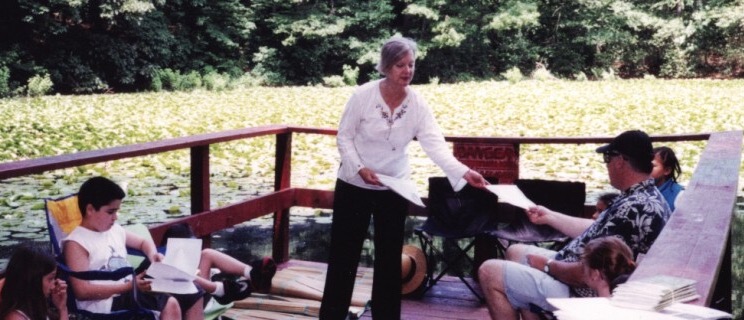
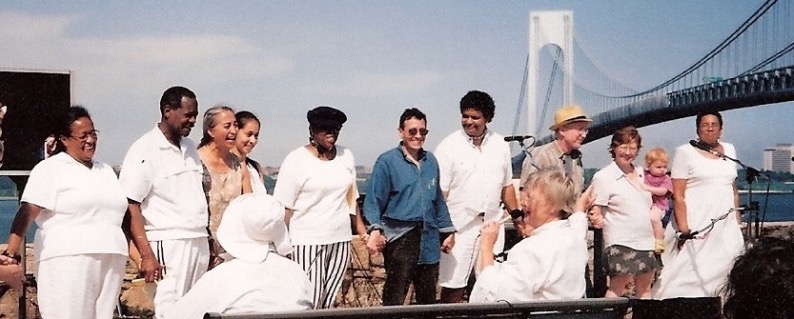
Photo: (top) Beth Gorrie at Huckleberry Finn at High Rock workshop. Photo: (bottom) Cast of Moby Dick marathon reading. Photo Credit: Staten Island OutLOUD.

Support for Readings & Workshops in New York City is provided, in part, by public funds from the New York State Council on the Arts, and the New York City Department of Cultural Affairs, with additional support from the Louis & Anne Abrons Foundation, the Axe-Houghton Foundation, the A.K. Starr Charitable Trust, and the Friends of Poets & Writers.

Old Photographs

4.30.15

When was the last time you looked through old pictures? This week, set aside some time to revisit photographs of yourself from the past. Pick one and write an essay from the point of view of your younger self. Try to recall what you were feeling in that moment. Have your feelings changed over the years?

Alters/Altars: A Writing Workshop at Little Tokyo Branch Public Library

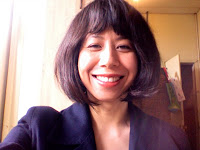
Alanna Lin Ramage is a writer, songwriter, and artist-in-residence at the Los Angeles Little Tokyo Branch Library, where she hosts innovative, community-building events and workshops at the Los Angeles Department of Writing and Power (LADWP!*). She has studied poetry with Thomas Sayers Ellis and poetics and performance theory with Jon Wagner and Mady Schutzman at California Institute of the Arts. Ramage composes original lyrics and music for film and television. This year sees the release of a cover album inspired by the Beatles in tandem with publishing her first collection of poems about monastery wildlife in Northern California.

Alanna Lin Ramage

A few years ago, in a fit by candlelight, I came up with a syllabus for a workshop called Alters/Altars. It was designed to help a person write and explore their way into an alter ego—the poetic self that feels its own voice and power while feeling all, but not revealing all.

In February of this year, thanks to support from Poets & Writers and the Little Tokyo Branch Public Library, I was able to teach a five-week version of the workshop in downtown Los Angeles.

One premise I was working with included the physical effect of writing as a physical act. For each class, participants would read their pieces aloud and receive positive feedback from the group. In some cases the reading would be formal, at the front of the room. On other days, I had readers stand in the middle of a group circle that echoed words or phrases as the story unfolded. One writer noticed that she read to a mostly quiet circle. She later commented that she realized she had to read "painfully slowly" to give listeners a chance to register her words more fully. She reread her piece to us and we happily listened to every word.

In another exercise, we gave alternate names to one another. The unspoken invitation was: “What name suits me in your opinion? What is my sonic incarnation? Do you really think it’s ‘Bubby?’”

The first workshop started with participants reading personal biographies or ads, and then writing fictional personal ads for someone other than themselves. The exercise allowed us to get to know each other while ascertaining each person’s unique writing style. Week two’s life stories were especially intense, offering glimpses into epic quests for love and destiny. Week three featured hypothetical after-life sequences from each person—revealing visions of beautiful, earthy, sublime, and often hilarious realities to come.

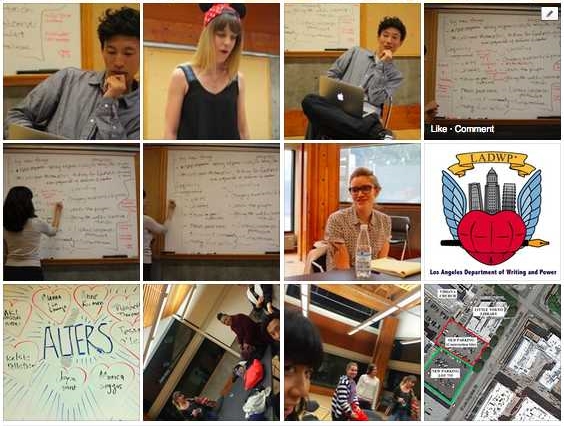
Alters/Alters Photo CollageWe had a dynamic, talented, and punctual group. It was a pleasure to discuss personal creative journeys, hear the mix of angst, frustration, wisdom, confidence, and steady determination that characterized each person. The group had great discussions about what makes a “healthy writer” versus what makes a “happy writer.”

My favorite session of the workshop included an assignment that asked participants to write about a sublime or transcendent moment. The results were diverse and fantastic. There was a great relationship-ending-epiphany story, an excellent dim-sum-as-travel-as-exploration-of-life story, a profound unity-with-wild-crustaceans story, and a stirring overcoming-self-while-overcoming-mountain story.

The session made me think about how creative anxiety can sometimes blind us to the larger themes we've experienced in life. It may keep us from sharing the stories we’ve already lived or from inventing stories that might express what we know.

So how do we move past this anxiety? Decide what themes are important to you based on your life experience. Once you have: Write on! (OK, that was a bad pun. I’m a workshop leader—it’s allowed.)

Writing alters you. Be brave and do the work; you just might tell a riveting story as you sacrifice your fears.

Photo 1: Alanna Lin Ramage; photo 2: Alters/Altars workshop. Credit: Alanna Lin Ramage and Anne Rieman.

Major support for Readings & Workshops in California is provided by the James Irvine Foundation. Additional support comes from the Friends of Poets & Writers.

Pages

Subscribe to Creative Nonfiction