Genre: Creative Nonfiction

Alters/Altars: A Writing Workshop at Little Tokyo Branch Public Library

Alanna Lin Ramage is a writer, songwriter, and artist-in-residence at the Los Angeles Little Tokyo Branch Library, where she hosts innovative, community-building events and workshops at the Los Angeles Department of Writing and Power (LADWP!*). She has studied poetry with Thomas Sayers Ellis and poetics and performance theory with Jon Wagner and Mady Schutzman at California Institute of the Arts. Ramage composes original lyrics and music for film and television. This year sees the release of a cover album inspired by the Beatles in tandem with publishing her first collection of poems about monastery wildlife in Northern California.

Alanna Lin Ramage

A few years ago, in a fit by candlelight, I came up with a syllabus for a workshop called Alters/Altars. It was designed to help a person write and explore their way into an alter ego—the poetic self that feels its own voice and power while feeling all, but not revealing all.

In February of this year, thanks to support from Poets & Writers and the Little Tokyo Branch Public Library, I was able to teach a five-week version of the workshop in downtown Los Angeles.

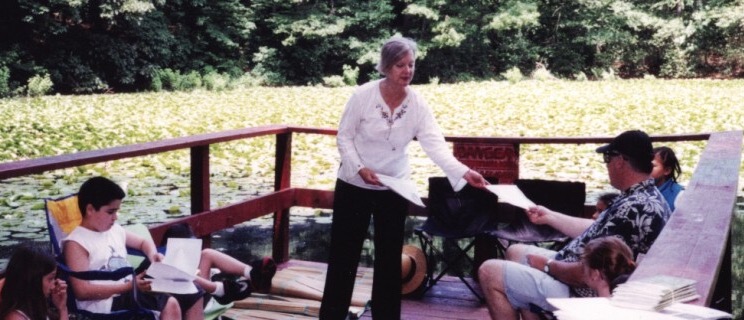
One premise I was working with included the physical effect of writing as a physical act. For each class, participants would read their pieces aloud and receive positive feedback from the group. In some cases the reading would be formal, at the front of the room. On other days, I had readers stand in the middle of a group circle that echoed words or phrases as the story unfolded. One writer noticed that she read to a mostly quiet circle. She later commented that she realized she had to read "painfully slowly" to give listeners a chance to register her words more fully. She reread her piece to us and we happily listened to every word.

In another exercise, we gave alternate names to one another. The unspoken invitation was: “What name suits me in your opinion? What is my sonic incarnation? Do you really think it’s ‘Bubby?’”

The first workshop started with participants reading personal biographies or ads, and then writing fictional personal ads for someone other than themselves. The exercise allowed us to get to know each other while ascertaining each person’s unique writing style. Week two’s life stories were especially intense, offering glimpses into epic quests for love and destiny. Week three featured hypothetical after-life sequences from each person—revealing visions of beautiful, earthy, sublime, and often hilarious realities to come.

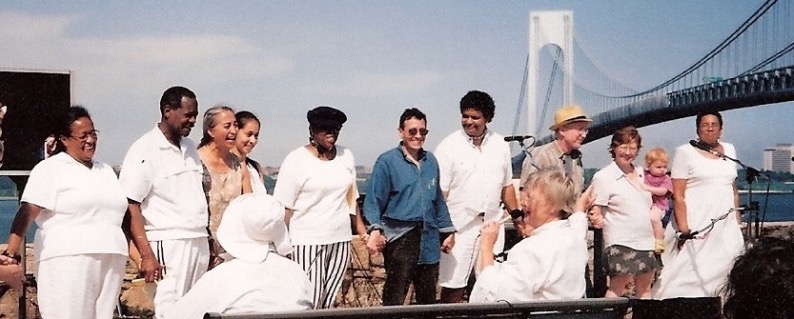
Alters/Alters Photo CollageWe had a dynamic, talented, and punctual group. It was a pleasure to discuss personal creative journeys, hear the mix of angst, frustration, wisdom, confidence, and steady determination that characterized each person. The group had great discussions about what makes a “healthy writer” versus what makes a “happy writer.”

My favorite session of the workshop included an assignment that asked participants to write about a sublime or transcendent moment. The results were diverse and fantastic. There was a great relationship-ending-epiphany story, an excellent dim-sum-as-travel-as-exploration-of-life story, a profound unity-with-wild-crustaceans story, and a stirring overcoming-self-while-overcoming-mountain story.

The session made me think about how creative anxiety can sometimes blind us to the larger themes we've experienced in life. It may keep us from sharing the stories we’ve already lived or from inventing stories that might express what we know.

So how do we move past this anxiety? Decide what themes are important to you based on your life experience. Once you have: Write on! (OK, that was a bad pun. I’m a workshop leader—it’s allowed.)

Writing alters you. Be brave and do the work; you just might tell a riveting story as you sacrifice your fears.

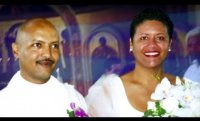
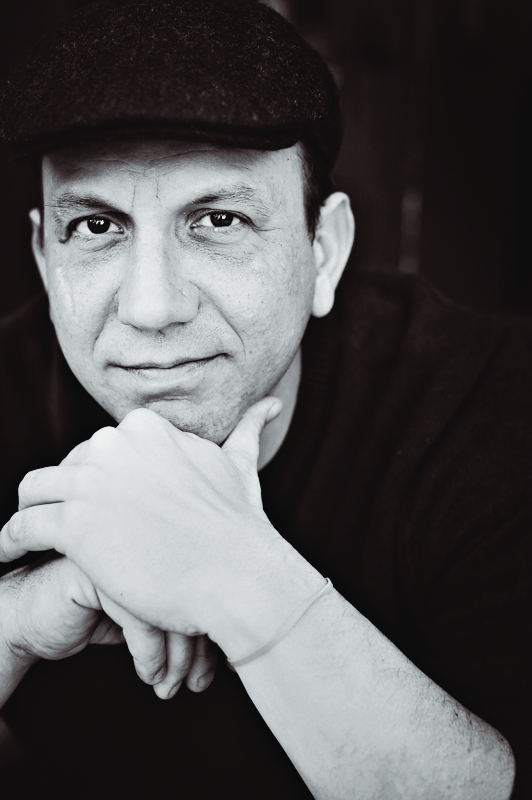
Photo 1: Alanna Lin Ramage; photo 2: Alters/Altars workshop. Credit: Alanna Lin Ramage and Anne Rieman.

Major support for Readings & Workshops in California is provided by the James Irvine Foundation. Additional support comes from the Friends of Poets & Writers.
Deadline Approaches for Essay Prizes

Submissions are currently open for two essay prizes: the Notting Hill Editions Essay Prize and the Southampton Review’s Roger Rosenblatt Comic Essay Prize. The deadline for both prizes is May 1.

The Notting Hill Editions Essay Prize is given biennially for an unpublished or published essay. The winner will receive £20,000 (approximately $30,370), and five finalists will each receive £1,000 (approximately $1,518). The winning essays will be published in an anthology to be published in October 2015. The winners and finalists are required to attend the award ceremony at Kings Place in London on October 3, 2015. Travel expenses are not covered.

Using the online submission system, submit an essay between 2,000 to 8,000 words with a £20 (approximately $30) entry fee by May 1. Essays published in a print or online journal between January 1, 2014, and April 30, 2015, are eligible; essays published in a book are ineligible. Visit the website for complete guidelines. Eileen Battersby, Michael Ignatieff, Phillip Lopate, Adam Mars-Jones, and Raymond Tallis will judge. Watch a video of judges Ignatieff, Lopate, and Mars-Jones discussing the art of the essay at the 2015 Jewish Book Week in London.

Judge Michael Ignatieff won the inaugural prize in 2013 for his essay “Raphael Lemkin and Genocide.” The runners-up were J. T. Barbarese, Belle Boggs, Leslie Jamison, Andrew O’Hagan, and Sameer Rahim. Notting Hill Editions established the prize in honor of the English essayist William Hazlitt (1778­–1830). Devon, England­–based Notting Hill Editions exclusively publishes essays, and is committed to “the vital role essays have had in our literary, artistic, philosophical, and political cultures.”

The Roger Rosenblatt Comic Essay Prize, launched this year by the Southampton Review, will be given annually for a humorous essay. The winner will receive $1,000 and publication in the Summer 2015 issue of the Southampton Review. Patricia Marx, a former writer for the New Yorker and for Saturday Night Live, will judge.

Using the online submission system, submit an essay of up to 5,000 words with a $15 entry fee by May 1. On the journal’s website the editors write, “We won’t even try to tell you what we’re looking for. The comic impulse resists definition, and we like it that way. But if your comic muse has led you to an essay that you consider a match, throw caution to the wind and send it to us.” All entries will be considered for publication. The winner will be announced by June 15. Visit the website for complete guidelines.

Published twice yearly by Stony Brook Southampton, the Southampton Review publishes poetry, fiction, and creative nonfiction.

Memorable Meal

4.23.15

This week, think back to the most memorable meal you've ever had. What made it so unforgettable? Perhaps it was the food, the company, the setting, the occasion, or an awkward moment. Write a personal essay about this meal and the symbolism surrounding it. 

PEN Announces Finalists for Literary Awards

PEN American Center announced this morning the shortlist for its annual literary awards. PEN will award over $150,000 in prize money to emerging and established writers and translators. The winners will be announced on May 13 and honored in a ceremony at the New School in New York City on June 8.

The 2015 awards will be given in seventeen categories, including poetry, poetry in translation, debut fiction, biography, creative nonfiction, children’s literature, and sports writing; the shortlist and longlist of each award is available on PEN’s website. Below are the finalists for a select few prizes:

PEN/Robert W. Bingham Prize for Debut Fiction ($25,000): To an author whose debut work—a first novel or collection of short stories published in 2014—represents distinguished literary achievement and suggests great promise. The judges are Caroline Fraser, Katie Kitamura, Paul La Farge, and Victor La Valle.

Molly Antopol for The UnAmericans (Norton)
Cynthia Bond for Ruby (Hogarth)
Phil Klay for Redeployment (Penguin Press)
Jack Livings for The Dog (Farrar, Straus and Giroux)
Merritt Tierce for Love Me Back (Doubleday).

PEN/Diamonstein-Spielvogel Award for the Art of the Essay ($10,000): For an essay collection published in 2014 that exemplifies the dignity and esteem the essay form imparts to literature. The judges are Diane Johnson, Dahlia Lithwick, Vijay Seshadri, and Mark Slouka.

David Bromwich for Moral Imagination (Princeton University Press)
Ian Buruma for Theater of Cruelty (New York Review of Books)
Charles D’Ambrosio for Loitering (Tin House Books)
Leslie Jamison for The Empathy Exams (Graywolf Press
Angela Pelster for Limber (Sarabande Books)

PEN/John Kenneth Galbraith Award for Nonfiction ($10,000): To an author of a distinguished book of general nonfiction possessing notable literary merit and critical perspective and illuminating important contemporary issues which has been published in 2013 or 2014. The judges are Andrew Blechman, Paul Elie, Azadeh Moaveni, Rahna Reiko Rizzuto, and Paul Reyes.

Danielle Allen for Our Declaration (Liveright)
Mark Fainaru-Wada and Steve Fainaru for League of Denial (Crown Archetype)
Sheri Fink for Five Days at Memorial (Crown)
Jonathan M. Katz for The Big Truck That Went By (Palgrave Macmillan)
Naomi Klein for This Changes Everything (Simon & Schuster)

PEN Open Book Award ($5,000): For an exceptional book-length work of literature by an author of color published in 2014. The judges are R. Erica Doyle, W. Ralph Eubanks, and Chinelo Okparanta.

Rabih Alameddine for An Unnecessary Woman (Grove Press)
Teju Cole for Every Day Is for the Thief (Random House)
Roxane Gay for An Untamed State (Black Cat)
Claudia Rankine for Citizen: An American Lyric (Graywolf Press)
Samrat Upadhyay for The City Son (Soho Press)

PEN America Center has administered its literary prizes for nearly fifty years. Established in 1922, PEN works globally to defend free expression, support persecuted writers, and promote literary culture.

Finding Beauty

4.16.15

This week, think about the things you find beautiful. Make a list of the items, structures, scents, and scenes that you find particularly appealing. Are there any entries on that list that might be considered unusual? For example, some people find the smell of gasoline pleasant or a high-voltage neon shade of pink alluring, while others are attracted to industrial architecture. Pick one of these entries and write about why you find it so beautiful.  

HippoCamp

The 2022 HippoCamp conference was held from August 12 to August 14 at the Downtown Lancaster Marriott in Lancaster, Pennsylvania. The conference featured craft talks, publishing and marketing sessions, panel discussions, a story slam, and readings for creative nonfiction writers, as well as a book sale featuring attendee and speaker books. Participating nonfiction writers included Lawrence Knorr, Lara Lillibridge, Janna Marlies Maron, Randon Billings Noble, Brendan O’Meara, Donna Talarico, and Allison K Williams. Carmen Maria Machado delivered the keynote address.

Type: 
CONFERENCE
Ignore Event Date Field?: 
yes
Event Date: 
March 21, 2026
Rolling Admissions: 
ignore
Application Deadline: 
March 21, 2026
Financial Aid?: 
no
Financial Aid Application Deadline: 
March 21, 2026
Free Admission: 
no
Contact Information: 

HippoCamp, Hippocampus Magazine, 210 West Grant Street, Suite 108, Lancaster, PA 17603. 

Contact City: 
Lancaster
Contact State: 
PA
Contact Zip / Postal Code: 
17603
Country: 
US

Start With a Title

Sometimes you need to finish writing your piece before you can give it a proper title. This week, pick the title first and write your personal essay around it. If something doesn't immediately come to mind, try and model your title after one of your favorite stories, books, albums, or movies. Then, free write for twenty minutes on anything and everything that your title brings to mind. At the end, organize your notes and use them as a framework for your personal essay.

Pages

Subscribe to Creative Nonfiction