
I was riding the N Judah streetcar line on a cold fall day in San Francisco when I got the call from Mary Jane Edwards, former executive director of the Jentel Foundation. I was in the city on a self-made book tour for my second poetry collection, Incantation: Love Poems for Battle Sites, and my phone lit up with the word Wyoming.
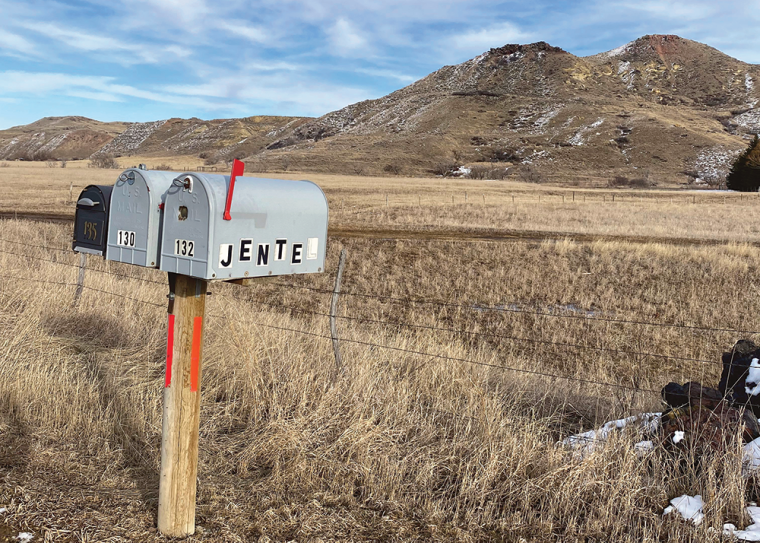
A mailbox signals an artists’ escape on Wyoming’s High Plains. (Credit: Xochitl-Julisa Bermejo)
“Hello?” I answered the call as the streetcar rumbled through a graffiti-covered alley.
“Is this Xochitl? Am I saying your name right? This is Mary Jane from Jentel.”
In our conversation she asked about my work with Women Who Submit, the nonprofit I cofounded. I politely answered her questions wondering if the call was an acceptance or an interview. She asked about my project, and I told her about the essay collection I’d been wanting to start on the writing life and the intersections of poetry, teaching, and organizing.
It’s long been my belief that writing residencies, while not essential for completing creative work, allow for the time and space to make big literary leaps and connections possible. These benefits begin with the submission process.
Residency applications typically ask two questions: (1) What project will you be writing while in residency? and (2) Why do you need this space and time to write?
Over the years I’ve found these two questions integral to my creative process. Contextualizing my writing for a selection panel has helped me to better understand and visualize my goals, making me more equipped to meet them.
As a creative writing instructor and advocate for demystifying the submission process, I ask my students to go through this same visualization process with me. I tell them to imagine they’ve been gifted a beautiful cabin in the woods where all their immediate needs are met. They are fed well, and after meals they can take long strolls through lush acreage. As they walk they have time to think. As they think, a project they’ve always meant to write comes to mind. A scene starts to shape. They can hear their characters speaking. I ask them to imagine running back to their cabin to find a desk waiting. I ask them to sit at that desk and imagine opening their computer. Then I say, “Now what do you write?”
The question is simple: What is the project you’ve always wanted to start but never had the time, money, or space to pursue? With a sense of urgency still in their minds, I have them write down the project.
Residency applications are an opportunity to dream. Writers granted an acceptance have an opportunity to see what happens when dream meets practice. I was about to learn my call from Mary Jane that chilly San Francisco day would turn out to be such an opportunity.
“Very good,” she said, as I finished describing my project. “Well, I just called to let you know, you’re coming to Jentel.”
“Really?” I gushed over the chance to start my essay collection. “Thank you for believing in it.” We hung up just in time for me to make my streetcar stop.

I arrived at Jentel, a small, rustic residency that receives artists and writers for three-week stays in cohorts of six, on a snowy Valentine’s Day weekend. I call it rustic because there’s no chef like at other similar retreats, and some residents have to share a bathroom, but the home is an architectural marvel created in the vision of Neltje, the abstract painter and philanthropist who founded Jentel. Sweeping ceilings and grand windows show off the natural Wyoming landscape that surrounds the estate, which is made available to residents for hikes and meanderings. While in residency, each artist receives a bedroom in the main house, an artist studio in an adjacent building, and a weekly stipend for personal needs, all of which was explained upon arrival by the residency program manager.
Jentel in winter. (Credit: Xochitl-Julisa Bermejo)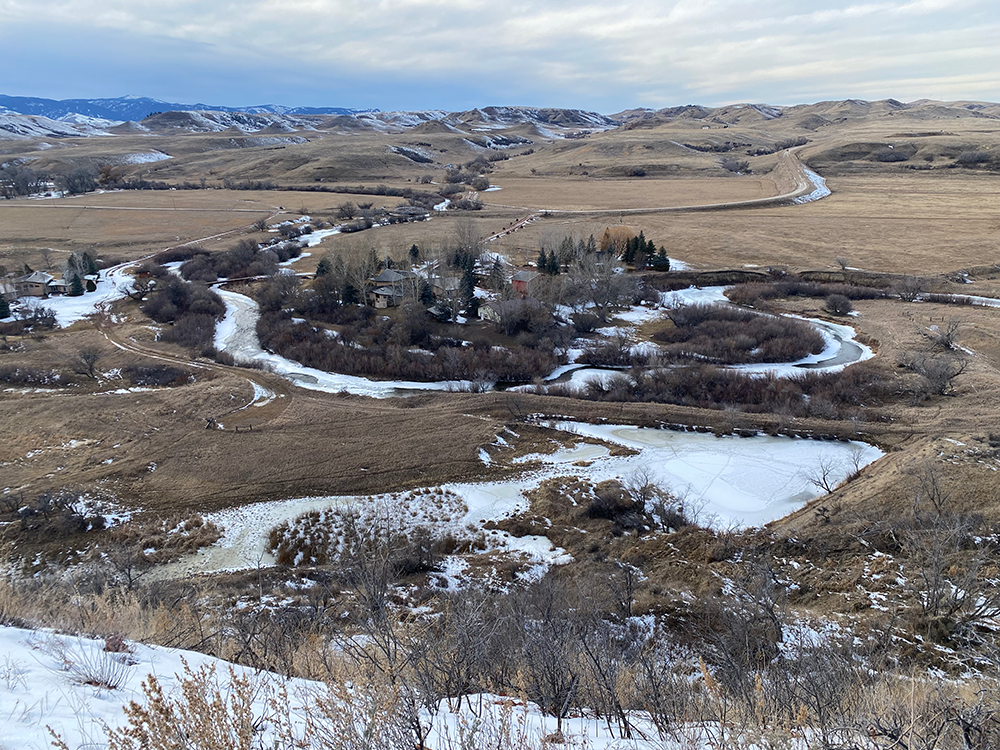
Many details make Jentel special, but my favorite is the writing studio.
A small cabin split in half by a wall and shared by two writers, it sits about fifty yards from the main house. Mine held a desk, desk chair, lounger, corkboard, bookshelves, two lamps, a gas fireplace, and one window that overlooked a spying aspen tree. I was allowed to arrange the room how I wanted, and over the first few days I moved furniture around until it fit my daily routine.
At the start of the day I went first to the writing desk, which was closest to the door, to do my morning meditations, journaling, and daily poem. Next, I moved to the lounger at the center of the room to read until it was time to head back in for lunch. Returning in the afternoon I made notes and pinned them to my corkboard before taking a nap in that same chair with the afternoon light dancing between the aspen leaves. In the late afternoon, I moved farther into the room to sit on a mat by the fireplace to draft essays. At dinner I trudged inside to cook, print pages from the day, and maybe watch an episode of Friends. Most evenings I returned to lay out pages across the floor and revise. Variations to this routine included hikes into hills with one or two other residents, an excursion to town for lunch and thrifting, Sunday family dinners, and an occasional movie night, but I never cared to wander too far from my studio.
Just before leaving for residency, one of my closet friends, Chicana writer Tisha Marie Reichle-Aguilera, shared an open call for a contest at Graywolf Press looking for nonfiction works-in-progress. The submission guidelines asked for a description, outline, and one hundred pages, to be sent by February 28. All I had was the project proposal I sent to Jentel and a two-week window.
“I’m never going to make it,” I told Tisha.
“What else are you going there for?” She challenged me to try.
By the end of my three-week residency, I had read eight books, written drafts of three new essays, completed a revision of one of those essays, written a description and outline for the collection, gathered a hundred pages of previously published and new work, and submitted to the contest. Nearly two years later, my collection is half done, with over twenty thousand words and six essays.
In the end I lost the contest—but consider how much I was able to do in three weeks. Consider that before I left, I knew only that I wanted to write an essay collection, but with the residency and the push of the contest deadline, I was able to flesh out the idea from a dream into reality.
The essay collection lives! This is the power of residencies. This is the power of the submission process.
Consider how much stronger your writing might become if you had a whole morning to read, an afternoon to draft, and an evening to revise. Consider what connections you might make while hiking into the hills, watching birds from your window, or taking a nap. Consider how brave you might become to explore your wildest creative ideas if someone gave you all this and said, “We believe in you! Go!” That’s what Jentel did for me.
The next deadline to apply for residencies at Jentel in Banner, Wyoming, is September 15. For focused time to pursue a dream project, also consider the Squam Writes Retreat in Holderness, New Hampshire, held from June 11 to June 14 for poets and prose writers, and the Edward F. Albee Foundation Residency in Montauk, New York, offering year-round residencies to poets, prose writers, and translators.
For details about nearly two hundred transformative retreats, search the Poets & Writers Conferences & Residencies database.
Xochitl-Julisa Bermejo is the daughter of Mexican immigrants and author of Incantation: Love Poems for Battle Sites (Mouthfeel Press, 2023) and Posada: Offerings of Witness and Refuge (Sundress Publications, 2016). She is a former Steinbeck fellow and a winner of the Maureen Egen Writers Exchange Award in poetry from Poets & Writers. Her poetry and essays can be found at the Acentos Review, Huizache, Los Angeles Review of Books, the Offing, Pank, Santa Fe Writers Project, and other journals. Her poem “Battlegrounds” was included in the Academy of American Poets’ Poem-a-Day, On Being’s Poetry Unbound, and Poetry Unbound: 50 Poems to Open Your World (Norton, 2022). Her most recent craft essay, “How to Write a Love Poem,” can be found at Cleaver. She is the director of Women Who Submit.