In 2012, I pulled a book off a shelf at Ragdale and an envelope fell out and landed on my foot. It was my first time at the Chicago-area residency—a much-needed stay, because my children were young and I was struggling with my second novel. I was stuck on a section set in 1955, in which a wealthy young woman was coping with misery as a newlywed. Frustrated and antsy, I had come downstairs and was looking idly at the books left behind by the family that originally owned the estate. (A remarkable family—architect Howard Van Doren Shaw built the main house, an arts and crafts masterpiece; his daughter was the sculptor Sylvia Shaw Judson, whose work you might know from the cover of Midnight in the Garden of Good and Evil; her daughter, the poet Alice Hayes, founded Ragdale as a residency in 1976.)
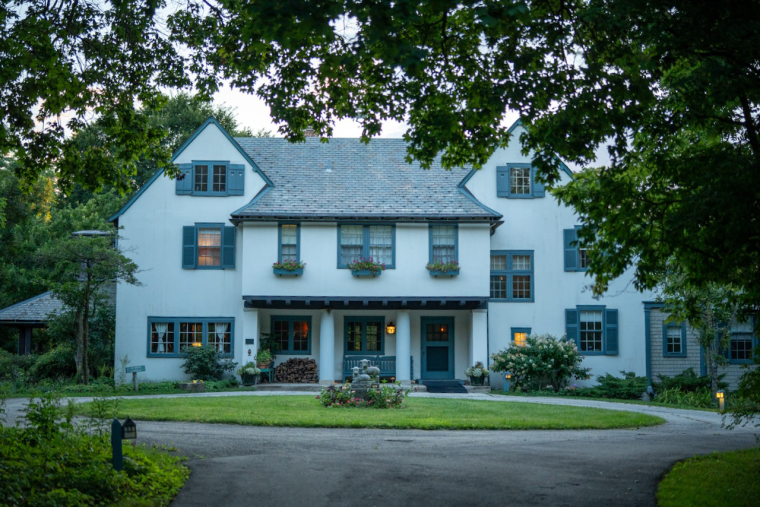
Ragdale House at dusk. (Credit: Rich Cahan via Ragdale)
Why I thought a dusty cookbook would somehow help me, I have no idea. But now here was this secret missive, sitting on my shoe. It turned out to be a letter home from a young, newly married Alice Hayes, living in Boston. She wrote about taking in “Harvard boys” as boarders, about the cook quitting and she and her husband struggling to fend for themselves in the kitchen, and about some movie they’d seen. Since the letter wasn’t dated, I Googled the movie. It came out in 1955, the exact year I was writing about.
I copied down the letter, then turned it in to the office for the archive. And I figured, why not use this stuff? So in the book that would become The Hundred-Year House (Viking, 2014), I had my own newlyweds’ cook quit. The inept meals prepared after her departure (vegetables baked under a great deal of cheese, for one) are from that letter. The cook’s departure became an essential catalyst for shaking up the household, moving the story forward. It got me back to work.
A year later I had returned to Ragdale and was working with the paper galleys of that same book. Characters deal with a problematic abundance of ladybugs in the book’s first section. As I worked, an actual ladybug flew down from the ceiling and landed on my manuscript, on the word ladybug. Was it helpful? Not directly. But it made me feel like there was some strange order to things, like the book was meant to be.
The thing about Ragdale is that absolutely everyone who’s ever stayed there has a story like this. Extraordinary serendipity, improbable coincidence, a lifeline from the universe right when one is needed most.
On that first stay I discovered that in every room at Ragdale, there’s a notebook in which residents leave a message about their time there. In older studios these go back to the late seventies. I decided to read a few pages every night and was struck by the entry from the writer who was there on 9/11, the way she spoke about walking the prairie with her new friends and mourning. And there were entries full of helpful advice: Go easy on yourself, take time to make friends with musicians, get out and write on one of the screen porches. Connect was the core message of half of them. The other half was an enthusiastic chorus: Keep working.
I read there about an artist and a writer who discovered they were working on the same obscure subject and gleefully shared resources. I read about a tapping cord on a window shade that woke a writer in the middle of the night. She got out of bed and wrote the best thing she’d ever written. There was no breeze in the room, no reason for the blind to do that. A playwright borrowed someone’s coat and then found a pin in its pocket bearing the word that was the title of her play in progress. The dancemaker she borrowed the coat from had no memory of the pin. As I read I began to feel like the inheritor of a long, blessed legacy of happenstance.
Meanwhile, at the dinner table, people discussed literal ghosts. No surprise; I’d already been to Yaddo, where ghost stories are legion, and knew that at nearly every residency, there’s ghost talk. Maybe it’s because when you put a bunch of people with overactive imaginations in one place (quite often a big old house) and they stay up late, traversing unfamiliar hallways, the shadows and noises quickly become the stuff of lore.
I’m not so interested in the hazy-woman-in-a-white-gown kind of story, though, or the ones where people hear something or “feel a presence.” Partly because those stories are all the same, and partly because I always suspect they’re the product of exhaustion. There’s a plausible theory that the nineteenth century’s interest in ghosts had a lot to do with carbon monoxide poisoning from gas lighting and appliances and its concomitant hallucinations.
But how do we explain the falling letter, the ladybug, the pocket pin, the hundred other examples I don’t have room for here? All these things have real-world explanations. A swinging window shade cord is not exactly Bloody Mary appearing in the mirror. But do some places just contain a different kind of energy?
Or, in a place of quietude and creativity, are we simply more able to notice the thousands of ordinary gifts the world gives us every day and find meaning in them?
Or are both true: Are there energies around us—in some places more than others—that operate unseen, like radio waves, ones we can sense only when we’re tuned to the right frequency?
Or maybe this is all silliness. Maybe this, too, is simply what happens when a bunch of overactive imaginations cram together. So let’s focus on an even more mundane brand of magic: the alchemy of creative people in a beneficent space, with ample time and inspiration.
Because in fact, even without my magic 1955 letter, I had people around me working in every discipline who would listen to my frustrations, share their own, start fascinating conversations, talk about their own works-in-progress, and keep me feeling more like a bee in a busy hive than a solitary writer working in the void.
The gardens and grounds of Ragdale. (Credit: Shaw McCutcheon via Ragdale)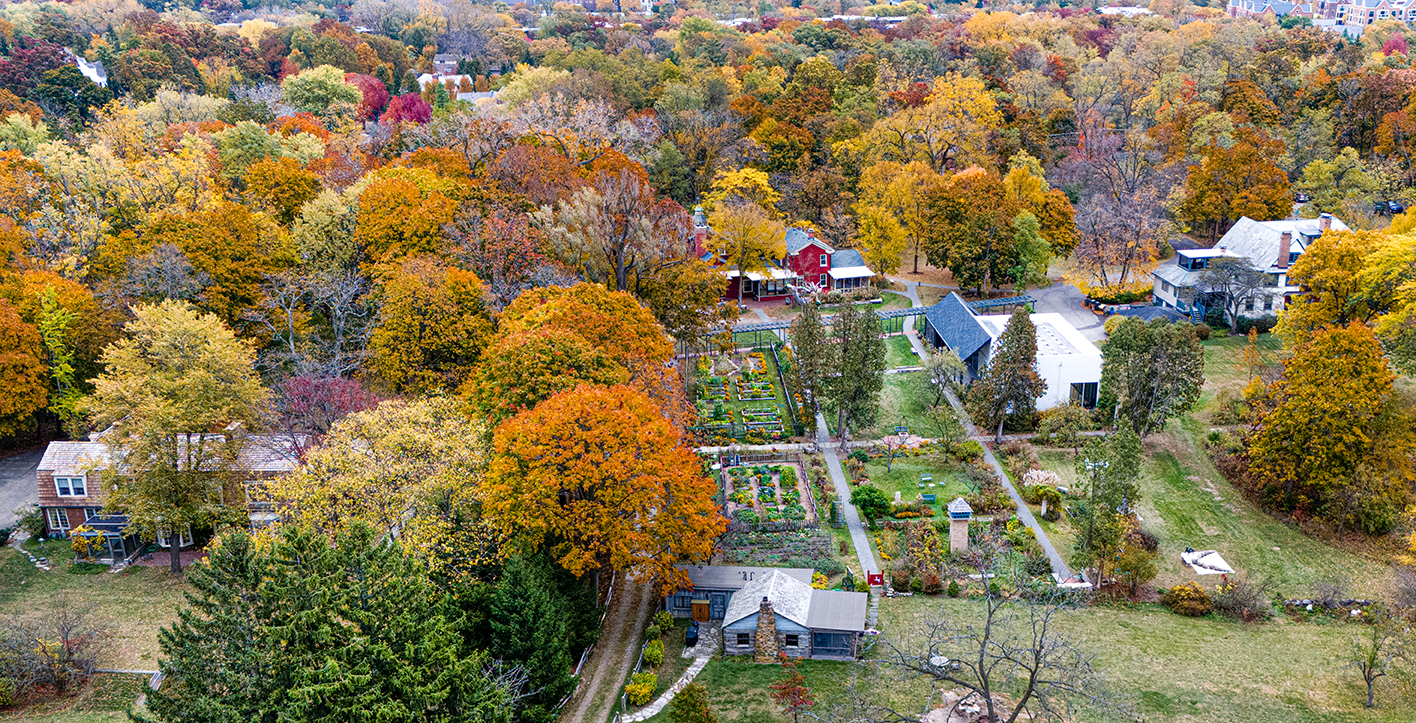
Flash forward a few years. I arrived not quite ready to buckle down on the novel that had been giving me fits, so I decided to write a short story. I titled it “Zamboni.” Partway through writing, I did the New York Times crossword on my phone. The center word of the whole puzzle was, bizarrely, Zamboni. I decided to take it as a sign, much like that auspicious ladybug. How did the spirit of Ragdale possess the crossword writer? Who knows. Let’s not think about it too hard. Finally, I got going on my novel, already titled The Great Believers—but I still doubted the whole project. I did the Times crossword again one evening. In the top left corner, one correct answer was Ian. This was the name of my first novel’s main character, so—while it wasn’t nearly as much of a coincidence—I decided to indulge in some magical thinking. It made me happy. Directly under Ian, the correct answer was Esme. Which was fun, because a minor character in the new novel was named Esme Sharp. Sure, let’s take it as a sign. Right under Esme, I realized, the correct answer was sharp. I mean—what the hell?!
It was January of 2017, and the presidential inauguration loomed over all of us, all our work. The majority of us took the train to downtown Chicago for the Women’s March, where we chanted and froze and bonded. As we rounded the route’s final corner, we came face to face—out of nearly three hundred thousand people—with Ragdale’s beloved chef.
It was a minor miracle, the kind I’d grown used to by then. But what did these miracles add up to, in the end? What was Ragdale trying to tell us, by following us to the city?
Nothing too mysterious there, only what we needed to hear. All these confluences and signs, they kept whispering the same two mantras: Come together. And keep working.
The next deadline to apply for residencies at Ragdale in Lake Forest, Illinois, is May 1. For more magic and creative support without leaving the Midwest, also consider the Anderson Center Artist Residency Program in Red Wing, Minnesota, offering residencies from June to October to poets, prose writers, and translators, and the Good Hart Artist Residency in Good Hart, Michigan, offering residencies year-round for poets and prose writers.
For details about nearly two hundred transformative retreats, search the Poets & Writers Conferences & Residencies database.
Rebecca Makkai is the author of five books, including Pulitzer Prize finalist The Great Believers (Viking, 2018), and is artistic director at StoryStudio Chicago.
Thumbnail credit: Rich Cahan via Ragdale