
His name was Walter. Each morning, as we gathered in my small cabin, chairs and couches forming a circle, Walter would bring a small gift to the group as we began our morning writing. A basket of berries from a local market. Douglas fir chocolates from a chocolatier in nearby Joseph, Oregon. And one morning, a large jar of local honey, which our entire workshop poured onto spoons to taste.
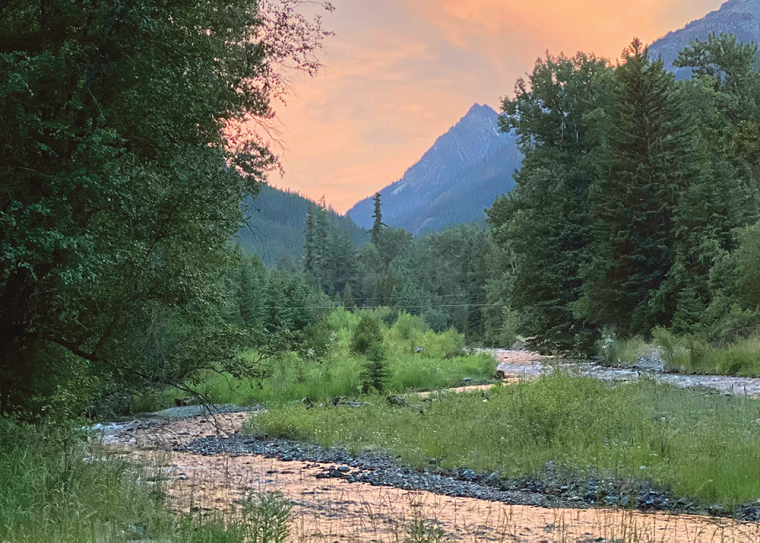
A scenic view near Fishtrap. (Credit: Nina McConigley)
Walter was ninety-four and wore a baseball cap. He wrote everything on a legal pad with a pencil in looping cursive. And over our week together, he wrote the best sex scene I have ever read from a student. He recalled a girlfriend he had before being shipped overseas during World War II. He had us all laughing and crying as he recounted the anguish of war with the joy of young love.
I myself was anguished that summer. It was 2018 and I had spent the spring in and out of doctors’ offices, trying unsuccessfully to get pregnant. By the time my husband and I drove the road that hugs Wallowa Lake to the cabin where I would be teaching for just over a week, I couldn’t help but laugh at the sign that greeted us as we entered Joseph. “This Little Town Is Heaven to Us. Don’t Drive Like Hell Through It.”
“Hell,” I said to my husband. “We’ve been in that all year.”

It wasn’t just that trying to have a baby was hell to me that summer; I had lost all pep for creating anything. Often I looked at a blank screen and closed my computer. Maybe I don’t have anything left to say, I thought. My novel sat untouched for months. I fretted and instead immersed myself more in teaching. And then I got an e-mail from the Summer Fishtrap Gathering of Writers, a workshop deep in the mountains of Oregon. Did I want to teach for a week?
I have attended summer conferences and retreats in which the list of writers and agents was impressive. I have seen people sip cocktails on green lawns and listened to New York City publishing gossip.
Fishtrap is not that. It is a quieter affair. First, it takes a lot to get there. Nestled in Wallowa County in eastern Oregon, Wallowa Valley is known as Little Switzerland. Wallowa Lake is a beautiful glacial pool tucked in the mountains, and the historic Wallowa Lake Lodge, where the gathering is based, sits next to it. People stay in cabins or the lodge, and many camp at the nearby campgrounds. You are ringed by Douglas firs, ponderosa pines, and western hemlocks. Mule deer listen to the readings.
That first morning I met Walter, I gave my students a prompt. After brainstorming they all headed out to my cabin’s porch to write. The prompt was simple: Take a true story from your life and add one fictional element. You could change the time or the weather, add people or snappy comebacks—whatever you wanted. Usually I don’t write when my students are writing. Instead I check my phone or fill up on coffee. But that morning I took a notebook and sat on the porch and thought of a moment in my life. And what I thought of was the story of the Space Shuttle Challenger exploding. Something I hadn’t thought about for years. I wrote about the day. How excited we were about a teacher in space and the memory of my teacher wheeling the TV out of our classroom after the explosion. I wrote and wrote—and suddenly I knew this would be the beginning of my novel.
There was something about Walter feeling so free to write about his life that gave me a kind of freedom to play, to generate pages every day. Not knowing what they were, Walter wasn’t thinking about publishing contracts; he was thinking about stories and the urgency of telling them. He became my teacher.
Writers gather outside Wallowa Lake Lodge. (Credit: Nina McConigley)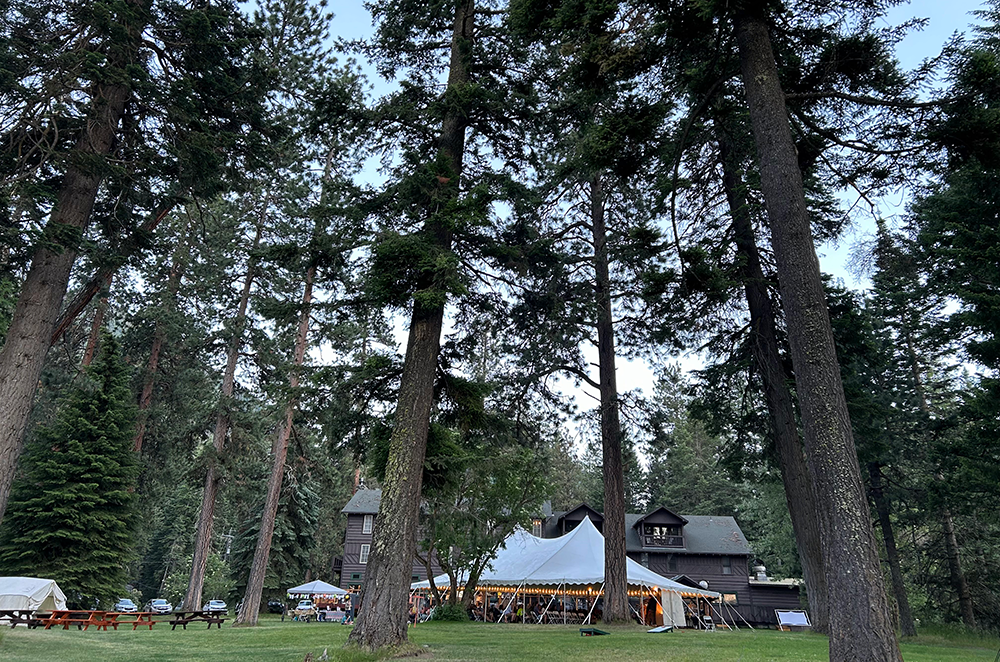
The Summer Fishtrap Gathering of Writers began in the 1980s, founded by bookstore owner Rich Wandschneider, historian Alvin M. Josephy Jr., poet Kim Stafford, and the community as a counterpoint to writing retreats based in urban centers. Fishtrap became a yearly tradition, and from that first summer, a unique circle of literary citizens of all genres and from all over the world have gathered at Wallowa Lake to write, to explore issues about not only the West, but the world.
Fishtrap is now a nonprofit, dedicated to “cultivating clear thinking and good writing in and about the West.” The summer retreat asks writers to come for intensive, small workshops of no more than thirteen students per group. Workshops are offered in fiction, creative nonfiction, poetry, and children’s literature. The Fishtrap staff hope to add playwriting soon.
Fishtrap is generative. In the morning students write in their workshops and share work. And in the afternoons and evenings, there are classes and readings. The week includes craft talks, panel discussions, open mics, featured author readings, public evening readings, and community events. It feels like a little community. Fishtrap also leaves plenty of time for tree walks and lake swims. There is an energy that everyone is there to create with no judgment. Fishtrap reminds me why I make art. The mix of writers varies from beginners to the MFA students at Eastern Oregon University (who attend Fishtrap as part of their program), and the gathering attracts all levels of writing. And yet it all works. There is an excitement to creating. You are not there to show off polished work. You are there to make.
Outside of town is the grave of Old Chief Joseph, a leader of the Nez Perce for whom the town of Joseph is named. The head of Wallowa Lake served as a fishing and camping ground for the Nez Perce people; wallowa is a Nez Perce word that connotes “fish trap,” with connection to the land and its winding waters. Wallowa Lake is full of kokanee, the region’s salmon, returning to tributaries to spawn.
It seems fitting that Fishtrap is named after this. I often think of writing like a body of water: still on the surface, and when we write we reach below the surface, deep into our unconscious, and bring something forth. Sometimes a fish, sometimes a story.
Last summer, after class, a student asked me if I would sign a copy of my book. He was a little embarrassed and then admitted he had bought my book used.
“And you already signed it…to someone named Walter.” My stomach fell. I wanted to think that Walter read it and donated it. But I knew if he were alive, he’d be well over one hundred.
“Walter was amazing. This book has good energy,” I told the new student. I reinscribed it to him, flipping through the worn copy, remembering Walter’s words.
I have now taught at Fishtrap six times. These days my two girls watch the deer and swim in the lake while I teach. I wish I could tell Walter what he means to me. That he got my writing unstuck with his wild storytelling. That I did write again. I did, in the end, have two daughters. I created once more. And it was at Fishtrap where it started again. Like the salmon, I found my way home.
The next session of the Summer Fishtrap Gathering of Writers at Wallowa Lake, Oregon, will be held from June 23 to June 26. For more literary community off the grid, consider the Community of Writers Workshop in Olympic Valley, California, near Lake Tahoe, held from June 22 to June 28 for poets and July 10 to July 17 for prose writers, and the Storyknife Writers Retreat in the wilderness outside Homer, Alaska, offering residencies from April to October for women poets and prose writers.
For details about nearly two hundred transformative retreats, search the Poets & Writers Conferences & Residencies database.
Nina McConigley is the author of How to Commit a Postcolonial Murder (Pantheon, 2026) and the short story collection Cowboys and East Indians (FiveChapters Books, 2013), winner of the PEN Open Book Award and a High Plains Book Award. She teaches at Colorado State University.