
When I was writing and editing my debut collection of short stories, Ninetails—a collection that centers on the mythological shapeshifting fox spirit across historical periods and places—I badly wanted to see a real fox in the wild. Living in New York City, the wildlife I encountered was ruefully standard: pigeons, squirrels, rats, and geese, along with the occasional turtle found sunbathing on a rock in the green ponds of Central Park. For me the opportunity to catch sight of a fox happens only at writing retreats—those escapes that promise isolation and time, often in expansive locales close to the wilderness. These retreats break me free of my routines and tics (and sometimes my bad habits) and let myself wander in a wild new place. These terrains are both physical and psychic, places where the act of writing, of remembering and dreaming, is braced against the onrush of new sensations. The air is fresher, the smells are new, the colors more vibrant. All of it summons forth the wild mystery of the life that lurks just beyond the window.
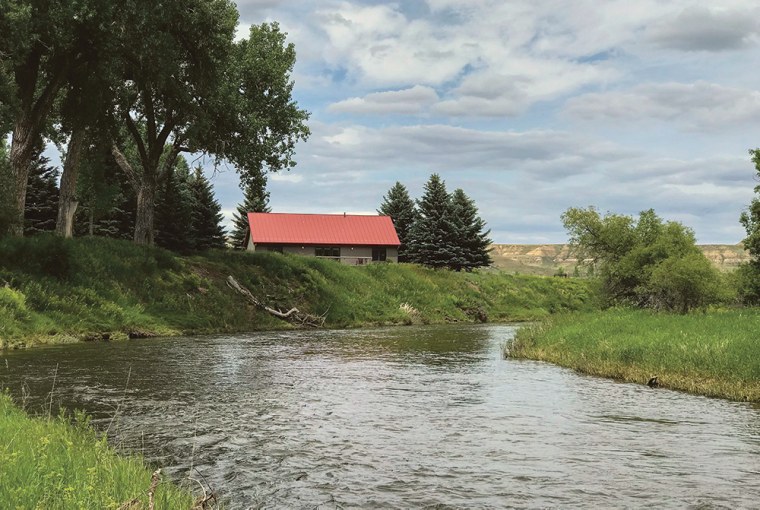
Kocur Writer’s Retreat at Ucross offers a view of the meandering Clear Creek. (Credit: Martirene Alcántara via Ucross)
At recent writing residencies I’ve attended, wildlife seemed a central topic of conversation. Upon arriving at Ucross, a creekside writers residency set in the sprawling grasslands of northeast Wyoming, city folks like me marveled at the intensity of the green, the pristine pastoral glow that seemed to go on for miles and miles. Those of us who had cars could venture out farther, into Bighorn National Forest and, beyond, the mountains of Yellowstone. One resident told the tale of an encounter with a bear mewling in a parking lot. Another saw a hulking moose, menacing against the majesty of the snowcapped mountains. At the time, my desire seemed humbler: to glimpse the shape of a fox somewhere along the route I took between my writing studio and the main barn, where the residents gathered for communal dinners. Soon residents and staff alike started alerting me of their fox sightings. One fox showed up at the window of a resident’s writing studio. Another lingered in the grass as someone drove up the road. The foxes came out at twilight, the program director explained. Sometimes she encountered a whole family in her backyard, a mother feeding and licking her kits.
And so I’d ride a bike down the road at dusk, ever-alert, searching for a flame-colored creature flashing across the verdant grasses. I thought of Lucille Clifton’s foxes in her poem sequence “A dream of foxes,” from her collection The Terrible Stories (Boa Editions, 1996). In the poems, a fox stands in front of the speaker’s doorway—the portal between the poet and the outside world. At first, the speaker is unsettled, afraid. But soon the speaker feels comforted by the alien presence of the fox, which seems to mirror her bewilderment. She had thought she was navigating the expanse of her own solitude, but the fox keeps returning to her. She begins to call the animal “sister fox,” and this becomes the impetus for the poet dreaming of a field in which women are safe and protected. Before seeking the foxes of Ucross, I had thought of this poem sequence as a personal paean to the poet’s solitude, but later I would think of it as a parable of the writing process itself. One encounters the self, one encounters the other, and at that crossroads, something gets imagined, gets made. At Ucross, I was deep in the editing stages of Ninetails. Surely if I’d see a fox in the wild, then the magic of that encounter would push me to the breakthrough, completion—right? I was stuck inside editing a story set in the city about a fox and a ghost who become unlikely friends, turning it over and over in a relentless loop.
One of the first writing residencies I’d attended took place a decade ago, in 2015, at Hedgebrook, on Whidbey Island in Washington state. At Meadow House, the last cabin built on the property, I had begun my serious foray into writing fiction, knowing that Ruth Ozeki had reached a crossroads with writing one of my favorite novels, A Tale for the Time Being (Viking, 2013), right there in that same cabin. The guest book was full of handwritten notes from marvelous writers, including the poet Naomi Shihab Nye and the feminist icon Gloria Steinem, who greeted her readers with “Dear Sisters of the Meadow”—a cultish yet charming moniker. I imagined us all—Lucille Clifton, her sister fox, all the women who wrote here at Meadow House—frolicking in this field with matching daisy crowns atop our heads. Across the road from the residency property, there was a fenced-off field, and in that field, two llamas stood sentinel in the distance. I remember standing in front of the fence, staring out at the llamas, who looked like tall, beautiful mirages. Slowly, to my astonishment, the llamas started advancing toward me, a long journey from the edge of the field to the roadside. They were saying hello! Perhaps they were hoping for apples. Soon they stood close enough to touch. I took about a dozen selfies. Loading firewood into the fireplace, building a fire, I thought about those llamas every day, their impulsive hello. It became an ongoing appointment—that fence at dusk, those llamas. As if in concert with their greetings, the pages arrived fast and smooth and just as unexpected. In a few weeks I had about a hundred pages, far more than I’d ever imagined writing. The creative breakthrough at Hedgebrook was that I took a leap trying a new genre I felt unstable in and found a sort of cadence—perhaps because I shared that unexpected moment with the llamas. Though in the years since I’ve given up on this novel, pivoting instead to Ninetails, those dormant pages are still uniquely generative to me, as if they were a gift from the llamas, or perhaps from my fellow Sisters of the Meadow.
At Ucross I didn’t end up seeing a fox. But I did see the pronghorn antelope, the whip of a white-tailed deer as I walked outside daily. The threat of ticks in early summer, the butterflies and caterpillars. The buzz of life was all around me. The author Cris Beam, in an essay from 2014 on being a resident at MacDowell, notes that “along with the animals, come the demons. Introspection, so vital to creation and yet so hard to cull in a city that demands products and results, is furrowed with demons.” It is true: Animals force us to confront the strange, the alien, and yet also the mortal, vulnerable, visceral, and wild parts of ourselves. The demons, the memories that are hard to confront. Perhaps that was a reason I sought them. At MacDowell, where I went for the first time in the winter of 2024, I was still looking for foxes. By then, Ninetails was already out in the world—I no longer had a premise for seeking them.
Then toward the end of my stay in Peterborough, at the turn of the new year, I finally got my encounter—just not the one I was expecting. On a snowy winter morning in New Hampshire, I was walking alone to breakfast. A beautiful cat was sauntering ahead of me on the path. I remembered thinking: Wow, I didn’t know that MacDowell kept pets. Before long the cat pranced into the woods next to the path, stepping and settling on a fallen tree. We stared at each other for a good thirty seconds. I snapped a few photos of it. As I continued walking down the path of glistening snow, the cat walked parallel alongside me, in the woods, and the strangeness of our parallel walking struck me as providential. As I showed pictures of the cat to my fellow artists at breakfast, one of them said: “That’s not a house cat. That’s a fucking bobcat!”
A surprise encounter. (Credit: Sally Wen Mao)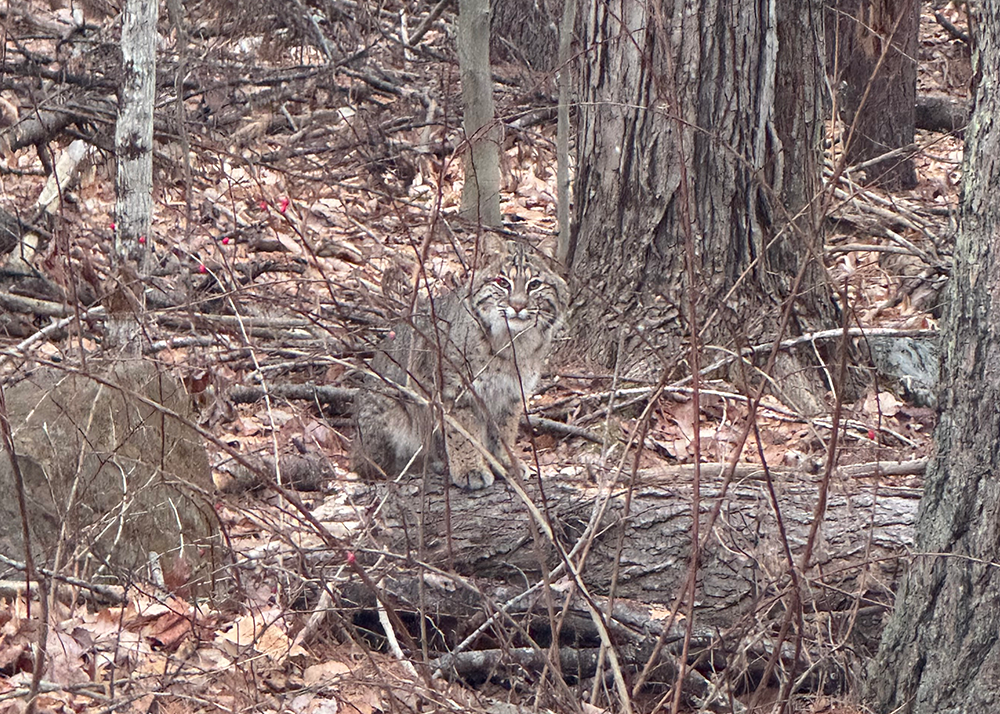
Much like the animal I was trying to find, the artistic process isn’t always something that can be tamed, or planned, or architected. The bobcat reminded me that the mysteries and unknowns of the writing project are its most rewarding aspects, because of the wonder it brings, and the strange and perhaps harrowing paths we are willing to follow because we are outside of our familiar spaces. I didn’t plan to write a bobcat poem, but the bobcat did show up in my poem that day. He will probably show up for the rest of my life.
Applications for residencies at Ucross in Ucross, Wyoming, in spring 2027 will be open from May 1 to July 15. Applications for 2027 residencies at Hedgebrook on Whidbey Island, Washington, opened in February. MacDowell in Peterborough, New Hampshire, will offer residencies in spring and summer 2027 with an application deadline of September 10. To set free the wild in your work, also consider the Tremont Writers Conference in the Great Smoky Mountains National Park near Townsend, Tennessee, held from October 21 to October 25 for poets and prose writers, and the Sitka Center for Art and Ecology Writing Residencies in Otis, Oregon, held from October 2026 to April 2027 for poets and prose writers.
For details about nearly two hundred transformative retreats, search the Poets & Writers Conferences & Residencies database.
Sally Wen Mao is the author of the story collection Ninetails: Nine Tales (Penguin Books, 2024) and three poetry collections: The Kingdom of Surfaces (Graywolf Press, 2023), Oculus (Graywolf Press, 2019), and Mad Honey Symposium (Alice James Books, 2014). She has been a resident at MacDowell, Millay Arts, Ucross, the Anderson Center, Hedgebrook, the Lannan Foundation Marfa Residency, and Saltonstall. She is currently an assistant professor of English at Baruch College, CUNY.