
I was thirty-one, had just gotten married, quit my toxic job, and been admitted to the Blue Mountain Center off the waitlist. I’d go to the residency in upstate New York for an unusually short stay: twelve days, ten if you subtracted travel. My parents had recently divorced, but my family had pulled it together for my wedding, a very stressful and painful and also beautiful time, and I was heading to India after my residency, rejected from the Fulbright I had applied for to research my novel—but I was going anyway. We had moved out of our apartment and put our stuff in storage. I would return to America in time to cast my vote for Hillary Clinton, who would become our first female president.
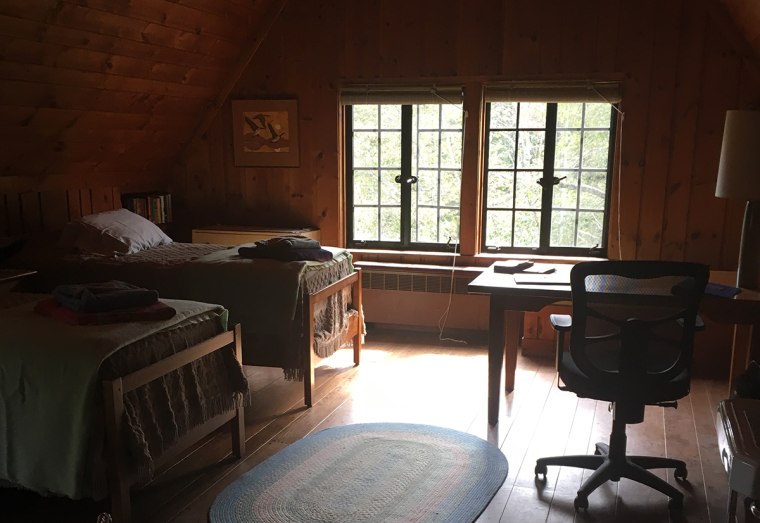
A peaceful spot for writing at Blue Mountain. (Credit: Shruti Swamy)
The residency was held in a rambling mansion beside a lake in the last breath of summer. They gave me a room on the top floor with two twin beds (“one for sleeping and one for napping,” my partner, back at home, suggested) and a small desk against the window, where I tried effortfully to write a honeymoon scene at a hunting lodge in rainy Darjeeling but mostly just stared out at the lake and thought about when I was going to swim in it.
It wasn’t just me who had gotten in off the waitlist; everyone had. A special session had been canceled at the last minute, and all of us had a windfall, prize-winning feeling. We were a largish group of journalists and nonfiction writers, a couple of playwrights and fiction writers, a few poets, and a composer who showed me how he scored the birdsong he heard every morning, along with the sounds of the lake lapping against the small rowboat and the dock. The age range was wide, and the eldest was in her seventies. I was the second youngest, which was instructive to me: At a time when I felt unmoored, unformed, the other residents suggested possibilities of how one might be—yes, through conversation, but also through rounds of Bananagrams, or during hikes: how they acted in a group, how they took up space, what they paid attention to.
There was talk of politics at every meal including breakfast, which I realize sounds unpleasant, but to me it wasn’t—I liked listening to how my fellow residents were making sense of the moment without having to offer how I was doing it. They were all worried about the world, and I was too, but the work they made in response was all so different: nonfiction about housing policy, a play about solitary confinement, poetry about the natural world. Over one dinner we discussed the kind of language only those who are dying are capable of delivering and how it was similar in poetic quality to one of the poet’s students learning English as a second language, crystalized and distilled; I said that that was how my grandmother spoke the English in which she told me all her secrets. And how one of the poets was commanded in a dream to take all the bowls from her home. She obliged, lining the path in her yard outside, fifty-one bowls, it was like a visual poem, she said, about emptying and being filled—But what do you eat cereal out of? I asked. A mug, she told me. And what about salad? She said she put it on a plate.
This poet and I talked a lot. She told me about ancestors, how you could call them to you by arranging them in a circle around you, in order of how recently they had departed. But you had to be on your guard, because some ancestors could not be taken at their word. Maybe the ancestor who had appeared to my grandmother’s cook in a dream on the night I was born could help me with my novel, if I were careful (the poet had listened seriously to me when I told her about this dream). Talking to someone who understood dreams, spirits, and gods was very different from talking to someone who understood structure, dialogue, and character: Though I had had many conversations about my novel, this way of looking felt different. I had found a copy of The Famished Road (Jonathan Cape, 1991) by Ben Okri in my room, and though different from the novel I was writing in every way, this spirit-haunted book seemed intended for me at that moment, a continuation of the conversation I was having at dinner. “I have a new sense of it as a wild, strange, thrashing thing,” I wrote in my journal, “maybe more about consciousness than it has been—maybe with my own perspective in it somehow.” Possibilities I could barely put into words, let alone write: “Something felt clear as I talked but feels diminished now.”
I had never been in a kayak before. The other fiction writer paddled me out to the middle of the lake at night when it was difficult to distinguish between the stars below and the stars above. It was still and gorgeous and a little spooky, even though we could hear, clearly, the voices of the people who had stayed onshore, the ever-present thrum of the crickets. The movement of the kayak across the dark water was a revelation to me: Oh, you can move through the world like this? With power but without effort, a seamless elegance that seemed applicable to transportation but also other things. In the lake I swam for the first time in years, putting aside an abiding self-consciousness about being seen in a bathing suit. In the water I not only remembered how I loved to swim, but I also understood my body to be a miracle. I swam all the way across the lake one day, exhausted and surprised by my own pluck. (The next summer, I took a swimming class to learn the crawl. Now I swim sometimes in San Francisco Bay.)
I failed at every goal I set for that residency: writing even a small portion of my novel (I threw away everything I wrote; it was not correct); finishing The Famished Road; correcting my newly formed habit of teeth grinding in my sleep (someone suggested hypnotherapy, but I still grind)—failed, even, at being happy (“all day in a grump: I removed myself from my room but was followed by the feeling of my failure: poor little mind!”). I flew to India and then back home, where I had three days of ecstatic reunion with the bookstores and populated sidewalks of my beloved city before the end of the Obama era and the last of my political innocence and what felt, at the time, like the world. I had written only in my journal and e-mails to friends, no fiction, but suddenly—in the temporary unfurnished apartment my partner and I were living in, upon a stack of books in the living room I had fashioned into a kind of floor desk, the entire first draft of the novel I had been working on for four years at that point charged out in a span of months. I had just signed with an agent, who sold it: Years later, after much work, it was published. I can’t help but think that it got written in those empty days I talked and swam and walked quietly through the woods, writing in my notebook: “no words yet, don’t blunt it with language.”
The deadline to apply for 2026 residencies at the Blue Mountain Center in Blue Mountain Lake, New York, has passed; the deadline to apply for 2027 residencies is expected to fall in February 2027. To be invigorated by the company of artists of all disciplines, also consider the Vermont Studio Center in Johnson, Vermont, offering residencies year-round to poets, prose writers, and translators, and the Virginia Center for the Creative Arts in Amherst, Virginia, offering residencies year-round to poets and prose writers.
For details about nearly two hundred transformative retreats, search the Poets & Writers Conferences & Residencies database.
Shruti Swamy is the author of The Archer (Algonquin Books, 2021) and A House Is a Body (Algonquin Books, 2020), a Rome Prize fellow, and a cofounder of the Dream Side, which offers retreats and craft classes to writers at all levels, both online and in person in San Francisco. Visit thedreamside.com for upcoming opportunities, including the Green Hours retreat in Southern Oregon.