
It had been a sarcastic couple of years. I’m thinking of the bald oncologist, how he shook the package my mother had brought to Dad’s Christmas Eve appointment: “Is it booze?” the good doctor asked, which made everybody laugh—even, and especially, Dad. Sarcasm has its place, after all; like baking soda, it can draw the sting out of a moment. That was our last Christmas Eve together. Not long after that, my dad stopped chemo; not long after that, he died; not long after that, I applied to the Disquiet International Literary Program.
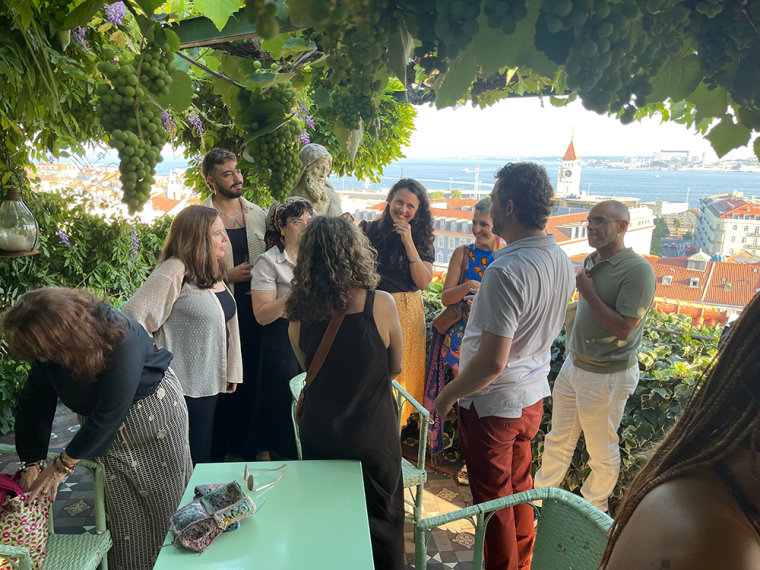
A last-morning get-together at Disquiet. (Credit: Disquiet International Literary Program)
I don’t mention all this to try to excuse how I behaved in Lisbon, or even to suggest that a certain slouching, go-screw attitude was, what, a by-product of my grief, or something? I’m just trying to describe a particular season of life in which I mistook cynicism for realism and sarcasm for a sense of humor. Because this is the not-quite-fatal flaw of literary conferences, literary retreats, and so on: They ask the best of us as writers and people, but we’re not always at our best.
Honestly I hadn’t seen any way around applying. Lusophone culture obsessed me—the music, the food, but especially the literature. By the time of Disquiet’s application deadline, I’d spent a semester translating a series of “labirinto” poems by Luís de Camões, bard-sailor and chronicler of Portuguese empire. How cool would it be, I thought, to see the very port from which Camões had sailed to Goa under that cloud of scandal and infamy? More important—most important—the Late Eminence, author of a certain 614-page epic of the Vietnam War, would number among a ridiculously accomplished group of workshop leaders and writers-in-residence.
So, anyway, I applied. I got in, then guilt-tripped the University of Houston, where I was an all-but-dissertation graduate student, into helping me cover airfare and board. Maybe you know what I mean when I write that it all seemed too easy, as though I were about to step off my cut-rate flight and into a long con or black-market organ scheme. I kept waiting for the other shoe to drop even after I landed in Lisbon and found my workshop populated by cool, talented people, the city exactly as beautiful as I’d heard it was. Even the locals were friendly. And though I’d often heard that you should never meet your heroes, the Late Eminence seemed to be everything I would’ve dreamed him to be, had I allowed myself to dream of such a thing in those dark days: funny, that is, and a little shy and humble about his success.
“I’m the second-best writer in my house,” he said more than once before smiling over at his wife, who also seemed great.
The Late Eminence didn’t remind me of my dad so much as he did my dad’s closest friends, a group of recovering poets, refugees from the sixties who used to wash up on the waxy olefin shore of my parents’ living room and yarn there for three, four weeks at a stretch while the Cubbies played the Cards on WGN. In theory, this should’ve made it easier to walk right up to the Late Eminence and explain how much his work had meant to me. I could have mentioned that I’d brought with me to Lisbon the hardcover, first-edition of his National Book Award–winning novel, a book I’d given my dad a few years earlier (or that he’d given me, I can’t remember which, and it doesn’t matter anymore; most of his books are mine now).
What still drives me crazy is to think how it all might have gone if I’d just managed to get out of my own way. But I couldn’t, not at first, or else I just didn’t want to. Sarcasm has its place, sure, but it’s dangerous when it becomes your modus operandi, a sort of background program of the mind that nullifies everything by placing it in a pair of quotation marks: “Everything.”
An idyllic view in Lisbon. (Credit: Disquiet International Literary Program)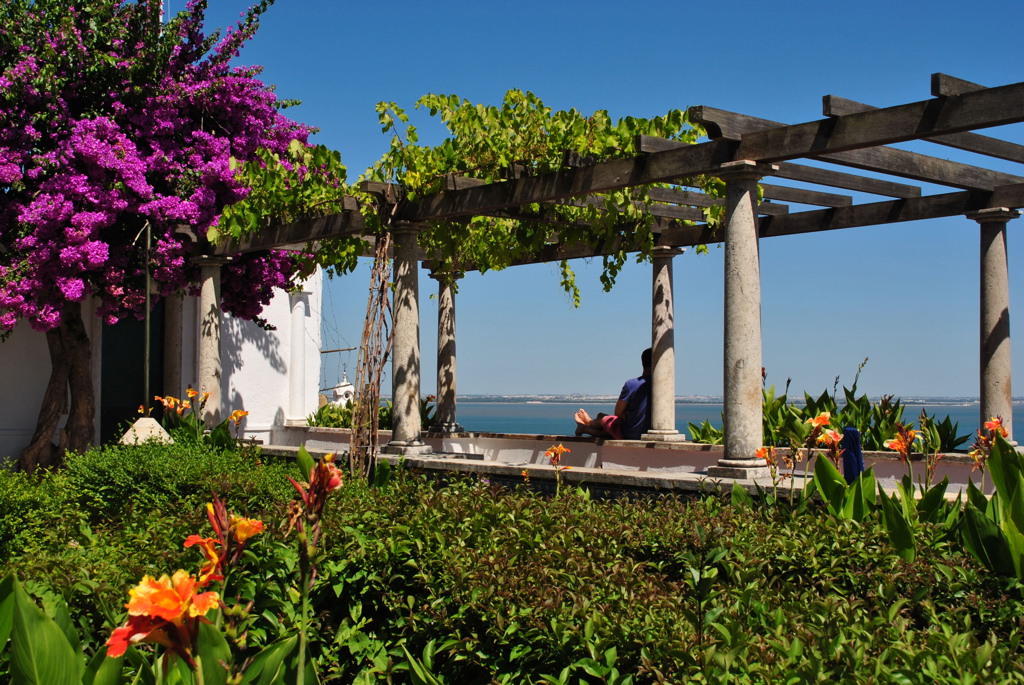
Suppose then a Friday. Suppose another faultlessly sunny Lisbon day has elided into a pleasantly cool Lisbon evening. Suppose you’re standing with a group of writers at a wrought-iron fence and that among them is the Late Eminence, your literary idol, the living yardstick against which you’ve measured everything you’ve ever written. Suppose everyone is admiring the view, staring wordlessly out at the rolling hills where the Portuguese built and then rebuilt their capital. Suppose you find yourself trying to be funny, saying something like:
“Man—what a shithole, right?”
I’d meant something like the opposite: Can you believe our good fortune to be here, to be alive and in good health and, most important, together? But that’s not how it came across. I remember just a brief silence, then a guffaw detonating on the far side of the half-circle, then the Late Eminence deadpanning:
“Man—what a schmuck, right?”
Maybe he didn’t call me a schmuck; I’ve replayed this moment so many times that I’ve worn actual holes in it. Maybe he just wondered aloud: What’s this guy’s problem? It would’ve been a good question, one for which I had no real answer. Ten or so minutes later, still squirming with embarrassment, I made my way back to my hostel and up to my room. By the time my head hit the pillow, I’d decided to blow it all off—the lectures and demonstrations, the community dinners, even the workshops—not so much because I didn’t want to go to them, but because I didn’t want to be around myself when I got there.
And this is the too-often overlooked virtue of literary conferences, literary retreats, and the like: It’s understood, even expected, that at some point you’ll go do your own thing. The Disquiet International Literary Program—any and every literary program—is of, by, and for writers. We writers aren’t necessarily famous for our social graces, tending as we do to get lost in our own stories. That night, for example, I had no idea that the Late Eminence would be cool, even friendly the next time I saw him, that he’d laugh the whole thing off; it was as though that beautiful evening at the Miradouro de Santa Luzia had been merely a joke, or a nightmare. That night, I had no idea that the four-thousand-word piece I’d submitted to the Disquiet workshop would breach its banks, widening until it became a sixty-thousand-word novel, and that when the novel was published one of the first people to write me with congratulations was a friend I’d met at the workshop in Lisbon.
Probably it’s better this way: As writers, as people, we never know what’s coming. On Saturday morning, I woke up early and took the train northwest, to Sintra, where I stared in what I can only describe as a state of appalled wonder at the rose-and-citrus castle there. What kind of a schmuck, I remember wondering, builds a thing this beautiful and then keeps it all to himself? And that may have been the exact moment things started looking up.
Applications for the 2026 session of the Disquiet International Literary Program in Lisbon are now closed, but the program is expected to run again in summer 2027; applications are typically due December 5 of the preceding year. For international adventure and fresh perspective, also consider the Iceland Writers Retreat in Reykjavík, held from April 15 to April 19 for poets and prose writers, and the Himalayan Literature Festival and Writers Workshop in Kathmandu, held from May 29 to June 5 for poets and prose writers.
For details about nearly two hundred transformative retreats, search the Poets & Writers Conferences & Residencies database.
JP Gritton is the author of the novel Wyoming (Tin House, 2019). His translations from the Portuguese have appeared in Asymptote, Brooklyn Rail’s InTranslation, Literary Matters, and the anthology Cuíer: Queer Brazil (Two Lines Press, 2021). He lives with his wife and son in North Carolina, where he teaches creative writing.