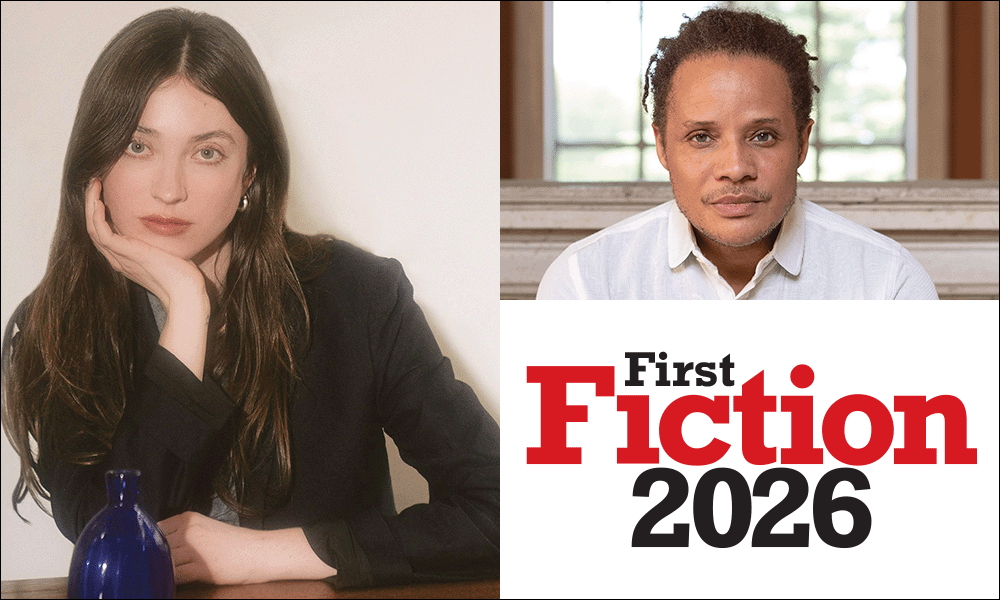
Devyn Defoe, whose debut novel, Burnside, will be published in August by Astra House, introduced by Jamel Brinkley, author of two books, most recently the story collection Witness, published by Farrar, Straus and Giroux in 2023. (Credits: Defoe, Ziru Mo; Brinkley, Daniele Molajoli)

Devyn Defoe and I met at Stanford University, where we were both incoming Stegner fellows in the fall of 2018. For the next two years, I would have the great pleasure of reading her work and getting to know her mind. Defoe’s work was dazzling. I was immediately struck by her fictional dreamscapes, which felt enchanted as well as cursed, full of life and on the precipice of death, both earthly and otherworldly. The prose was sharp, vivid, intelligent, and breathtakingly sentient but at the same time marked with a trace of Chekhovian or Didionesque coldness.
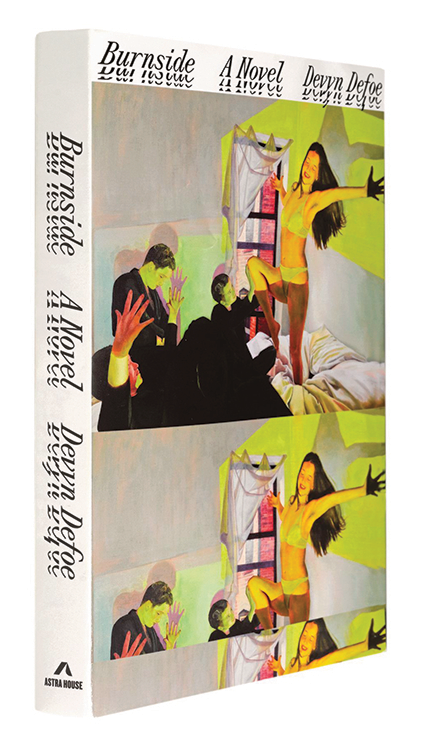
Burnside is the tale of two young women living in a strange, unforgettable, rather terrifying city in California. The book reflects many of the concerns I saw in Defoe’s work back then, including climate disaster, the brutality of capitalism, and violence, particularly the threat of gender-based violence. The prose, delivered in the voice of one of the young women, seems somehow even more varicolored, even more exciting on the level of syntax. There’s a breastaurant. There’s a rat bus. There are mysterious fires. It was a thrill to encounter such odd pleasures in the novel—pleasures I craved and that felt familiar to me—but also to observe, with admiration, the degree of artistic execution. This book is ideal for readers who love language and who are trying to reckon with the world we live in now.
I’d love for you to talk about how Burnside began and developed—the story of the story, so to speak. What guided you most reliably to the completion of the novel, and what were the biggest hurdles?
I had moved back to Sacramento and was noticing shades of the city, the ways it had changed since I’d left, the coldness particular to midsize cities where everyone tangentially knows everyone but nobody really talks to their neighbors unless it’s concerning a property interest. I was ruminating on Sacramento’s unsettling history of serial killers and also on my childhood spent listening to the lurid details of murders due to the nature of my parents’ jobs—they’ve always worked in law, and today they’re both judges. I was interested in how these grisly narratives had rooted into the public psyche, almost like folk stories. The true-crime genre was experiencing a media reckoning and also heightened attention with the arrest of the Golden State Killer, which had some sticky personal significance to me. My dad signed the arrest warrant. Originally there was a goal to write something similar to the book Murderland: Crime and Bloodlust in the Time of Serial Killers [by Caroline Fraser], though fictionalized and much less scientific; it started as a metaphysical investigation into whether violence could be an emergent property of landscape. There was no map to the end, at any point; it was a gradual discovery through the characters. The biggest hurdle was the ending. I resisted it for a long time; I wanted something else to happen. Accepting what the book wanted to do was the only way forward.
Once the book was acquired by your publisher, how significantly did it change during the editing process?
Quite a bit. We fleshed out the narrator’s backstory and added more definition to the background mystery. In many ways the editing process was a relief because I’d spent a long time stewing in the text by myself, and it’s such a joy working with smart people. My editor, Maya, and I share so many of the same literary influences and interests, like Joan Didion and Toni Morrison, Northern California and the particulars of the weather and the vibe. It was really a perfect match. Mostly we worked on adding scenes and shaping the narrative arc.
Readers will be taken immediately by the unnamed narrator’s remarkable voice. How do you think about the element of voice in fiction generally, and what were your goals with this specific voice?
I love to reach the fugue state where the rhythm of a sentence takes over and determines the next. It starts from sound. Similarly the narrator is somebody who would like to relinquish control, for someone else to take responsibility. She’s sort of alien to herself. She’s figured out all sorts of ways to disappear. Voice is slippery, sort of inherently suspect; you look for the decorations. Different facets of her character leaked out through the places she’d shine a spotlight on and through her evasions. Ultimately I was most interested in the fractures, the places she can’t bear to look, where the language breaks down.
What do you think of as the fundamental unit of prose composition? Is it the sentence? The paragraph? Something else?
The quintessential Stegner question—I don’t think I ever figured out my answer to it. If there’s anything I love more than a paragraph that goes on forever, it’s a sentence that goes on forever, and in either case most editors will want to splice it, so the distinction has little utility to me in terms of drafting. But I experienced both situations during the edit. For the most part a split paragraph had little impact on the text, but splitting a sentence cast all sorts of surprising ripples that shifted how I approached the fault lines in the narrator’s psyche; it was quite generative. The sentence is closer to the nerves, but I’m suspicious that those who pick the paragraph are able to more clearly articulate their thoughts.
The great Nina Simone famously said that the artist’s duty is “to reflect the times.” How would you describe your artistic obligation, if you believe you have one? How do you think about Burnside, as your first major artistic statement?
I don’t think it’s something I thought about consciously during the writing process, but there was always the desire to reflect the turbulent economic situation of millennials and younger generations and to decry that stupid, smug avocado-toast-boomer rhetoric that was so common a few years ago. You still hear it sometimes now but blessedly far less often. I think it would have been impossible to write if the intention had been to make a statement. I write because I have to. If I didn’t I’d lose my mind.
Anaïs Nin’s theory that fiction developed as a form for confronting the taboo, the shameful subject too awful to discuss, is the best summation of my thoughts about Burnside. I’m reluctant to speak too much for the book—I’d rather it speak for itself. But I consider it a horror story. Didion talked about her novels as cautionary tales, to an extent. I feel more or less the same.
An excerpt from Burnside
It felt, the majority of the time, that there was no ground beneath my feet, that holes could open up along unsuspecting roads, that even in the comatose flat of the valley I could trip easily off a cliff, and instead of feeling any sort of surprise, understand immediately that I had not been looking closely enough at my surroundings. In those days I entered into situations with the almost religious expectancy that something catastrophic would shock into motion the propulsive mechanism so clearly operating in the lives of others, along for the ride in the purest sense, pointing out as it passed out the window the Valero station where unleaded gas was cheaper by thirty cents. For a while I involved myself with a man I met in the corner of a house show in Southside Park. I felt his eyes on the back of my neck, the enormous pressure of the surrounding walls, a point in the revolving center of the room as dense as lead. Do you realize that no one in your town says hello? It was the first thing he said to me, before hello. He kept much to himself, including his first name; I called him Donner, which was apparently his last. He claimed he was descended from those misfortuned pioneers stranded at Truckee Lake who ate the bodies of their dead relatives; I never knew if this was true, but found the story suspicious, assuming the name would have died along with the men. He was from someplace else and just passing through, though he seemed to have gotten stuck along his way, crashing on a couch in the flophouse on I Street. He had been here long enough that he was working, somewhere, under the table. He’d gone to some liberal arts college and considered himself a vagrant philosopher of sorts, or maybe an anthropologist, shifting between places, latching on to regional affectations that seemed to him representative of something dire and looming in the psychosphere. He had a small Moleskine notebook in which he wrote down regurgitated snippets from university press books. I flipped through it sometimes, whenever I was waiting for him in his car. He cited Thomas Moynihan, Schopenhauer, Bataille. Something had pushed our species to orient the spine perpendicular to the ground, a secret above us we were always trying to reach. The history of violence on earth could be directly mapped along the human spine. He told me that the body was a prison spurred into existence from the initial confrontation of life with itself, that the first faces among organisms emerged in cannibalistic flatworms out of the need to protect the violated self. Nothing was inseparable from the reactive core of an original suspicion.
He had a long scar down the side of his neck that he attributed, only when I asked, to barbed wire.
From Burnside by Devyn Defoe. Published by Astra House. Copyright © Devyn Defoe 2026. All rights reserved.