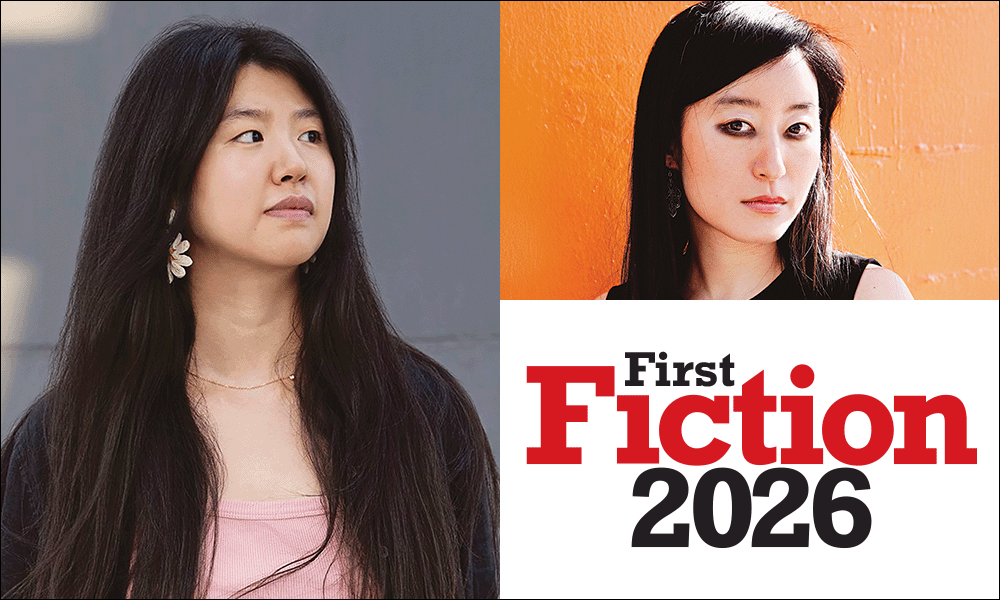
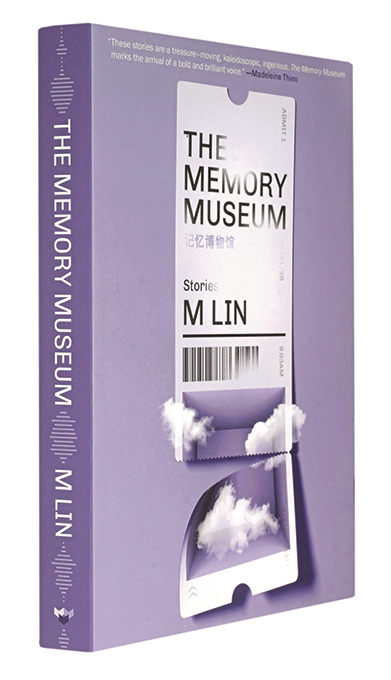
M Lin, whose debut story collection, The Memory Museum, was published by Graywolf Press in April, introduced by R. O. Kwon, author of two books, most recently the novel Exhibit, published by Riverhead Books in 2024. (Credits: Lin, Guo Guo; Kwon, Smeeta Mahanti)

I met M Lin at the 2024 Sewanee Writers’ Conference in Tennessee, where I was co-teaching a fiction workshop with Sarah Shun-lien Bynum. Upon reading the first few lines of Lin’s writing, which evoked a hot summer in Beijing, I broke out in chills. The language was precise while verging on the epic, melancholic yet surreal. I knew at once: Here was a voice I wanted to follow.
I was right, and I have. Now with the publication of her debut story collection, The Memory Museum, everyone can read nine of Lin’s thrilling, virtuosic stories about Chinese people in the diaspora and in China, including a couple on a divorce honeymoon, migrant workers, a censorship-balked filmmaker, and thieves. The fiction in this relatively slim but expansive book spans places from Shanghai and Pittsburgh to Morocco and New Zealand, time periods ranging from the contemporary to the distant future, and so much more.
What has surprised you over the course of writing and editing The Memory Museum?
I love this question—it’s such a writerly query because perhaps only writers understand how much of what we write is surprising and sometimes even mystifying to ourselves. I started writing fiction in 2020 and wrote the stories in The Memory Museum from 2021 to 2023. This is to say I was very new to all of this, and therefore so much of the book is surprising [to me]. In retrospect I am surprised by how many of the stories were born whole, meaning that the first drafts were very close to the finished drafts. As I continue to grow as a writer, I’m learning those are fortunate anomalies—beginner’s luck, one could say. In the course of writing, I was most surprised by how comfortable and interested I was occupying a diverse range of perspectives, sometimes even opposing ones, and fiction’s capacity to hold contradictions, perhaps more than any other art form.
I also want to mention surprises in the process of editing. With my editors’ inquiries, I was constantly surprised by how much deeper I was able to dig into the worlds of these stories and how much more there was to discover about these characters and their lives. I am a firm believer in editing and a collaborative editorial relationship.
How has the book changed?
Even though some edits we made might look insignificant on the page, their effects are endlessly significant. That is the art of editing and of language, right? Like the ancient Chinese saying goes—when a single thread of hair is pulled, the whole body moves. The butterfly effect of the most granular.
My relationship to the book has also changed. Inevitably in the process of publishing, the book becomes more and more of a public object, not to mention the commodification of it. I’d still like to maintain my own private relationship to the text, but at the same time I understand that I have to let it go into the world, hope it will have a life of its own, wish it the best, and move on.
I imagine there are scenes, characters, and maybe whole stories that didn’t make it into this collection. Maybe they’re compost. Are there any such scraps that still live especially vividly inside you?
Yes! There is one story that didn’t make it into the collection. It had too many things to say, things I still hope to say in other ways. It was the only story in the collection that started with an idea instead of a character or a situation or even a feeling. It had many facets I wanted to explore, almost like an essay. The ideas were many: Asian versus Asian American, immigrant versus émigré, interracial dating, female friendship, solidarity versus individuality, a person’s perception and self-perception—you see the problem. On a craft level I wanted to attempt an idea story: What if a story’s aim is not to emotionally move but to intellectually engage the reader? How could I organize time and space differently in such a story? What are the limits of a narrative, and how can I stretch them? Can we accept a messy narrative to reflect a messy reality and resist the urge of clarity and conclusion? Writers past and present have addressed such questions in their work, and I wanted to see what my answers might look like. I don’t think I figured it out with that story, obviously, but I’ll keep trying.
What advice might you have for an earlier writer self, the younger M Lin who is just starting out?
This may be my effort to give myself the easiest narrative in order to move forward in life, but I believe that whatever mistakes my younger self made are what shaped me into the writer I am today. They were all necessary, precious, and meaningful. So no advice. Okay, maybe I would tell myself to enjoy the early writing days more, without an agent, without a book deal, without an understanding of “the industry,” when writing was pure—pure pleasure and pure pain—and so full of potential.
The range of the stories—geographic, of course, but also temporal, situational, structural, and epistemological—is remarkably, beguilingly wide. What sent you flying so far from one story to the next in motifs, preoccupations, and so on, if in fact that was how it felt to you?
On a craft level I was more aware of the wide range of experiments I was trying: a retrospective voice with long temporal distance and vignettes in “Scenes From Childhood,” multiple perspectives and flashing forward in “You Won’t Read This in the News,” intentional narrative distance while still striving for intimacy in “Shangri-La,” inserting a screenplay in a short story for “Touch Egg,” a polyphonic portrait of a political movement in “野火烧不尽/no prairie fire can destroy all the weeds.” I was an excited new writer and played with my material not unlike a child with a new toy, I suppose. However, the content of these stories did not feel far-flung from one another at all. All of them are rooted in my own life and those of people I know. Perhaps they speak only to the multitudes of contemporary China and the Chinese diaspora, for whom reality can be very fractured, and the multitudes of people in migration. Frankly I believe it is the condition of our times. Nevertheless, just beneath the surface, if one is willing to see it, everything, every thing is connected.
Do you have any fears or anxieties around publication that you’d feel all right discussing?
Usually I’m not an anxious person, but I did start to get anxious when we first headed into publicity. I didn’t know all of that is part of a writer’s work—or, rather, the published author. Once I recentered myself and realized that much of the publishing process is out of my control, the anxiety faded. The Memory Museum is a book I’m proud of. Now my fears and anxieties mostly involve the future; I want to continue writing books that I can be proud of.
An excerpt from The Memory Museum
“Scenes From Childhood”
II. Curious Story
I was born and raised in the former capital of China in the early 1990s. My parents had met in Tiananmen Square in May of 1989, when they were university students, not long before the history of the country was forever changed and its future trajectory irreversibly determined. In the crowd charged with ambition and optimism, my mother heard my father talking in the dialect of the province where both of them had grown up: my mother a city girl from the provincial capital, my father, the youngest of a farmer’s three sons, from a poor village.
The adjective poor was my father’s retrospective modifier when he told me stories of his childhood, describing the kind of poverty that had become obsolete by the time I could understand the weight of what he said. I never asked him whether he had realized that it was redundant to stress that his village was poor, because every Chinese village in the sixties and seventies of the last century existed in absolute destitution. He told me how a piece of flesh along the edge of his ear froze off because his family couldn’t afford a winter hat, how every week he walked three hours to his middle school in the town center, rain or shine, and how by the end of the school week he had to dip his hardened bread in hot water so it would soften. He loved talking about Spring Festivals the most, the utter ecstasy of seeing meat on the dinner table once a year, and, proudly, the fact that at seventeen, when he had scored high enough on the College Entrance Exam to enter a prestigious university in Beijing, he had never ventured farther than his own town. At the time, I, who was fed imported formula and traveled abroad at the age of six, felt bad for the child who became my father. But from where I’m sitting now, his childhood seems idyllic, utopian even—a time when money could solve all problems and people could take comfort in believing that life was always going to get better.
At least once a year, my parents took me to visit Grandpa, my two uncles, and their swarm of children, and at first, the village confused me. Whenever our taxi wound along the dirt path into the village, curious onlookers would watch from the side of the road. They sat on short wooden stools on their stoops, their gazes following us all the way to Grandpa’s house. When we emerged from the car, they stood up and waved at my father with recognition—It’s An and his wife and daughter coming home from Beijing! They flashed friendly smiles at me, calling me by my pet name, Tiaotiao, as if I should have known them as intimately as they seemed to know me.
It took me some time to understand why our arrivals played out that way. The first thing I understood was that the villagers were not outside because they were expecting us; it was simply how they passed time when they were not working in the fields. Sitting before their houses’ red metal gates, they waited for others to stop by for a chat, a meal, or a cup of tea. Sometimes they kept their hands busy, knitting sweaters, sewing shoe inserts, or shelling dried corn into straw baskets to make cornmeal. More often, though, they just sat in the sun, looking at whatever entered their field of vision. Don’t you have things to do? I wanted to ask them. Adults in Beijing always had things to do. Even I, a child, had things to do: homework, games, books, parks, museums, playdates, and piano lessons. The villagers seemed to live in an alternate universe, where time ticked in adagio instead of allegro, and there was always an extra beat to rest. They sat in front of their houses as their shadows tracked Earth’s spin like sundials. I remember thinking, when I was old enough to recite Reform and Opening slogans like Time is money, efficiency is life, that they were squandering their money and lives away. I didn’t know what I know now: that economic development is a sham, Confucian work ethic is repression, time is not money and efficiency is not life, and that I was allowed to take breaks, to waste time, to not do.
The last time I visited the village, a few years before I fled the country to avoid arrest, people no longer sat by the then-paved road. Smartphones had taken over the village like they had elsewhere. Like their city counterparts, the villagers stayed in their own houses and learned about each other’s lives on tiny screens, so aesthetically enhanced that they stopped recognizing the real faces on the street. Back when I was a child, grown-ups gathered in each other’s houses, congregating around tables, the men boisterous and unpleasant, drinking and chain-smoking, while the women conversed quietly in their company, occasionally coughing from the blinding fog of smoke. The men’s favorite drink was dizzy water—that’s what I called the sorghum liquor in green bottles. Just a few cups of it made the biggest man walk as if he had just pirouetted for ten minutes. I knew the women in the room hated it as much as I did, but they didn’t have the privilege of a child, whose absence was tolerated without judgment. I made my escape as quickly as possible and wandered around outside.
Whenever the villagers saw me on my own, they would stop me in my tracks and say, Come here, Tiaotiao, but I wouldn’t come close until they spoke again and introduced themselves as my father’s uncle’s cousin or my father’s cousin’s uncle. One by one, they told me their memories of me as a bubbly toddler and how fond they were of my pet name, “jump jump.” I did not like my name, for I didn’t think that I was a jumpy child. It was not until much later that I learned that the rural tradition in the North was to give children flippant and demeaning pet names, names much worse than mine, like “stinky egg” or “dog leftovers,” so the gods who like to take away the good kids would skip over the obviously unworthy. My name was to protect me. Could that be why I have survived until now?
From “Scenes From Childhood” from The Memory Museum. Copyright © 2026 by M Lin. Reprinted with the permission of Graywolf Press, Minneapolis, Minnesota, graywolfpress.org.