
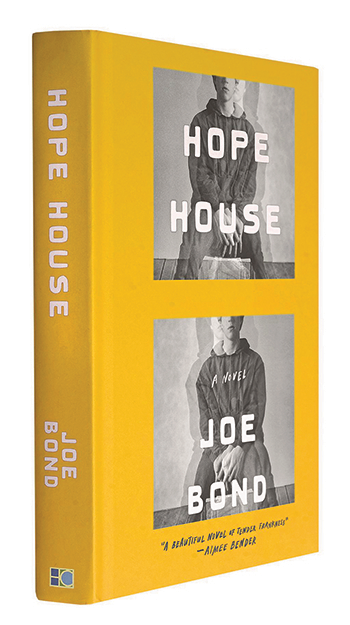
Joe Bond, whose debut novel, Hope House, was published by Hub City Press in May, introduced by Aimee Bender, author of six books, most recently the novel The Butterfly Lampshade, published by Doubleday in 2020. (Credits: Bond, Kelli Hall; Bender, Mark Miller)

Years ago, while reading for a contest, I came across a story about teenage boys in a treatment home and immediately leaned into the freshness of the language, the emotional depth reached so quickly through an attentive and thoughtful image-maker, the high stakes delivered with a light hand, and I chose it as winner of the Masters Review’s 2018 Winter Short Story Award for New Writers. What a true thrill, years later, to encounter these characters again in a novel—set in Kentucky in the 1980s—to spend time with them as a group and also on their own as they grow and don’t grow, as they reach out into the world and close in on themselves.
The book shifts back and forth between a range of points of view, always considering who is fitting in and at what moments. This is a novel about home, but it is not sentimental or easy; the boys in the book are dealing with heaviness and uncertain futures, and Joe Bond never shirks from the weight of what they’re dealing with. He’s a gifted writer, and there’s a powerful humanity within this book, something we need badly these days.
It’s been inspiring to see this full and layered world evolve from what was such a memorable short story. Can you talk about expanding a short form into a longer one? How did you tease out and develop all the thematic strands?
The novel actually began as poems. I didn’t have much time to write. I would stand around playgrounds all over Atlanta watching my son and jotting down lines about kids I remembered [growing up with]. By the time I worked a poem into a story, I already had a half dozen boys on the page. That first story left me some clues as to who they really were and how they might come together, but it also showed me what was missing. You can’t understand troubled teenagers without knowing what they’ve come from. A kid sold drugs. Okay, but why? Another beat up an old man. That’s awful, but what led him to that moment? The boys I grew up around in treatment called their stories “past histories.” A novel gave me the space to follow their lives back a little further and let those histories sit side by side. That was important, but I was even more interested in the present and how the boys relate to each other inside the home—how they talk, what they notice, the small ways they care for one another, and the ways they don’t. The novel form let those interactions accumulate over time, so that their lives began to feel shared rather than separate.
Voice and dialogue are so important to this book, and you gather such a distinct group together. What is the role of the ear in your work—listening in real life and to your imagination?
In the home my dad ran, we had kids from the city, the hills, and every place in between. I was always around—shooting pool, playing basketball, sitting in on group counseling. I never took a note. I never imagined I’d write about it—I was too young. But when I started those poems years later, that world came rushing back, and I found that the boys’ voices were ingrained in me like a brother’s or a best friend’s. They couldn’t talk like they had back wherever they were from. They couldn’t curse or use slang, but still you could hear in their voices street and country, and when blended with the vernacular of treatment, it gave the home its own unique language—restrictive but also liberating, allowing the boys to be vulnerable in ways they couldn’t have been otherwise. They were experts at manipulating its rules and rhythms, often inverting them into little acts of independence and disrespect: “Sir, Mr. Watts, sir, you already told us that story, sir.” As I wrote, memory and imagination worked hand in hand, with voice often arriving before I knew who a character was. You get two teenagers talking after lights-out and you start to understand them. What do they dream about? What are they scared of? Where are they going to go when it’s time to go home?
I’m wondering about point of view, too, as what you’re doing feels unusual and very effective. You’re mostly using a “we” first-person plural POV as a guiding framework, but then you’ll spend time with a particular character, moving closer to third person or even first person. How did all of that help you capture these characters alongside the overall feeling of the group?
In real life you could feel the “we” the minute you walked into the home. When the group was running well, there was such a powerful sense of togetherness that it infiltrated everything the boys did, right down to how they spoke: “This group is about to get itself right.” The first-person plural captures the group’s consciousness and cohesion, the boys’ shared sense of self. It’s an articulation of belonging from a group of boys who’ve never had anyone. But it comes at the cost of losing individual identity. I wanted that tension between the group and the individual to course through the book and reveal something about each kid. In the end they’re all going to be out in the world again, on their own, and the shifts in point of view allowed me to acknowledge that fact while preserving their individual stories.
In addition to writing, you’ve worked in a variety of roles—as a childcare worker, a security guard at a psychiatric hospital, and more. What can sentences and imagery do to capture the experience of what it’s like to be face-to-face with another person? I’m thinking about why we need language to capture our lives, along with all the crucial ways we connect with each other.
Writing has been a way for me to make sense of my life. As a kid I thought I would run a home one day—that was the plan. It didn’t happen. Growing up around the boys was such a unique experience, but those years were gone to me. They didn’t seem to fit with how the rest of my life had played out. Writing recovered them and gave me a new way of seeing them. Becoming a father changed what I felt for the boys and their parents and the people trying to help them—people like my dad. Writing the novel helped me understand him, too. His mother ditched him. He never had a father. He was like the kids he worked with—one of them. That wasn’t something I understood when I was young. It took time and it took language, stories. I believe there’s magic in how a book comes together and what’s shown to us when we slow down and stay with something. We begin to see beauty and tragedy and complication—life in depth. Revisiting a group home on the page, seeing some of the kids again, and their counselor, did that for me. Writing is hard, but there are reasons we keep at it.
An excerpt from Hope House
Absent Without Leave
We came from all over the state, from five minutes outside of Cincinnati to an hour out of Arkansas, from the streets but also the sticks, from projects like City Heights to shotgun shacks in Clay City. Some of us were lifers—we had come to Hope from other homes, other programs—and some were temporaries, but all of us were runners.
We ran two days before Christmas, the day after Thanksgiving, and Sundays when no one came to visit. We ran when the group had it out for us and the JTOs did too, when we didn’t earn a phase, when we didn’t earn a phone call, and when our best friends went home.
But mostly we ran when we were new. You couldn’t lose your phase if you were on Orientation. You couldn’t lose your time if you hadn’t put any in.
That didn’t mean there weren’t consequences. Jon Alan, the first time he ran, bolted bowlegged down the hill on a Saturday night to meet up with a woman he had supposedly made love to. We were sure she didn’t exist. Watts brought him back late that night with his face blown up like a basketball. Peers thought he’d been beat, but he’d got himself lost in the woods was all and the mosquitoes had eaten him alive.
You could run—the doors weren’t locked—but that didn’t mean you were getting anywhere. It made a lot more sense to wait until we were already out in the community, so we did. We ran off from day treatment, basketball tournaments, and fishing trips. We ran off from church—every head bowed, every eye closed. We ran when Watts took us into town to see the fireworks and a group of high school girls laughed at our Skippys. They were dressed up, beautiful, and there we were in the cheapest, sorriest shoes the state of Kentucky could get a deal on. Watts couldn’t put us in anything better because he’d spent the last of his money—our money—printing Hope House into the chests of our phase shirts as if it were something to be proud of, something to announce, the whole group wearing the same damn outfit and our heads shaved. We could see it in the eyes of everyone we passed that they couldn’t decide whether we were criminals or in a cult.
We ran when we realized we weren’t free, that there was something other than walls between us and the world. We ran when we remembered where we were and where we weren’t but also when an opportunity arose, when staff left their car keys in their jackets, their jackets draped over the desk chair in the hall. Every so often our legs took off on their own—we were running before we realized it.
It was a problem. People in the community didn’t want us out on our own, stealing their cars, breaking into their homes. Watts warned us: They’re gonna shut us down.
Still we ran, even when we weren’t sure what we were running from.
That first time I took off, I thought I had it all planned out. I told myself all I had to do was make it to the highway, and then I did—I made it. I’d imagined sirens, a search, dogs on leashes pulling the police along in the direction of my scent. But it was quiet out. It was cold.
A pair of headlights broke through the darkness. I jabbed my thumb out over the road and waved my arms. I couldn’t believe my luck—a pickup truck, and it was stopping. I caught up to it out of breath, my heart pounding inside my chest. The passenger-side window rolled slowly down and a stranger I could barely see leaned into his steering wheel and peered out at me.
In all my eagerness to be free of the old house—free from everyone and everything in it—I had failed completely to anticipate what I was about to be asked.
“Where to?”
I stood on the side of the road silent and stunned.
The guy asked me again—“Where you headed?”—but all I could do was stare at him, no idea, until finally he drove away.
From Hope House. Copyright © 2026 by Joe Bond. Used with permission of the publisher, Hub City Press. All rights reserved.