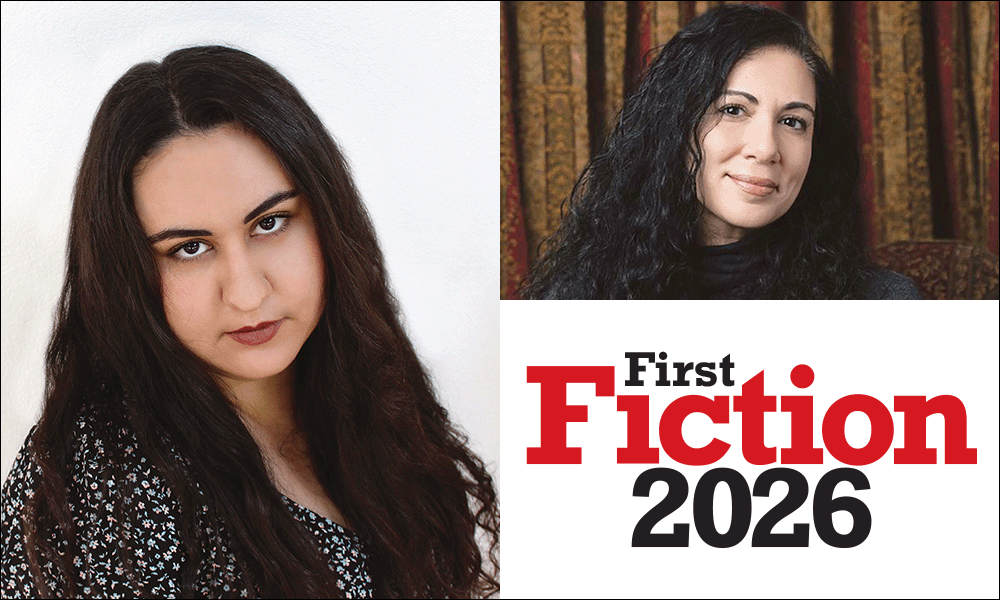
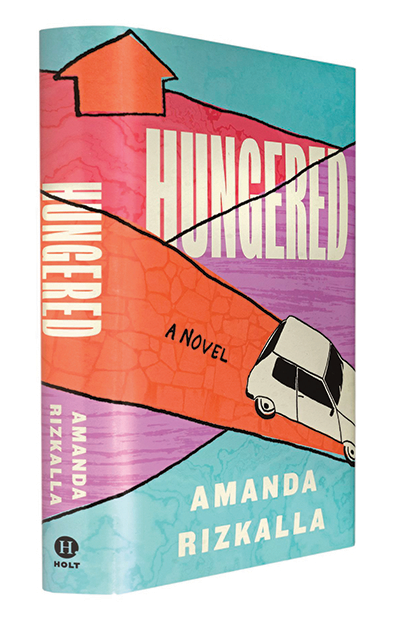
Amanda Rizkalla, whose debut novel, Hungered, was published by Henry Holt in May, introduced by Susan Muaddi Darraj, author of eight books, most recently the novel Behind You Is the Sea, published by HarperVia in 2024. (Credits: Rizkalla, Grant Kendrick Parker; Darraj, Matthew D’Agostino)

An advance reader’s copy of Amanda Rizkalla’s debut novel, Hungered, arrived in my mailbox just before I left for a trip to Tampa. The night before my flight I read the first few vignettes in the book, immediately engrossed in the saga of young Sofia, a brave narrator struggling to hold her family—and herself—together while everything falls apart. The next morning, on the plane, I continued reading, entranced by the novel’s structure and Sofia’s vulnerable but resilient voice. In fact, after landing I sat myself down in the baggage claim area, my suitcase by my feet, and finished the last ten vignettes before calling a Lyft.
Rizkalla brilliantly portrays a young teen facing economic insecurity. Her mother has left Sofia’s father and is driving around town with Sofia and her brother, working extra shifts and trying to find a place to rent; until then the three of them sleep in the car every night, scrounging for food and a place to shower during the day. Sofia is constantly told to deny herself the things she craves—food, a warm bed to sleep in, true friends. Hungered is a stunning debut from a talented new Arab American literary voice.
Sofia is a dynamic character caught in the snare of others’ conflicts, such as the rift between her parents, the drama caused by her classmates, and the socioeconomic system that threatens her family. Amid all these problems, she nurtures her own inner life. What were your goals and challenges in creating her character?
When I began crafting Sofia’s character, I knew that I needed to understand what she might observe as well as what she might be unable to comprehend, to get a full sense of her voice—and her limitations as a narrator. At twelve years old, she is caught between childhood and adulthood, sometimes venturing into one before being pulled back into the other. Sometimes she sits up front with her mom, as an equal, and other times she sits in the back seat with her little brother, a child again. Her position in the car, and relative authority, changes throughout the book as she weathers the in-betweenness of adolescence.
I wanted Sofia to be more than her circumstances, more than a character who things simply happen to. It was important for her to have an emerging sense of self as someone who loves school and learning, wants to paint and develop close friendships with those around her. To bring her character to life and understand what felt important at that age, I tried to remember what it felt like to be twelve years old by listening to old songs, rereading my middle school diaries, uncrumpling notes I passed in class. This degree of understanding, of remembering, felt crucial to writing a book in the present tense, which demanded a minute-by-minute, sometimes second-by-second account of Sofia’s thoughts, feelings, and experiences.
One of the challenges in writing from Sofia’s perspective was having her notice but not fully make sense of things that I knew adult readers would pick up on. Sofia, while perceptive, often misses out on the full picture. Her limitations as a narrator made it so there was a second, invisible plot running alongside the events that Sofia narrates. It was a little like writing with invisible ink—intentionally leaving certain things off the page and trusting the reader would pick up on what was omitted.
One of the things I love about this book is its structure. Sofia shares a series of vignettes about the days after she, her mother, and her brother leave home. Some are lengthy, but some are quite short, conveying tension and urgency. How did you create and sustain this structure?
I knew that if I was going to tell a story that was largely about precarity and inconsistency, the structure of the novel had to not only accommodate these elements of the book, but also reinforce them somehow.
Early on in the writing process, I thought that in order to write a “real” novel—a respectable, publishable one—I needed to write it using traditional chapters. This was because whenever I walked into a bookstore, picked up a novel, and flipped through it, that’s what I would see: chapters of roughly equal length, organized by a table of contents. When we first learn about writing, it is typically through the rules that are passed down to us: grammar, spelling, punctuation. I think the same is true in storytelling. We learn by studying conventions. It wasn’t until I started reading more widely—novellas like “Days” by Dorthe Nors, which unfolds in a series of numbered lists, and Grief Is the Thing With Feathers by Max Porter, a novel-in-verse—that I realized I was thinking about craft the wrong way. Craft is a set of observations about writing, not a set of rules. Once I understood that, I began to look for a different form for the novel, one that better fit the story I was trying to tell.
Something I really appreciate about vignettes, and what made it apparent that they were a good fit for Hungered, is their inherent flexibility—the shortest vignette in the book is only a couple of words long, the longest ones span multiple pages, and toward the end some of the vignettes are merely sentence fragments, pieces of thoughts. Vignettes can make and then break their own rules, can change their mind about what they want to be. The same is true for the white space that follows each vignette, which I often thought about in terms of breath; the white space can hold the surprise of an inhale, the tension of a held breath, or the relief of an exhale. The sheer range of experiences that vignettes and the accompanying white space can capture is what made it a sustainable form for a story about a life in flux.
Admittedly, revising within this structure had its challenges. Rearranging the vignettes felt like staring at a hundred lily pads floating in a large pond and trying to figure out how to move them around without tangling the roots underneath—that is, keeping the causal links between the events intact. It helped to print out each vignette and try different configurations on the floor of my apartment. Eventually an order emerged.
This novel depicts economic insecurity and cultural divisions so realistically. Can you share the ways in which you wove these threads throughout the narrative?
To me those two aspects of the book get at the central loneliness of the main character. Sofia feels at odds with the people around her—financially, due to her family’s circumstances; socially, having been removed from her friends and trying to make new ones; and at times culturally, as a half-Mexican and half-Egyptian girl coming of age in the United States. However, she often lacks the capacity to acknowledge these feelings, let alone process them.
I know from my own lived experience, particularly as someone who experienced housing insecurity as a teenager, that these feelings hardly ever remain confined to any one part of a person’s life; they seep into everything. On a craft level this meant that these moments had to amount to more than just plot points. They are visceral, psychological experiences for Sofia. If something affects the narrator, it affects the narration. And if the narration is affected, then everything from imagery to syntax to structure will be too.
In terms of the story itself, I wove these threads through small, almost mundane moments in the novel—glances between classmates, exchanges between teachers and students, overheard comments from family members—knowing that in real life, this is often how these tensions materialize.
How long did it take you to complete the novel? And can you share a bit about the path to publication?
From the first draft to publication, it took about eight years. The novel began as a fourteen-page short story I wrote in my sophomore year of college. As soon as I turned it in, I knew there was more I wanted to explore in the piece, more I wanted to say, so I worked on it whenever I could for the next couple of years: in between classes, during quiet shifts at my work-study job on campus. Eventually the short story expanded into a novella.
After I graduated in 2020, I moved to the Midwest to attend the MFA program at the University of Wisconsin in Madison. That was the first time in my life that I could devote all of my attention to reading and writing and learning about craft, and that—plus the support of the truly amazing community of writers and faculty at the university—helped me conceive of Hungered as a novel. I met my incredible agent, Ayesha Pande, through the program, and we went out on submission in late 2024. The novel found a perfect home with my editor, Retha Powers, at Henry Holt a few weeks later.
What was the editing and publishing process like for you?
During the editing process, Retha helped me identify areas to expand as well as aspects of the story that needed clarification, to make the book the strongest version of itself. In her edit letter, she organized her feedback by character instead of plot, which helped me reframe the revisions I wanted to make. I feel lucky to have worked with someone with such a knack for asking the right questions, for pointing out things that I could not see on my own, and for doing so in a way that made me eager to return to writing. We did a round of developmental edits, then a round of line-edits, and then it was off to the copy editor. Every step of the way I knew I was working with a team of people who understood what I wanted the book to be.
An excerpt from Hungered
When mama and I wake in the morning, I lift Rafa’s head from my shoulder and rest it on a bundle of clothes—the yellow sweater I wore the day before, the puffy olive jacket teta mailed in a padded envelope from Egypt for my birthday last month. I climb into the passenger seat. We watch the sunrise together, mama and me. We watch it from the window. The sun has caught on the hook, the fisherman has reeled it up, and it sits flat and bright against the blue, dying.
“Mama,” I try again. “What about school?”
She says nothing.
The next day:
“Mama?”
“Sofia,” she says. “Stop.”
We go to the public library, where the soap in the bathroom pumps out in pearly white droplets. I hold them in my hands for a moment, the shimmering, slippery beads, and wonder who I could trick. If I could sun-bake them into pearls and sell them. Then maybe we could sleep on real beds tonight. We wash our faces, our necks, holding each other’s hair back from behind. Mama passes me the toothpaste from inside her bag, and I squeeze a peppermint trail onto my index finger. I swish warm water around inside my mouth—swishing, swishing—then spit it out. Rafa does the same. We rub toothpaste around our gums, our teeth, reaching in deep, and swish that, too. Mama washes underneath her arms and pats herself dry with a clump of brown paper towels. “All clean?” she asks.
“All clean,” we say.
When we drive to tonight’s parking lot, mama makes sure to stop at all of the stop signs because Camila, her friend from nursing school, told her that one time, around here, a police officer stopped one of her cousins for running a red light and then asked for his driver’s license. It all went downhill from there, she said. He is gone now.
“But anyway,” Camila said, walking into her kitchen to refill the water pitcher. It was a few days before we left baba and we were over at her house for dinner. “I’m sure Rhonda will put in a good word for you at the clinic,” she said, the knob squeaking as she turned on the faucet. “Plus, they’re short-staffed. They need people.”
Mama sighed. “I really hope so.”
“And your nursing license?”
Mama smoothed out a frayed corner of the place mat. She said she had kept it active, renewing it every two years ever since she stopped working seven years ago, when she had Rafa. If she let her license expire, it would become “delinquent,” and she did not like the way that sounded. “It’s renewed through next year.”
Camila nodded. “Then you’re all set.” She poured water into our glasses, the spout poking out like a beak from the pitcher.
We had tilapia for dinner that night, with crunchy battered-over fins, bones as thin as sewing needles, eyes like plump, clouded marbles. Camila made one for each of us, stuffing their bellies full of lemon slices and rosemary and garlic before dredging them in flour and deep-frying them. She kept a bowl of candy on a bench by the front door, left over from Halloween the week before. She offered some to us before we left her house, shaking the candy until it rattled in the bowl, the gold chocolate coins, lollipops the color and cut of jewels—ruby, amethyst, topaz. I wish I had taken some.
From Hungered by Amanda Rizkalla. Copyright © 2026 by Amanda Rizkalla. Used by permission of Henry Holt and Company. All rights reserved.