
T Kira Māhealani Madden’s debut novel begins for the reader as it did for the author, with a stranger’s proposition of murder.
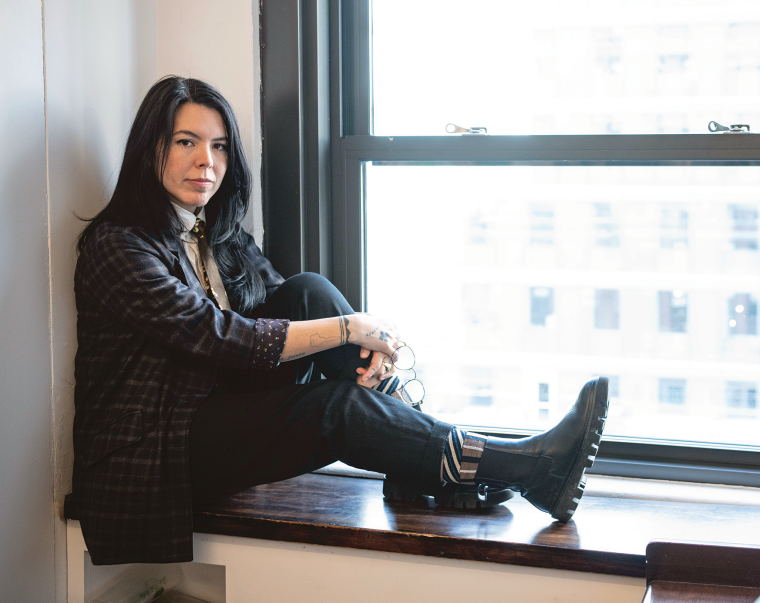
T Kira Māhealani Madden, author of Whidbey. (Credit: Donnelly Marks)
In Whidbey, published by Mariner Books in March, Birdie Chang is on her way to Whidbey Island off the coast of Washington state to hide from the world in general and, specifically, from a man named Calvin Boyer. Years ago, when Birdie was twelve and living in Florida, Calvin sexually assaulted her. Now, at twenty-eight, she is plagued by his incessant missives over e-mail—attempts to apologize, attempts to reestablish connection—and haunted by how a best-selling memoir by another of Calvin’s victims has spotlit the story in the media. When the handsome, inquisitive Rich Amani engages Birdie in conversation, she impulsively tells him about Calvin, a man she says she’d kill if she could. Rich offers to do it for her, no strings attached, to avenge her simply as a kindness. Not long after, Calvin is murdered.
If this setup sounds familiar, that’s because Whidbey pays homage to the opening of Patricia Highsmith’s 1950 novel, Strangers on a Train, brought to the screen a year later by Alfred Hitchcock. Madden was thinking of Highsmith when she penned it, though its inspiration came from personal experience. “This scene, which is the kernel of the story, is true,” she tells me over a cup of steaming mint tea.
In 2017, Madden herself was on the ferry to Whidbey Island, to Hedgebrook’s Writers in Residence program. During the residency she had to leave and return several times to get a restraining order against her stalker and childhood abuser. On one of those trips, she met a talkative stranger, a man. Exhausted, not eating well, frustrated that the peace of the residency had been broken by a predator who refused to leave her alone, she unburdened herself to him. In response he said he could “whack” this guy for her and no one would ever know she was involved. Disturbed, Madden distanced herself from him, but in the days afterward she spiraled. She’d told this stranger intimate details of her life, and there she was on an island, in the woods, isolated. She felt vulnerable, frightened—and curious. “I’m a very shy, private person,” she says. “Why was I so willing to tell him everything? What in me needed opening? What needed relief?”
Madden wrote a short story interrogating the situation but found it “flimsy.” These questions wouldn’t leave her. She had another story in progress, about a mother named Mary-Beth whose son was returning home from a long prison sentence. Madden wondered, “What if Mary-Beth’s son was the pedophile in Birdie’s tale?” From those alternating perspectives, Whidbey was born.
It would take almost ten years, countless drafts, hours of research, and hundreds of pages of backstory for Madden to bring the novel to its final form: a narrative that spirals outward from Birdie and Mary-Beth to incorporate a multitude of characters, each harmed in some way by Calvin Boyer, each let down by systems of incarceration and punishment that fail at their stated goal of safety and rehabilitation, and which offer no humane services of care and psychological support to predators and pedophiles, or their survivors. This is the narrative sleight of hand of an expert storyteller, to start with what feels like the entry point to a compelling, straightforward thriller only to reveal a sweeping, choral literary exploration of crime and punishment and the abuses society refuses to look closely at or in some cases, when it comes to the treatment of sex offenders, even acknowledge.

Madden meets me at a New York City café, which on Fridays lays the tables with watercolor trays and reserves them for art making. I had no idea this would be the case, but Madden, with a playful smile, is game to paint while we chat in the Greenwich Village establishment. In fact she appears at home with a paintbrush in her hand, layering shades of purple and blue on the thick, cream-colored paper. Though she lives in upstate New York, she’s dressed in black coveralls and Chelsea boots, her face adorned with stylish red glasses, the quintessential look of a downtown Manhattan artist.
“That whole Hedgebrook residency I was pushing on bruises,” she tells me. Her father had recently died, and writing from grief moved her to examine a variety of tough experiences from her childhood in Florida, such as her parents’ addictions, being bullied by peers, and her sexual abuse. A fiction writer at heart, she thought writing a couple of essays might clear her head, but each piece raised more questions, which she followed. At that point, in her late twenties, it had been five years since she received an MFA from Sarah Lawrence College. She was working on her sixth book—none of them, at that point, published—and querying agents to no effect. Figuring she had nothing to lose, she included essay pages along with novel excerpts in her query letter. Agents responded to the nonfiction, and so, almost by accident, Madden ended up writing a memoir.
Long Live the Tribe of Fatherless Girls was published by Bloomsbury in 2019. Madden makes clear Whidbey is not autobiographical—if you want to know her story, you should read her memoir—but the experience of publishing Long Live did have a profound impact on the novel and on Madden’s life. In the course of publishing and writing nonfiction, her abuser resurfaced in her life. The court appearance Madden was reeling from when she met that stranger on the ferry eventually led to a federal case against her abuser, which brought her in contact with other victims. (I am, as Madden did in conversation, alternating between the language of victim and survivor when describing people who have experienced childhood sexual abuse.) “I had some frank conversations with those survivors,” she says. “There was, I felt, reasonable resentment of the fact that I was able to tell this story, write and publish a book about it, and be considered a ‘credible witness’ in the court system as an author.”
She continues: “I became interested in the intersection of privilege and the hierarchies of victims. Who was being asked to tell their story and in what way? Who was more educated? Who had more wealth? Who had greater proximity to whiteness?” While promoting Long Live, she made posts on social media, was interviewed on NPR, and openly discussed sexual abuse at readings and events. “For some of these women, this man ruined their life. They can no longer use their name, be publicly located, or hold a job because of their mental health conditions.”
In Whidbey, Madden investigates these questions of privilege via the character of Linzie King, another survivor of Calvin’s abuse, who appears on a nationally popular dating show. When the producers of the show learn Linzie’s story, they coach her into telling it on air, which leads to Linzie being hailed as a brave hero in the media and by people who, for lack of a better word, can only be described as fans. Eventually, pressured by various men who seek to monetize her fame, Linzie works with a ghostwriter to pen a best-selling memoir. In early drafts of Whidbey, only excerpts of Linzie’s memoir appeared, and she was portrayed more as a punch line than as a character. As Madden put it, Linzie’s book was “a corny, racist, shallow memoir that was getting all this fanfare and attention, in contrast to the seething resentment that Birdie had as a woman of color whose story was dismissed by the police.”
Early readers didn’t respond to this, in part because it seemed Madden was punishing herself through the character. She had to learn to allow herself more grace and kindness and find a way to love Linzie, which came from inhabiting her perspective on the page. “Over drafts, Linzie became the heart of the book to me,” Madden says. She thought carefully about how readers would encounter Linzie’s story, what assumptions they’d make about her, and how those assumptions might be shaken when they learned about the suffering she’d endured beyond what the public perceives.
Through Linzie, Madden realized that Whidbey was about more than abused women. “The first draft idea is that the man who abused these women is the one who is at fault in the story,” she says. “It’s simple. So then those in proximity to him, like his mother, are complicit in this villainy. But through many, many drafts I thought more deeply about who is vilified and why, and it was more interesting to me that the villain be the role of the media and our social systems.”
Just as there is no villain, there are no heroes either. Every character, including victims of abuse like Birdie and Linzie, has moments when they are not their best, most compassionate selves, and not all of them turn out to be reliable narrators. Madden was driven by the question, “What does it take for someone to betray another person who is abused when they themselves have felt abused by the system?” As with her memoir, the more Madden wrote, the more questions revealed themselves.
Here again Madden thought of Highsmith, who she read as completely as she could. In her diaries, Highsmith wrote that she didn’t consider women cunning or interesting enough to be the stars of her stories. Madden wrote in opposition to this, so although Calvin’s crimes catalyze the narrative, Whidbey centers women on every page. “I wanted to write a Highsmith-type novel where the women are simultaneously the most cunning villains and heroes,” Madden tells me, “and they betray each other and themselves.”
There’s humor, too, and sweetness, a full range of emotions. This is intentional, Madden explains. “Before any scenes of abuse or pain, I wrote my characters eating, fucking, going to the movies, drinking at a bar, showing up to work. I allowed myself to know them in their daily lives first. Only then—with the fullness of their cravings and toothaches and moments of boredom—could I see where the pain radiated, reverberated. A reader only looking for exterior drama within rising action will not find that here; I wanted readers to get to know these characters, to have to know them, as full, dynamic people before their many violences are revealed. Further, I wanted to write ‘unlikable’ characters like Birdie, Mary-Beth, and Linzie to ask the question: Does it matter if someone is likable for us to believe them? Know them? Find compassion in our hearts for them?”
She admits that Whidbey asks more of a reader than the typical crime novel. “I hope reading it feels like staring at the sun,” Madden says. “I want it to feel unbearable at times because I think that is truer to how life is, rather than making it satire, or funny, like My Favorite Murder, or other more palatable, culturally dominant narratives.”
I love a novel that subverts your expectations,” Jessica Williams, vice president and editorial director of fiction at William Morrow and Whidbey’s editor, tells me over Zoom. “Whidbey has a killer setup, but it doesn’t go where you think it will go.”
Williams acquired the manuscript for Mariner as a partial—only part one was complete, with a proposal for how the rest of the book would play out. From their first conversation, Madden and Williams vibed. “Williams has a gift for a ticking clock, tragic form, structure,” Madden says. “I land on the lyric, the beautiful. I can spend all day in sentences, then step back and it’s a mess!”
Watching Madden paint, I’m not sure how much credence to give this statement. As often as she hunches close, attuned to her brushwork, she leans back to take in a wider view of the canvas. Her paper is covered in the warm, purplish tones of sunset, and she’s adding, to my surprise, hints of green and brown. “I always want to find the misfit,” she says. “What is the sentence or section that doesn’t quite make sense but just has to be? I want to leave that in there, to leave the reader with that question.”
In the third and final act, questions become central to the novel. From her earliest plans, she knew she wanted Whidbey’s ending to be big, explosive, Shakespearean in scope. That was a nonnegotiable for her, and Williams was all in. She left Madden alone to complete the manuscript, then once Madden was ready, Williams became very involved. “She wanted to see and discuss every draft, every storyline, every version,” Madden says. “Nothing was too much.”
At one point the last part ballooned to include over thirty perspectives. Williams loved the ambition but tells me, “I kept asking her, how do we contain this story? How do we maintain a sense of purpose? How do we bring the reader through it with intention?” She pauses and with the calm confidence of a teacher says, “That comes down to craft, right?”
The container turned out to be an omniscient narrative voice, a few sentences of which had popped into a draft that Williams spotted and encouraged Madden to nurture. The result is that as the novel expands in structure, character, and scope, the narrative voice changes in myriad small but impactful ways; the introduction of quotation marks where before there were none, for instance, or a shift of one character’s voice from first to third person, all of which raise the question of veracity. What parts of the book feel true and why? To Williams this uncertainty brings the reader into the book as a participant. “We’re forced to think about the way we look at these types of stories, how they’re playing out in the news cycle, and even how we respond to them in a fiction like the very book we’re reading. Part three is what makes Whidbey a work of art.”
Pulling this off as successfully as she does required years of labor on Madden’s part. Some of that was purely imaginative—Madden keeps a book on the zodiac and personality types on her desk; she sketches out pages of backstory to ensure the characters are not reflections of herself, that they have a life of their own. Madden’s wife, the editor Hannah Beresford, says the most important method Madden uses to bring three-dimensionality to her characters is discussing them as if they’re actual people. “There’s no end to the amount of life data you can fortify each character with just by talking about them,” Beresford tells me. “Sometimes those conversations were hilarious, a game of possibilities, like imagining how they’d handle a flat tire. Sometimes they were devastating. Some truths about these characters were as difficult as they were persistent.”
In addition to being her imaginative partner in crime, Beresford traveled with Madden on research trips. “We drove all over Florida, top to bottom. We timed the drives the characters took, we saw what they would see, smelled what they would smell.” Madden’s research also included meeting with experts in a wide range of fields, from doctors and therapists who treat sex abusers to correction officers and sex abusers themselves. Even small details in the book, such as Birdie’s job as a film projectionist, a rare gig these digital days, were made precise by Madden shadowing a projectionist at an art house. “People are wildly forthcoming with her because her curiosity is so infectious,” Beresford says. “And at home I’d often find her at her desk, back to the wall, turning pages, scrolling articles, studies, experiments, legislation, heat cranked to eighty degrees because that makes her feel safe.”
An understandable desire, not only because of Madden’s personal history, but also because this grim material often pushed into the torturous. Even the most extreme narrative events are based on truth: Calvin being legally forced to live in a colony of sex offenders beneath a bridge in Miami-Dade County; Mary-Beth on the stand at the trial blaming the survivors in the courtroom for ruining her son’s life; protesters showing up at Calvin’s funeral in the midst of Mary-Beth’s grief.
Author Chelsea Bieker, a member of Madden’s writing group, says, “It takes work, commitment, and a special rigor to bring something lived into the fictional realm, change it, craft it, and bring a reader into that relational energy. To do it well you have to be fearless, and Madden is absolutely fearless on the page. What comes of this is something so universally true, so vivid and alive, you can’t turn away from it.”
Calvin’s murder in the opening part of the book lingers over the entire edifice. Whidbey is not just a propulsive whodunnit; it also asks why did they do it and, more perplexingly, was the act justified? Did it change anything for the women left in its wake? Throughout the book, people project their feelings, assumptions, and expectations onto not only Calvin, but also the women he harmed. What, Whidbey keeps asking, do those women want?
They’re not always sure—sometimes they don’t even know what it is that they feel. On the ferry, when Rich challenges Birdie about Calvin, she snaps at him, at which point he says, “Oh, there it is…that’s where it lives.” The unspoken it in that sentence is rage, and here again Madden pulled directly from her own life. Madden tells me that at a 2016 Tin House workshop author Lidia Yuknavitch read some pages of Long Live and asked her, “‘What about your rage? Where does your rage live?’ That question altered my life and my art. Whidbey is, in many ways, an answer to that prompt.”
Yuknavitch remembers that moment. “Women in particular are encouraged to swallow their rage, or carry it to term, or bury it to keep the house in order,” she says. “But rage insists and persists, and deserves story space, so that it might transform.” That alchemy, Yuknavitch tells me, can happen in art, and Madden agrees. “My novel and memoir were not as painful to write as one might think. Writing feels more like a place to put that pain. It feels productive, a way of controlling something that was, in the moment, uncontrollable and intolerable. I write to get some of that back, with the safety of distance. It’s actually fun for me. And moving. And spiritual.”
And it never ends. Madden says, “As comforting as it is to think that someone can be rehabilitated, just as it’s comforting to think someone can heal, we know from nature, from grief, from gender and sexuality, that it’s all in flux, complicated, without an end point.” As Birdie eventually discovers, Whidbey Island in the metaphorical sense is an illusion. There is no place to hide from yourself. The real question is, how do we live with ourselves, damaged as we might sometimes feel, confused and angry as we often are? And how can we create a society that honors that complicated reality and, ideally, provides help and resources to everyone who requires it? This demands a morality that goes beyond black and white, villain and hero, and which focuses on survivors’ needs, not perpetrators’ punishment.
As our conversation winds down, Madden reveals that she plans to stroll past Patricia Highsmith’s former Greenwich Village home, only a few blocks away, but before we say goodbye, she gifts me her artwork. The canvas is a haze of pink and violet, with a dark depth of shadow and the glint of oceanic blue. I realize I had it wrong. She wasn’t painting the twilight but the dawn, a gorgeous liminal space open to the possibility of all that lies ahead.
An excerpt from Whidbey
Beyond my cabin, beyond Thelma’s farm, beyond the duck lagoon, a winding road with sharp turns led out to Useless Bay. The beach was usually empty, mostly driftwood—hugely white and tangled—a shore of beheaded Medusas. Seaweed fluttered from the sand like weathered grocery bags; you could barely tell the difference.
The air, near that water, never felt warm. It still rained, daily. At twilight the bay receded, curving into perfect mirrored pathways that beamed back only sky. It was as if a whole twisting highway formed on the ground like that. Birds jumped along the sand, and it shone like slick putty. As the birds walked beside me, dark auras pooled around their webbed little feet.
If a person passed me, I’d shoot my head down, clutch my owl helmet to my stomach. Some afternoons, if the figure was just right, I imagined it was Rich walking towards me. Other days, I imagined Calvin. For years, I’d lied to Trace, to my mother, to my therapist; I’d told them all that in my visions of Calvin, I killed him—strangulation, a knife, anything that allowed eye contact as his own life faded, his body collapsing into a kneel before pitching forward into a meaningless after. It is good, to identify and place your anger, one therapist said. But my truest, fiercest fantasy was this: Calvin simply apologized, flatly, almost silly, and together we’d decide all of it—all the years and losses, all the court appearances and sentences and evidence and dismissive judges and lukewarm coffees—had been some wild and complicated misunderstanding. Then we’d find things in common, two unlikely friends laughing at a recent news item, bonding over a mutual favorite film, staring out at the horizon, relieved, healed. But the people on the beach were never Calvin or Rich, and my eyes bolted to my boots every time. Sometimes these people would toss out a hello, but never wait for an answer.
Excerpted from Whidbey by T Kira Madden. Copyright © 2026 by T Kira Madden. Reprinted by permission of Mariner Books, an imprint of HarperCollins Publishers. All rights reserved.
Brian Gresko is a writer and illustrator based in Brooklyn, New York, who co-runs Pete’s Reading Series. Gresko is a founding member of Writing Co-Lab, a teaching cooperative.