
It is a thoroughly windy day in New York City when I meet Jake Skeets, who lives in Norman, Oklahoma, over Zoom to discuss his new and much-anticipated poetry collection, Horses, out in March from Milkweed Editions. I settle into the comfort of being indoors, away from the harsher realities of the season’s weather. As our conversation starts, Skeets reflects all the adeptness one would expect from the current Navajo Nation poet laureate and a 2020 Whiting Award winner. He has the insight of a scholar: He now teaches at the University of Oklahoma, by way of Diné College in Tsaile, Arizona—having previously received a BA in English and Native American Studies from the University of New Mexico in Albuquerque, about one hundred fifty miles east of where he grew up, in Vanderwagen, as well as an MFA in poetry from the Institute of American Indian Arts. But he also possesses an affability that makes it feel as though you’re talking to a childhood friend; with a warm laugh that punctuates his thoughts as well as an all-too-real mention of doomscrolling, he reveals a generosity of mind that invites a listener in.
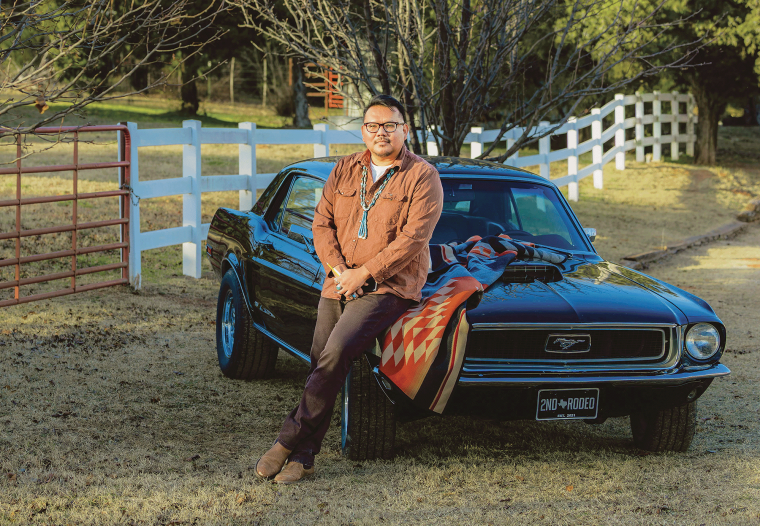
Jake Skeets, author of Horses. (Credit: Melissa “Mel” Drake)
Given his patient and careful approach to language both on and off the page, his personality does not surprise. Skeets’s meticulous cultivation of language is felt in his poetic decisions, such as the spare text he uses to great effect on the field of the page in his debut collection, Eyes Bottle Dark With a Mouthful of Flowers (Milkweed Editions, 2019). Winner of the National Poetry Series, the Kate Tufts Discovery Award, and an American Book Award, as well as a finalist for the Lambda Literary Award in Gay Poetry, Skeets’s first book centers on a 1979 portrait of his uncle Benson James, in Gallup, New Mexico, that was taken by photographer Richard Avedon. Placed in front of an all-white background that was meant to undo the context of the subject, therefore rendering it invisible, James is labeled as a drifter in Avedon’s work. In an effort to return context to the life of men like his uncle, Skeets, who is Tsi’naajínii born for Tábąąhá, wrote Eyes Bottle Dark, and published it with James’s portrait as the front cover, to create a world on the page instead of erasing one, all while showing the brutality enacted upon men and a town, the beauty that still remains. Skeets is a poet of balance, of placing what some may consider disparate subjects in close proximity to each other to create a philosophical entanglement that enlivens both. Eyes Bottle Dark is full of queer desire and violence, lexicons of the earth as well as man-made materials and infrastructures.
Horses is dedicated to the land, with the book’s concept originating from the death of 191 horses at a stock pond on the Navajo Nation in 2018. “The horses were found thigh- and neck-deep in the mud,” Skeets writes in the notes section of his book. They died in search of water due to the extreme drought the Navajo Nation is facing. This circle of horses provides a larger metaphor, Skeets tells me, for the current moment we find ourselves in regarding the climate crisis and continued colonial and capitalist ideologies that appear to be leading us to the end of the world. Of Skeets’s latest endeavor, former U.S. Poet Laureate Joy Harjo says, “Behind these poems is a reverberation of horse songs echoing…and as you listen you will hear, feel, and know that beauty is possible even when it appears impossible.” There is beauty again, cropping up in such an arid landscape.
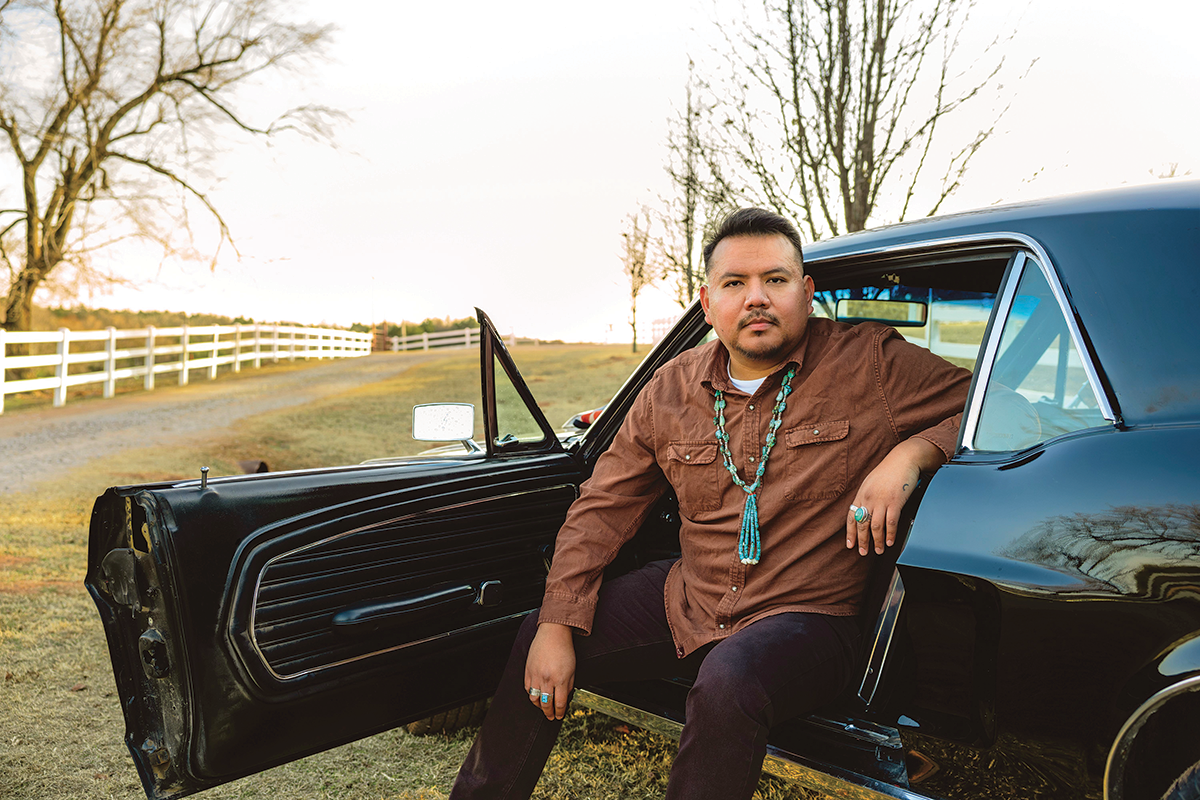
As I sit miles away from Skeets, our computer screens facilitating the chat, his capacious thoughts cover enough ground, metaphorically and literally, to make me feel as though we are in the same region, the same state—if one is to abide by such borders—the same room. I can’t help but notice a ring on his right hand, a hefty blue-green gemstone set within an engraved silver band. While watching this flash of color, as he lifts his hands to gesticulate or adjust his glasses, I am reminded of his 2020 essay “The Other House: Musings on the Diné Perspective of Time,” in which he unpacks the translation of the word turquoise, dootłizh, from Diné Bizaad (the Navajo language) to English. While dootłizh can mean “the color blue or green,” the Ł connotes something more, “a deep space that has the capacity to possess an entity within it, like time.” Embedded in this word then are ages of sediment deposition and erosion, transforming landscapes, the unearthing of a stone to then become a piece of jewelry to be worn by a poet in the South. The wind outside continues whipping my apartment windows, though in reading Skeets, he teaches me that wind is also a carrier of life—“in the wind / there is hope, like a moon opening her eye,” he writes in “Field Song”—that it can bring with it the promise of a new world.
The following is an expanded version of the interview that appears in the print edition of the March/April 2026 issue of Poets & Writers Magazine.
You are a poet of simultaneities. How do these intersections between various energies and beings come to you, and is there a larger theory behind your placement of seemingly disparate themes and subjects alongside one another?
I have been actively interested in the ways in which my upbringing, coming from the Navajo Nation and that type of environment, has and still continues to shape and frame the way that I think about the world around me. I’m specifically interested in language because as a poet that is our primary tool, in this case English as a written language and the very nuances that are embedded in it. Not only is it a tool that poets use to express this form of beauty or entanglement, but it’s also a language of conquest and empire. Our history in the United States has proved the ways in which this language that poets are so invested in has also been the ways in which violence has been justified and extended across this country, across the world. Diné, or Diné Bizaad, is my first language, but unfortunately it was taken from me. Language is a kind of socialization, an encoding, because the way we evaluate our emotions is generally [in] our most organic language, but in my case, because it’s something that I don’t necessarily have with me, I’m left with English.
So I’m really interested in using poetry as a way to get back to this idea of wholeness. Or this idea of being and becoming at all times, because from my understanding of Navajo creation stories and language—this is, of course, not solely unique to Diné and can be applied to other Indigenous cultures across the world—our ways of being and living, our knowledge systems, really offer space for simultaneity, whereas English as a colonial tool is invested in binary. You’re either good or you’re bad. You’re either legal or you’re illegal.
I think poets in particular have a unique sensibility of being able to hold these things for the general public, their families, their communities. The reason readers—myself included—come to poetry, is because [poets are] showing us that there is a way in which we can hold all these feelings at the same time. Yes, we feel happy, but we can feel sad. We can feel hopeful, but we are also doomscrolling, right? There is a way in which our bodies are capable of holding so much. Our language isn’t, which I think is a huge deficit that English has.
In this collection, land is featured as beloved, place, and atmosphere. In the process you decenter the “I,” or rather, the speaker enters an expansive role as a carrier—of sound, wind, morning, light. How did you understand the land’s relationship to the body and the existence of the speaker?
The very seeds of Horses were these poems that were using Diné Bizaad, and I’m not a fluent speaker, so a lot of my work was in translation, writing out a line in English and then trying to find my way back into Diné using dictionaries and my partner, who’s fluent. But one of the things that I kept coming across is that, because I am a poet of fragment, I don’t necessarily have a speaker all the time. I try to decontextualize a line to focus solely on image, and that kind of crystallization of the line and language isn’t something that operates so freely within Diné. In Navajo a sentence is something that carries the full weight of meaning. You can’t say something in Navajo with fragments; it needs to have a speaker. The speaker needs to be existing in time and place. There also needs to be an orientation of who the speaker is engaging with. The image has to exist within the world around it—that encoding is very much a part of Diné personhood. So this sort of decentralized speaker is something that I had to really negotiate in the text. And by using Diné a bit more in my poems, I realized how much of a weight the speaker does carry in work.
I then became hypervigilant in where the speaker showed up. From the early versions of this book, it was going to be a meditation on climate and the land, and then this decentralized speaker. There was no real “body.” It was a work of the ecopoem. Then these poems about becoming and sexuality and desire, especially the erotic from Eyes Bottle Dark, showed up. It became: How do I reconcile the body and the land, and how do I write about both at the same time, without being self-serving or having one particular element outweigh the other?
I turn to queer poets in general to understand how they were and are approaching land and setting and place within their works about the body and sexuality and the erotic. What I’ve learned is that queer poets are often writing about the end of the world because queer futurity has always been conditional. I was going back to queer writers and poets from the seventies and eighties, the AIDS crisis, where a future wasn’t necessarily promised to you. And so I learned how to approach the end of the world as this very tactile thing. The speaker therefore becomes someone who’s able to transform themselves and be fluid. They’re able to be a conduit for either the land or the body or other elements like plant or animal life. What I’ve learned is that the word I, that pronoun, has so much capacity within it. It acts as a mirror; it acts as a carrier. It’s so many things.
How did your relationship to the balance of language on the page change from the first collection to the second?
It started out of spite really [laughter], because with Eyes Bottle Dark one of the reviews on Goodreads said it is like a poetry collection if you cut it in half. That told me that my use of white space was going over people’s heads, which is fine. In this collection, rather than utilizing fragment as a tool, I was really interested in the sentence. I put it upon myself to work in and understand long form as a way of trying to move about this particular world. One of the things I learned is that the sentence and the longer line actually give the poet a lot more freedom to move about a story and a narrative.
In Eyes Bottle Dark, because I was so new to poetry, perhaps I was scared of it a bit—I wanted more distance between myself and the reader. And I wanted a sense of ambiguity and mystery as a form of reclamation and trying to protect Diné identity so that there isn’t so much accessibility or content that can be cannibalized by a colonial reader. In Horses, now that I have a bit more experience and know how to advocate for myself as a poet behind the work, I have more agency on the page and take up more space. If we can think about the line as a kind of vessel or, again, a carrier of meaning, I can let more in.
Did the field of the page activate the poem for you anew in this collection, now that the field is even more literal as landscape and we’re dealing more directly with ecocide?
In Horses the field of the page offered me this larger landscape to work within. In Eyes Bottle Dark I was situated in a particular locale. Because it was so specific, I needed to be focused within one particular moment, one particular area. Whereas in Horses I’m trying to take up an entire region. The physical pages that the reader is turning back and forth—that became landscape. It became traveling, because Horses was written primarily when I was living at Diné College in Tsaile, Arizona, which is in northern Arizona around the Four Corners area. And it started around the pandemic. On the Navajo Nation the pandemic restrictions were very strict because of how much it ravaged these rural communities. One of the restrictions was that we couldn’t leave our house during the weekends, except to go grocery shopping. If we wanted to get “good groceries,” organic groceries, we needed to drive into a border town. I drove to Farmington, New Mexico, which was almost a two-hour trip from Tsaile, but the drive is so beautiful because you pass the mountains there. When you get across the summit, you see what they call the San Juan Basin, and that’s where the Ship Rock formation is. That became the page for me. How do I populate this area with story and language and myself and what’s happening around it? [Much of] Horses was written as I was in the passenger seat or driving and actively revising in my head. That traveling and the circumstances of my life really did warrant this kind of larger exploration of the sentence and the page.
In your poem “After Dark” there’s a stanza: “I learn to love him / so erosive it eats / through the canyon,” which entangles the eros, literally found in the word erosive, with the climate crisis. How does the queer love of the speaker work alongside the degradation of land for you?
Where I come from on the Navajo Nation, same-sex marriage is not something that’s on the table. It’s not that it’s against the law; it’s just that they don’t allow same-sex marriages within our tribal government. Being of queer affiliation is still something that is seen as a form of degradation, or erosive. A lot of our lives, especially as children, we are conditioned to be this straight person. If you’re a boy, you’re taught that you have to go out there and get a wife, you join your wife’s family, you help your wife’s family with their livestock and their land, and that’s how you are operating as a Navajo man. I’m not going to operate in the way that my family and my community and other Navajo people have.
When you pair that with this idea of climate catastrophe, there is a way in which we have to recognize that the land is not this villain trying to wipe us out. The land is trying to correct itself for us. We are the ones who are going to have to do something about changing course. For me, really understanding the nuances of that language and critiquing it [is important], so that when we see erosion we can see eros as part of that word. As a people, what does it mean when we are faced with a potential climate catastrophe? How do we reconcile, negotiate, accept, fight against? Our [English] language and linguistic structures almost dictate that we choose one, but we can choose all of them. We can both accept and fight against. With Horses I’m really trying to open up this space to have these larger negotiations about being a person who is alive during the verge of this potential catastrophe, potential end of the world.
Has your continued learning of the Navajo language—how thoughts are constructed using an object-subject-verb structure in Diné—added to your poetic thought process and changed how you work with the English language, which follows a subject-verb-object structure?
In some ways, yes, especially around the decentralized speaker and what is noticed first, which is also an element in fiction. What information do you convey to a reader in a novel or a short story? That is the way in which we decentralize the speaker or the narrator [in Diné Bizaad], by characterizing and building out the world. What that tells me then is that Diné as a language is very rooted in storytelling. Naturally then, all speakers of Diné are storytellers, because the way they are speaking engages this kind of outside-in approach of, “This is the place. I’m going to describe it to you in space and time. And this is the speaker.” That’s a very different way of thinking about the world. In English you say, “I am going to the store,” whereas in Diné we would say, “The store is where I am going.” But the context can change if it is a store that you are planning to go to or going to now or have gone to, and on which day. You can get as specific as you want and it changes the length and the verbiage, everything. That kind of understanding of the world is key to storytelling: being observant and knowing how to then translate that experience to an audience.
In a 2020 interview with the Broken Plate you said, “There are only some moments where I let the reader into the life and thought way of [the] Diné universe.” How do you strike that balance between sharing your world with readers book after book, and letting them in, with protecting knowledge which is not meant to be spoken or written about publicly?
My response might change tomorrow. It’s very subjective and it’s something that I have gone through and thought about and retracted on. There’s no clear neatness. I have a very instinctive approach to what I write. It changes depending on what and who I’m writing about, but I also feel like as Diné we’re almost shielded from [oversharing] because, again, the ideas that are rooted in Diné worldview and universe don’t really have English translations. English as a language doesn’t have the capacity to hold the depth of Diné knowledge. It’s only possible in the Diné linguistic structure.
As someone who is still so elementary in terms of Navajo language literacy, I am almost shielded from doing something by mistake. But I’m still actively thinking about what to share and what not to share. As writers, part of the process of writing is going to be this constant negotiation and reconciliation. That’s the form within which I am deciding to participate, and that makes the discourse, the craft, and the meditation of craft that much more dynamic. It doesn’t just become writer and audience, it becomes writer, community, and audience. The more you add to that doesn’t necessarily take away [from the writing process]. It adds this breadth of knowledge and information to the exchange.
What role does silence play in how you think of poetry, especially since Horses begins with “just before the silence / a circle of horses in a brightening storm”?
Silence for me, especially with Eyes Bottle Dark, was a way of protection, of seeing how I could take away things and let silence do the work of letting the reader participate in the process of meaning making. In this new collection I even provide context at the end, so there isn’t that much space for silence because I’m trying to do work with the reader on the page. But for me that silence became a kind of physical orchestration in thinking about the duration of moving through the poems and the pauses or moments of break that happen. The time it physically takes to turn a page, for me that’s a sense of silence that hurts. So with Horses I was very invested in punctuation and the ways in which I took away punctuation and the ways in which I offered it back. Punctuation became my way of introducing “white space.” If you don’t use punctuation correctly, then you aren’t as literate as other folks, or your language is deemed less than. Punctuation is something that is rooted in, especially for Native folks, this boarding school environment.
I was really interested in punctuation as a kind of colonial tool and finding a way of reclaiming it for the sake of sound and image and the line and poetry. What does the comma represent? How do I use the period? When you think about the sentence, you automatically think convention. There is a way you write a sentence. As a poet I’m looking for ways that I can talk back against, reclaim, and decontextualize what it means to write in sentences. Punctuation can be this embodied presence of people, of animal and plant life. It can be overgrown weeds. It doesn’t have to be about the flow of logic.
You’ve spoken about having fewer first readers for this collection than your debut. What did the writing process look like for you?
Horses wasn’t written in isolation per se. I didn’t have readers, but I was in conversation with many other poets, especially the writers that I mention at the end of the book: Luci Tapahonso, Nia Francisco, and Joy Harjo. I wanted to prove to myself that I could be a writer post-workshop, post-MFA. That I could develop a writing practice. And maybe my advice for other writers would be to try to avoid sending your manuscript to readers, at least in the beginning or at the other half of it. Take some time for yourself to develop that “I,” of how do I do this using my own toolbox, the toolboxes that I can borrow from other writers without them actively being in the room? That’s a way of sustaining a writing practice, of sustaining ourselves as writers so we’re not actively being reliant on other folks to do the work of analysis or feedback.
In your poem “If Senses” you write: “then, dream / a beautiful land, free free free free.” What does freedom look like for you?
What does it mean to want a future? What does it mean to yearn for that future? In Diné worldview, the morning, that dawn time or bluish hue in the sky, is a symbol for this sense of futurity. The morning is one of the most important times of day. It’s when your body is rising from this long slumber that you’ve had, hopefully [laughter]. For me freedom would be being able to live for the next morning. To welcome the next morning without a sense of fear. But oftentimes, again, our futures are held conditionally. They are actively being attacked and bombed, where the morning time becomes something that’s not possible or becomes a moment of anxiety. It’s being slowly taken away from us. There’s another line in Horses where I say, “the morning is our one sole government.” That’s what freedom is about, this investment in futurity, the future.
How do you negotiate moving through grief and beauty as you speak to the current time we’re living in?
In this collection grief is in the small moments that we build up throughout our day. Noticing birds is a sense of beauty, but it’s also a sense of grief. “Oh, there are two birds swinging around each other,” but they’re rigged to each other almost. Again, I wanted the simultaneous existence of both grief and beauty. Oftentimes when we pair them together we might consider that would be detrimental to beauty or overly optimistic about grief. But I think it [presents] a real tenderness about being alive. If we’re able to actively be in the presence of both grief and beauty at the same time, that’s an intimacy I feel we should all strive for. We know that the promise of tomorrow is held up in the air for a lot of us, but that doesn’t mean we can’t yearn or desire for it in the way in which we yearn or desire for someone. This book is very much a study of the self, so much as it is a study of climate change—the ways in which we can allow ourselves to be tender when we’re so bombarded by all these different things, like aggression. How do we take the time to sit in a quiet moment and really be with ourselves? That is the simplest way of thinking about Horses.
Patti Smith’s Horses album was huge for me as I was thinking [through this collection]. There are moments of chaos and music, but if you listen to it for the moments of silence, where it slows down—those were the moments I was really invested in. I wondered then, How do I carry that over into a poetry collection? How do I make this collection that of noise and quiet?
Is tenderness part of how you conceive of writing?
Tenderness is not necessarily something that is additive, right? Tenderness is something that is part of the overall whole. In a writing practice, it can be self-care advice, making sure that you’re eating and staying hydrated and doing those things. It’s also allowing yourself to be lost and not trying to create large arguments all at once, but really taking the time to go day by day, moment by moment, punctuation mark by punctuation mark. Allow yourself time to enact that type of dedication and care to language. In turn, hopefully you begin learning ways in which you can take time for yourself.
As writers, we want to consistently be producing, producing, producing, because it’s the way the market often works. We [feel the] need to be applying and publishing and doing these things all at once. But something I learned in this second book is that—maybe this is the transition from the first book to the second book that [other] writers can talk about—our first books are often our theses. After we move beyond the [MFA] thesis or the first book, you’re now in the world, and you have the abundance of the world at your disposal, but you also have its limitations. My instinct was to produce, to get back into it. Then the pandemic hit. It slowed everything down. For the longest time I felt, I can’t write, I can’t do this. I felt like I was not being a writer. But I wanted to be tender. I wanted to slow things down and give myself some time. It took me about three years to finally get into the motions of writing this book, but I finished it.
Has being the third Navajo Nation poet laureate and a professor influenced how you come to writing these days, and how you think of poetry and its role within a larger community?
I’m constantly learning from my students about poetry, especially in a place like Oklahoma and at a university where we don’t have an MFA program. I normally have students coming from many different majors. They’re not necessarily writers, and it is very helpful for me to understand their perspectives around poetry and writing in general. Then I know where other readers might be that I’m not tapping into. Maybe as a writer I am solely focused on the literary reader, but there are other readers out there. There are [people with] a range of experiences who I’ve learned how to have conversations with regarding poetry.
With the poet laureateship I’m also dealing with my own communities and how scared I am of them [laughter]. I’m scared to read my poems to them because I’m dealing with the erotic, queerness, all those different things. But it’s a good type of anxiety to have around that demographic, because it teaches me that maybe in my next book I need to write where I’m not afraid. Yes, as a queer person I do need to challenge my communities and where I come from. Queerness is a valid way of living in our world, and that’s not to say I’m any less Navajo. My next book is contending with that now. I’m actively learning from my community about how I can write a poetry collection that feels—I don’t want to say closer to them—more tactile for them. Maybe I’m done trying to challenge them, maybe now let’s have my memories of growing up on the reservation and what that was like. Of course, naturally queerness will come in because that’s [part of] who I am. This third collection I’m working on is a further meditation on tenderness, but also on me. I spent all this time focusing on a long legacy of border town violence, then the climate catastrophe. This third collection is just me. That’s the plan right now.
You’re also working on a debut novel, Dawnhouse, which is forthcoming from Pantheon. How has the turn to fiction writing been for you?
[Laughter.] It’s definitely been a learning curve, but one I feel is rooted in a sense of self-discovery. Again, as I’m learning the elements of fiction, like observation and narration and how you build out a world and understand dialogue and setting, I’m thinking, That’s naturally what my mom does, or what [my family does] when they’re speaking Navajo. That’s something rooted in who they are. They know how to tell a story, whether it’s dialogue or there’s a change in timing or place. I grew up around storytelling, it’s just a matter of translating that onto the page. I told David Treuer, my editor, the last thing I want is a poet’s novel. I want it to feel like, for lack of better words, a “traditional” novel. So that translation from poetry to fiction is something I’m still working through. How do I lessen the lyric? It’s a different type of labor than I’m used to.
It feels like I’m a student all over again almost. But of course, that sense of tenderness and delicacy around the line translates so beautifully to the sentence. All the kinds of questions the poetic line asks of you are very fun to enact with the sentence because you have more elements at play, and you have this new additive called the paragraph. How do you move around paragraphs as kinds of stanzas? It’s been a huge undertaking of mine, but it’s also a beautiful one because I’m learning this new world. I’m really excited for folks to hear about the story that I’ve been working on and that has grown with me these past few years.
India Lena González is a multidisciplinary artist and the features editor of Poets & Writers Magazine. Her debut poetry collection, fox woman get out!, was published by Boa Editions in 2023. Find her online at indialenagonzalez.com.