
Twenty years ago, at an Athens bookshop that sold beautifully detailed maps, globes, and guidebooks, I purchased a map of the city. It hung on my wall for many years, a cartographic guide to my imagination. As I was coming to know Athens, I studied the map to understand the arteries that connect the neighborhoods, the long avenues designed to assert the city as European, the streets that surround the central market, and the avenue that runs to the sea. By looking at this map I began to understand the more circular, digressive routes that subvert the city’s straight lines. Whether I was writing about a 1967 Athens and the military coup that seized power overnight, as in my first novel, or a more contemporary Athens affected by the global financial crisis, as in my second, maps helped me imagine a fictional psychogeography for the characters I had created on the page.
Though I was writing fiction, accuracy felt important, even if the geographic and spatial logic made sense only to me. Because contemporary Athens is capacious and multicultural, its neighborhoods varied and dynamic, sleepy and energetic, spreading up into the mountains that surround it and out to the sea, there was space, to my mind, for my own fictional rendering of the city, for an imaginative expansion of what was happening in the in-between. To explore the ways a place acts on a life, and a life acts on a place.
But to think about mapping an invented world into a real place, or onto a map, is only one way to think about inhabiting fictional worlds. Maps tell only one kind of story, after all. A map given to a tourist at a hotel might feature archaeological sites and museums; another map might detail the metro and train lines; another might give walking routes to the city’s gorgeous hills or the best places for brunch. Maps might privilege one era over another, one ideology over another. A map is not only a representation of a place, but is also filtered by and for various perspectives. And maps are often flawed: If you’ve ever used Google Maps on a Greek island, say, you might find yourself tearing through a two-track road in an olive grove, wondering why you didn’t simply follow the signs.
A view of the Croatian island of Hvar that the author imagined for the narrator of her novel Archipelago. (Credit: Jeremiah Chamberlin)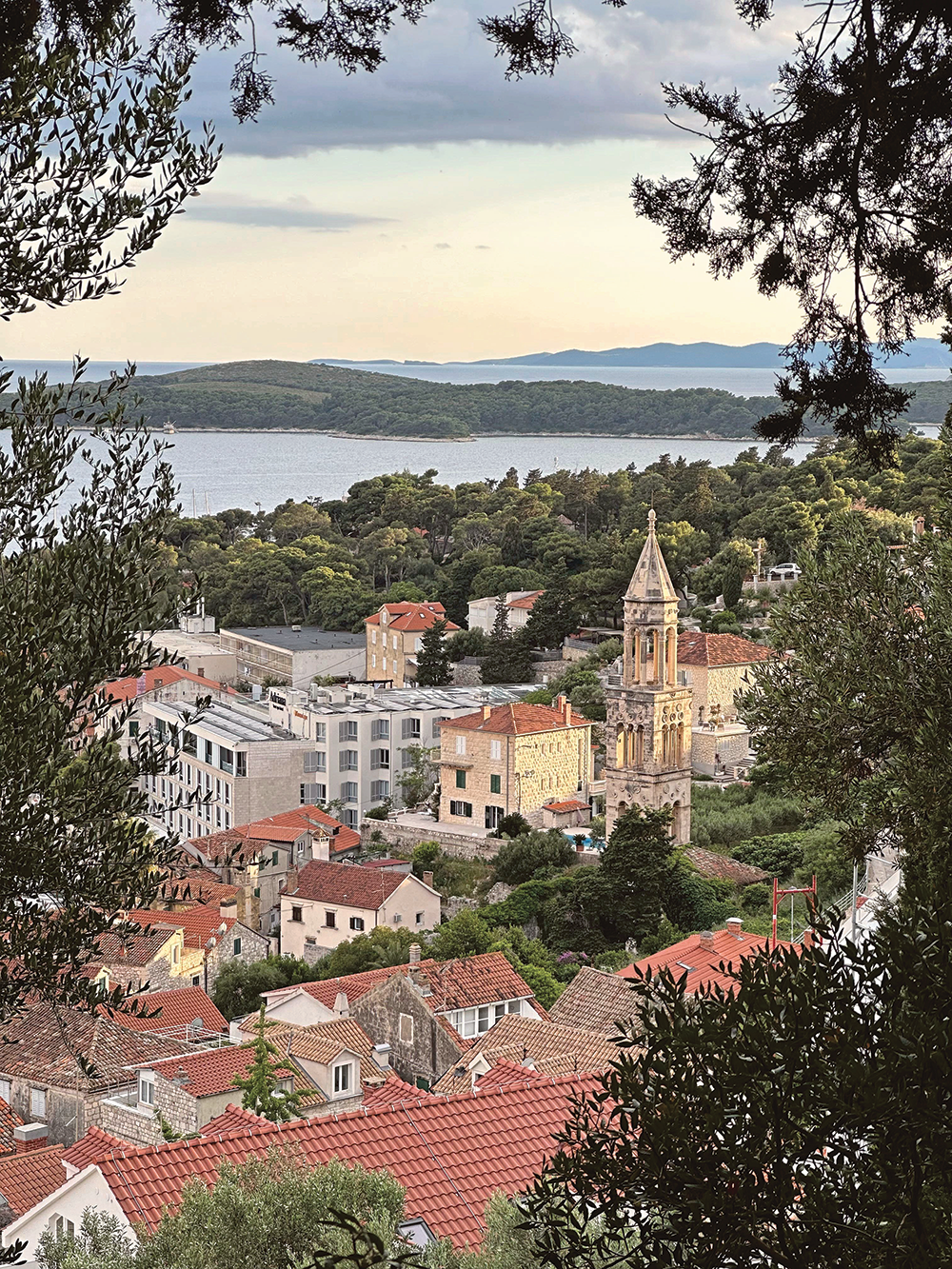
My third novel, Archipelago, is not set within the confines of Athens, nor within the boundaries of any large city, but instead follows a translator as she moves throughout the Balkans, both by land and by sea. I hoped to think beyond maps, beyond borders; I found myself reluctant to define certain places by name. The world of Archipelago is slightly surreal and boundaries of various kinds shift, and to ground the setting too clearly in a particular place seemed antithetical to the book’s preoccupations.
Yet it wasn’t until my editor asked why the places in the book—as well as the narrator herself—were not named that I began to further interrogate this choice. I knew I wanted to resist the kind of place-as-character discourse that might arise when writing about a location that’s more likely known, at least by much of your English-speaking audience, as a place of holiday and leisure, or reduced to its crises, or that’s seen through an othering lens. But this can arise whether you name the locale or not.
At first I might have said that I imagine fictional settings as composites, a reminder that the world in which we’ve become emplaced is a fictional dream. As Peter Ho Davies writes in A Lie Someone Told You About Yourself (Mariner Books, 2021): “A story can be 1 percent true and 99 percent made up, or 99 percent true and 1 percent made up, and the reader won’t know the difference, the writer doesn’t have to declare.”
But I wasn’t thinking only about truth and invention. I also admit an anxiety about belonging, about authenticity, about the kind of claiming we inevitably do when we write about a place. “Certain places seem to exist mainly because someone has written about them,” Joan Didion writes in “In the Islands,” an essay from The White Album, published by Simon & Schuster in 1979. (Really? Exist to whom, and for whom? This brings to mind the travel articles that highlight undiscovered Mediterranean islands). “A place belongs forever to whoever claims it hardest,” she continues, “remembers it most obsessively, wrenches it from itself, shapes it, renders it, loves it so radically that he remakes it in his image.” But I don’t want any place to belong to me, not for a short time or forever. I have no interest in ownership of a place (though I sometimes want to belong to a place), and I definitely don’t strive to remake a place in my own image as much as I want to translate one version of the places I love to the page.
It was in the summer of 2024, though, while beginning research on a nonfiction project on Greek-island (over)tourism that I considered something else. After a long swim, I sat resting on the beach. Apart from one woman who approached to warn me about some jellyfish, I was alone. The island was Spetses. A young French couple, beautifully dressed, arrived, staked out the scenery, quickly disrobed, took photos of themselves on the small ladder that swimmers use to enter and exit the water, and left. They did not get wet; they were the only ones in their photo; and they documented the experience of swimming, or having swum, or perhaps the future perfect, they will have swum, without ever actually swimming.
Once you notice something it’s impossible not to see it everywhere, and a version of this photo-taking couple appeared again and again: a duo in matching crocheted dresses pretending, inexplicably, to emerge from the water, or a linen-clad figure gazing out at something in the distance, or a sunbather sprawled precariously over stones, even after a local warned her it was a dangerous position to be in when the boats arrived and created huge waves that crested over the rocks. One morning, while having coffee in a small café overlooking the sea, I watched a parade of beautifully dressed photo-takers come and go, come and go, snapping themselves in actions that were performed but not necessarily experienced. And I see them on social media while I’m in those very places: A woman sits curled up like a cat on the low wall of someone’s small home, a pretty door matching her dress; included in the post’s captions might be tips on getting to the house, along with a kind reminder that this is indeed someone’s home, so be respectful.
Travel influencers—what a word—sharing photos of themselves in these Instagrammable spots have created an aesthetic and a form of travel writing a genre of its own, and quite often they do include this helpful sharing of maps, GPS coordinates, so that we, too, might visit the place, easily locate the spot, and insert ourselves into that very same backdrop for the photo. The instinct is a democratic one, I suppose, a strange and misguided understanding of the term gatekeepers, but I much prefer the intentionally vague shots captioned Somewhere in the Aegean—under which several others might demand: “Where??”
So in direct contrast with my earlier desire for geographical accuracy emerges an aversion to precision, something fixed and reproducible, which the Instagram map favors. The ability to reproduce, again and again, the same exact image. But places are not static; they are dynamic.
Of course I know that social media is not literature; literature and the sustained focus it demands might be its antidote. But social media, like literature, contributes to the way we experience place, and the genre of travel writing is as old as travel itself. “Naxos is a bit of a slut,” writes the British poet, novelist, and travel writer Lawrence Durrell in The Greek Islands (Viking Press, 1978) with all his maddening, exacting certitude, “while Paros is all gold and white like her once famous marbles. If Naxos is a vivid parrot, then Paros is a white dove. You wake earlier in Naxos, but you sleep deeper in Paros.”
The first time I read this I laughed, I admit, at both his audacity and the surety of his sentiment. (I have woken earlier in Naxos, and slept more deeply in Paros, but perhaps this is the power of suggestion, perhaps another reason I hesitate to name.) My reluctance to name—a name, like a border, is a kind of definition—might instead be to avoid the monolithic essentializing (“which island is better, Naxos or Paros?”) so often ascribed to places already defined by the monoculture of tourism: beaches and beach bars and photos of sunsets, brightly colored doors, bougainvillea. Something as legible as a coordinate on a map.
When you zoom out from a city map and look at a map of the Mediterranean, you see cities represented as dots: Marseille and Dubrovnik, Alexandria and Athens, Beirut and Izmir. But when you look at islands, the first thing you might notice are their distinct shapes—bordered and defined by the sea that surrounds them. Lauren Markham notes in A Map of Future Ruins: On Borders and Belonging (Riverhead Books, 2024) that a border is a “fiction of great consequence.” Maybe I’m trying to smudge those borders, to write of shorelines and spaces that are not inert and enclosed but instead boundless and active and open.
“It is astonishing the number of people who go around dreaming of an island,” writes Tove Jansson in Notes From an Island (Sort of Books, 2021). I admit that I, too, have imagined I might choose an island, then disappear into it. We often speak of islands as isolated and insular (the Latin word for isle is insula), but they’re also open: connected geologically and volcanically, ecologically and infrastructurally, through shipping routes and ferries that sail in and out of ports; islands are linked through the fiber-optic cables like garden hoses running the internet under the sea. The tides of the Adriatic are linked to the Ionian. A seismic tremor off the coast of an Aegean island brings seismic waves and destruction to Turkey. Wildfires on one island bring firefighters from another. An island’s mood can change when the ferries are halted because of the winds, keeping people there and keeping people away. Look out from the coast of one Cycladic island, say, and you’ll see the other islands in the distance: sometimes as clearly outlined as wood carvings and other times appearing and disappearing in the haze. It’s impossible to sit in the beach town of Kini, on the island of Syros, and not be aware of Gyaros, an island with a violent history of punishment and exile, now designated a protected site by the World Wide Fund for Nature, formerly the World Wildlife Fund, for Mediterranean monk seals (a story for another time). The aliveness of the islands comes as much from who and what lives there as from who and what is arriving, welcomed or protested, embraced or denied.
In Mediterranean: A Cultural Landscape (University of California Press, 1999), Predrag Matvejević’s genre-bending cultural history and meditation on the Mediterranean, translated from the Croatian by Michael Heim, he writes: “The Mediterranean is not merely geography. Its boundaries are drawn in neither space nor time. There is in fact no way of drawing them: They are neither ethnic nor historical, state nor national; they are like a chalk circle that is constantly traced and erased, that the winds and waves, that obligations and inspirations expand or reduce.”
When I was writing Archipelago, which bounds across the Mediterranean, from the Aegean to the Adriatic to the Ionian, traversing borders, I was thinking about this tracing and erasing, the expansion and reduction. I didn’t want my narrator to inhabit the places she moved through as much as I wanted those ecological and cultural landscapes and seascapes to inhabit her. I wanted to challenge the rhetoric of home and homecoming, of possession and belonging, while also playing with those themes. I didn’t want to superimpose her upon a landscape, to have her swim without getting wet.
I wanted to write a kind of continuity, or as Daisy Hildyard puts it in The Second Body (Fitzcarraldo Editions, 2017), a “global presence of the individual body.” To feature not only a multilingual consciousness, but also an archipelagic one. Though Édouard Glissant was writing about the Caribbean, his “archipelagic thought” was key to my thinking about islands, and writing, and writing islands: a sense of interconnectedness, an allowance of opacity, an embrace of ambiguity. To belong to one place and open up to others simultaneously.
Perhaps this is why I blur the lines: I want to think archipelagically, to write against discontinuity and into a sense of connectedness. Much like the narrator of Archipelago, who answers to a name she doesn’t recognize as her own, I also want to dis-member what I know, then re-member it once more. I want it to remain unmappable and mysterious, too.
Naming of course acknowledges, or buries, important geopolitical and cultural realities, and I don’t mean to discount the significance and power of names themselves—particularly when writing about a region where names and borders continue to be fraught. But in my work of fiction, I also wanted to think beyond geopolitical lines, beyond nationalism, beyond what Amitav Ghosh calls the nation-state: the “ultimate instance of discontinuity.” I suppose when I write about these islands, I imagine the interconnectedness of archipelagoes: an awareness of and connection to what is happening at the other edges of the sea.
Natalie Bakopoulos is the author of three novels: Archipelago (Tin House, 2025), Scorpionfish (Tin House, 2020), and The Green Shore (Simon & Schuster, 2012). She is an associate professor at Wayne State University in Detroit.
Thumbnail credit: Jeremiah Chamberlin