October 13

10.13.11

Imagine a character whose job—such as a banker, thrift store cashier, babysitter, college president—typically implies certain traits about this person and a certain lifestyle. Write a story in which this character's life outside of his or her work is drastically different from what is typical. Explore in your writing why this is so, using it to inform the plot and to create tension in the story.

Two Debut Novels Among National Book Award Contenders

The National Book Foundation (NBF) announced the National Book Award finalists today from Portland on Oregon Public Broadcasting.

The finalists in poetry are:
Nikky Finney for Head Off & Split (TriQuarterly Books/Northwestern University Press)
Yusef Komunyakaa for The Chameleon Couch (Farrar, Straus and Giroux)
Carl Phillips for Double Shadow (Farrar, Straus and Giroux)
Adrienne Rich for Tonight No Poetry Will Serve: Poems 20072010 (Norton)
Bruce Smith for Devotions (University of Chicago Press)

The finalists in fiction are:
Andrew Krivak for his debut novel, The Sojourn (Bellevue Literary Press)
Téa Obreht, who was honored by the NBF last year as a 5 Under 35 author, for her debut novel, The Tiger's Wife (Random House)
Julie Otsuka for her novel The Buddha in the Attic (Knopf)
Edith Pearlman for her story collection Binocular Vision (Lookout Books)
Jesmyn Ward for her novel Salvage the Bones (Bloomsbury)

This year saw the first graphic book finalist, in the nonfiction category: Lauren Redniss's Radioactive: Marie & Pierre Curie: A Tale of Love and Fallout (It Books). The nonfiction shortlist also includes biographies of Malcolm X and Karl and Jenny Marx, as well as Stephen Greenblatt's The Swerve (Norton), a look at Lucretius's philosophical poem, "On the Nature of Things."

The National Book Award winners will be announced on November 16 in New York City.

In the video below, Finney reads and discusses the story behind a poem from Head Off & Split.

Fifty-Seven-Year-Old Debut Author Wins German Book Prize

The Association of German Publishers and Booksellers Foundation (Börsenverein des Deutschen Buchhandels Stiftung) awarded its 2011 German Book Prize on Monday evening just before the start of the Frankfurt Book Fair.

Fifty-seven-year-old author Eugen Ruge won the twenty-five-thousand-euro award (approximately thirty-four thousand dollars) for his first novel, In Zeiten des abnehmenden Lichts (In times of fading light).

The novel, which received the Alfred Döblin Prize in 2009 when still in manuscript form, was praised for its humor despite the gravity of its subject. "Ruge's family saga is a reflection of East German history," said the prize jury. "He manages to tame the experiences of four generations over fifty years into a dramatically refined composition. His book tells the story of the socialist utopia, the price demanded of the individual, and its gradual extinction."

An English translation of Ruge's novel is in the works, but a firm publication date has not been announced. In the meantime, English speakers can read a translated excerpt on the website Signandsight.

M. L. Liebler at St. Clair Shores Library

Longtime P&W-supported sponsor and writer M. L. Liebler, author of fourteen books of poetry including The Moon A Box, which received the 2005 Patterson Poetry Award of Excellence, blogs about his monthly workshop at St. Clair Shores Library in St. Clair Shores, Michigan.

They all gathered, once again, as they have on the third Wednesday of the month for the past twenty-one years. Students, mothers, senior citizens, retired politicians, teachers, librarians, real estate agents, retired cops, and the occasional visitor who heard about us and wanted to “check us out.” Last night’s visitor was a fellow named Skippy, a retired Navy man from Connecticut who was so impressed with the quality of the work he heard and read that he politely asked if he could publish some of it in his church paper back home.

I love these folks. I have met monthly with them as a small way of giving back to the community where I was raised and still proudly live. In fact, I live in the same house that my wife grew up in, and where I walked to every night while dating her when we were fifteen-year-olds.

Last night we heard and workshopped wonderful poems by the former County Commissioner who lamented the destruction of the ecology of America by contrasting it with the beauty of Spain’s wide-open spaces and well-kept urban areas. After this piece, a widow read her satirical poem about a suburban man who lives his life in a rush and doesn’t realize the beauty around him.

Another cool, outside the box, poem was a wonderfully rich work entitled "The Ascetic Life" by a retired librarian who explored the contemplative life of a “Holy Fool.” A young teenager read a poem that was written to get “something off [her] chest.” It was a poem about how her younger sister has continually belittled her and put her down her entire life. The poem was her empowering response that she “wasn’t going to take it anymore.” The poem received cheers from the seniors and an “I know exactly what you mean” acknowledgement from another teen in attendance.

The evening concluded with another moving poem from one of our newer regulars, an eight-six-year-old widower who never wrote a poem in his life until he joined our group. He wrote about frequently waking up thinking there were “a lot of people in [his] house,” only to realize that he was alone.

To quote Walt Whitman, “Have you ever felt so good to get at the heart of poem?” These people, young and old, are doing just that, and the great majority of them have never written a poem in their lives until now. I am grateful and honored to spend time with this diverse and welcoming group of poets. For me, this is where the real poetry in America lives!

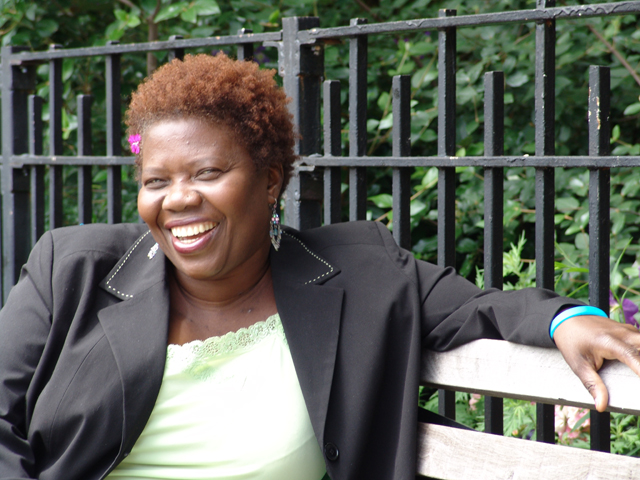
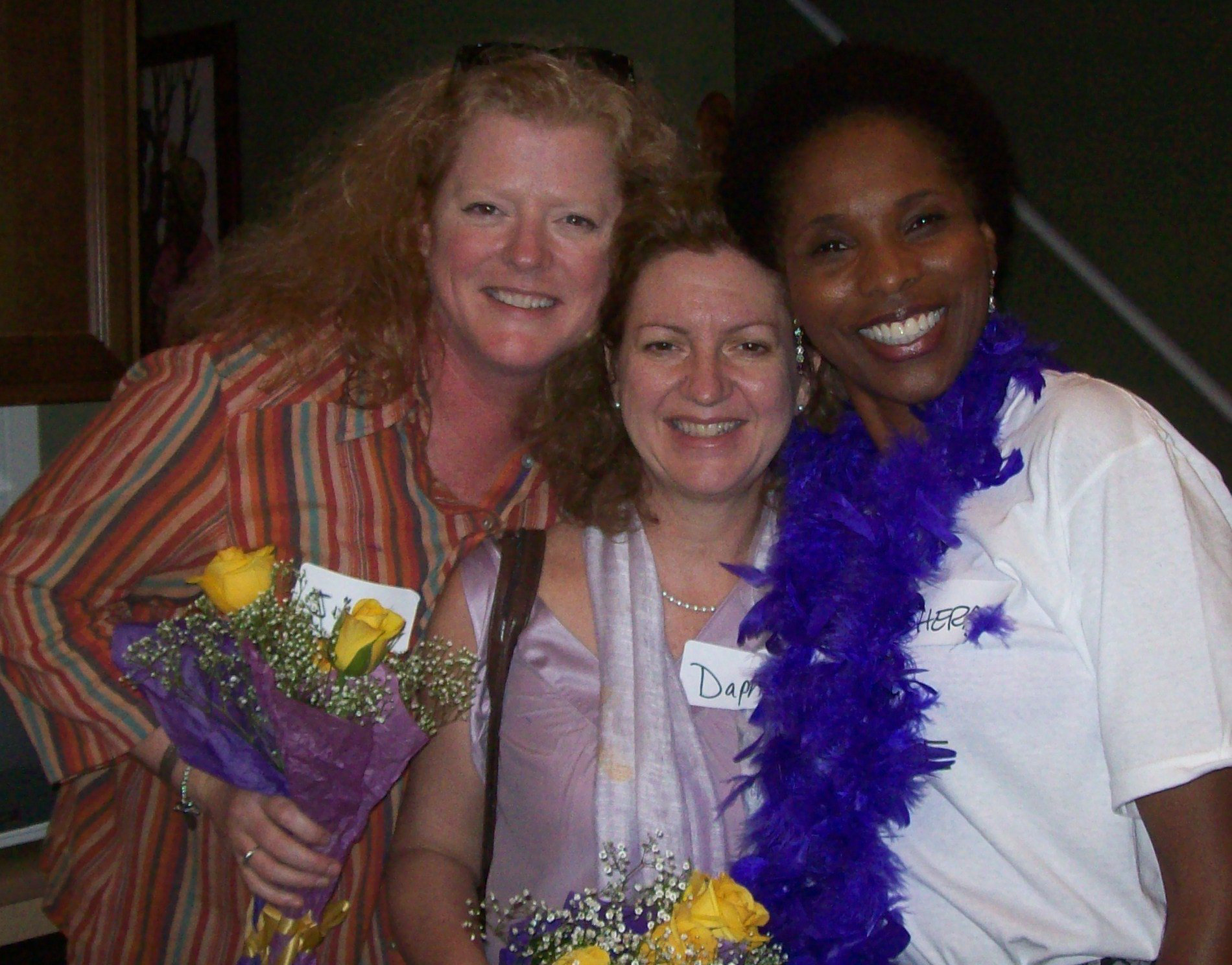
Photos: (Top) M. L. Liebler. (Bottom) M. L. Liebler with workshop participants. Credit: Pamela Liebler.

Support for Readings/Workshops events in Detroit, is provided by an endowment established with generous contributions from the Poets & Writers Board of Directors and others. Additional support comes from the Friends of Poets & Writers.

October 10

10.11.11

Transform a poem that you've written or write a new poem without using the first person.

Caroline Brown's Unconventional Journey

Instructor of applied theater at Cornish College of the Arts, Caroline Brown has facilitated workshops for diverse groups, including veterans, AIDS widows in Kenya, and incarcerated women, as well as P&W-supported writing/performance workshops with BABES Network-YWCA and Compass Housing Alliance in Seattle, Washington. Caroline shared some reflections on her work with us.

What makes your writing workshops unique?
For the most part, my focus has been on the use of theater and performance as a means of helping marginalized communities share their stories with a wider audience. Writing has inevitably been an integral part of this process.

What techniques do you employ to help writers open up?
I conducted a five-week writing workshop with Seattle-based BABES Network-YWCA, an organization that supports women living with HIV/AIDS. I asked the women to help me create group guidelines for the duration of the process. One woman shouted “spelling doesn’t count!” I was so pleased to hear her say this, as I know were the rest of the women. This simple guideline gave the women permission to avoid self-editing, trust their instincts, and find their voices.

I offer exercises that reveal commonality and reduce feelings of isolation amongst the group. I do this by asking participants to create collective poems or short stories that reflect both the diversity and similarities of the group. While conducting the workshop with Compass Housing Alliance, an organization that provides services and housing to homeless and low-income people, we created a composite character that reflected each individual’s respective experience. The group chose a key turning point for the character and took turns answering questions as that character. They were able to collectively narrate the story of how he met his goals. I feel strongly that the participants would not have been as engaged had the same subject matter been discussed outside the context of a fictional story.

What are the benefits of writing workshops for underserved groups?
The work can be tiring and there are times when I yearn for a more conventional career. It is during moments of doubt that I remind myself of experiences such as the one I had working with incarcerated women in the Rhode Island state prison system. Upon completing a writing exercise one of the women asked me through tears if “we did these exercises on the outside.” She was being released from prison the next day and was scared of “going back to her old ways.” The workshops helped her to recognize herself as a good person, something she had never felt before. Her fear was that without such an outlet, she might forget this feeling and start making unhealthy decisions again. What stopped me in my tracks was the fact that such workshops are not so readily available to those who need them the most.
 
What effect has this work had on your life and/or your art?
I am inspired by the risks individuals take within the creative process and the freedom they gain from doing so. My greatest challenge in this work is to remember how important that journey is to everyone, including myself. After seven years of encouraging others to endure the challenges that come with the creative journey, it is important to remind myself to embark on the same. I owe it to myself as well as to those who have shown so much courage in the face of their own hesitations toward the creative process.
 
Photo: Caroline Brown. Credit: Sven McNichols.

Support for Readings/Workshops events in Seattle is provided by an endowment established with generous contributions from the Poets & Writers Board of Directors and others. Additional support comes from the Friends of Poets & Writers.

October 6

10.6.11

Write a scene for a story with two characters involved in the Occupy Wall Street movement. Use news stories about the movement in order to gather details to create a realistic setting.

Poet Tomas Tranströmer Wins Nobel Prize in Literature

Eighty-year-old Swedish poet Tomas Tranströmer was named winner of the Nobel Prize in Literature at an afternoon press conference in Sweden today.

"Because," says permanent secretary of the Swedish Academy Peter Englund, "through his condensed, translucent images, he gives us fresh access to reality."

Tranströmer, whose profession is psychology, investigates the "big questions," says Englund, such as death, history, memory, and nature, but in a way that does not belittle the human condition, but rather "makes us important."

Translated into sixty languages, Tranströmer's most recent collections published in the United States are The Great Enigma: New Collected Poems (New Directions, 2006) and The Half-Finished Heaven (Graywolf Press, 2001). U.K. publisher Bloodaxe Books released an updated volume of their 1997 translation, New Collected Poems in 2010.

The Nobel has not gone to an author from Sweden since 1974, when Swedish poet Harry Martinson and Swedish novelist Eyvind Johnson shared the award.

Unpublished Writer, Rising YA Star, Mother of Two Among 5 Under 35 Honorees

The National Book Foundation has announced the latest crop of emerging writers to be recognized with the organization's 5 Under 35 honor.

Nominated by former winners and finalists for the National Book Award, the five young fiction writers will be feted later this fall at an event hosted by John Waters in New York City.

Shani Boianjiu of Jerusalem, the youngest of the honorees at twenty-four, was selected for 5 Under 35 by Nicole Krauss. A veteran of the Israeli Defense Forces, Boianjiu is working on a novel titled, "The People of Forever Are Not Afraid."

Danielle Evans, author of the PEN/Robert W. Bingham Prize–winning story collection Before You Suffocate Your Own Fool Self (Riverhead Books, 2010), was nominated by Robert Stone. Evans, a graduate of the Iowa Writers' Workshop, lives in Washington, D.C.

Julia Glass selected New York State native Mary Beth Keene, author of The Walking People (Mariner Books, 2009). Keene, a mother of two boys, is working on her second novel.

Alaska-born Melinda Moustakis, whose first book, Bear Down, Bear North: Alaska Stories (Unviersity of Georgia Press, 2011), won the Flannery O'Connor Award in Short Fiction, was selected by Jaimy Gordon.

Oscar Hijuelos chose Louisiana author John Corey Whaley, the first 5 Under 35 author to be recognized for young adult fiction. Whaley's debut is the novel Where Things Come Back (Atheneum Books for Young Readers, 2011).

The 5 Under 35 celebration, held on November 14, will kick off National Book Awards week. The awards in poetry, fiction, nonfiction, and young people's literature will be announced at the foundation's annual dinner on November 16.

Poems, Stories, Entire Books Welcome in Winter Anthology Contest

The Winter Anthology, a "collection of contemporary literature informed by history and older art, twenty-first-century science and philosophy, and the ending of print culture," is accepting entries for its 2011 contest.

All submissions will be considered for publication online and subsequently in Volume 2 of the anthology, alongside the poetry or prose of the winning writer, who will be awarded one thousand dollars.

This year's judge is poet Lisa Russ Spaar, a professor at University of Virginia whose poetry books include Glass Town (Red Hen Press, 1999), Blue Venus (Persea Books, 2004), Satin Cash (Persea Books, 2008), and the forthcoming Vanitas, Rough, which Persea will release next year. Spaar has also published essays in Shenandoah and Virginia Quarterly Review, and her poetry appeared in Volume 1 of the Winter Anthology, with poems by Lucie Brock-Broido, Jean Valentine, and Charles Wright and novel excerpts by Karl Ove Knausgaard and Magdalena Tulli.

Works of any genre are eligible for the contest. Each entry, which may range from two poems or a single essay or story to an entire book of up to fifty pages, must be accompanied by a ten dollar reading fee.

The address for print submissions and a link to the Winter Anthology's Submishmash entry page (which requires writers to submit an eleven dollar entry fee) are posted on the contest website. Entries must be submitted by November 15, and a winner will be announced in the winter.

Pages

Subscribe to RSS - blogs