Genre: Poetry

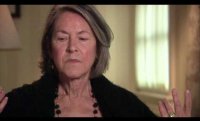
Louise Glück for the Academy of Achievement

Caption: 

“There are a number of people my own age, who are doing extraordinary, remarkable work, but I feed more on the young—the sounds they are making are different, new.” In this 2012 interview for the Academy of Achievement, Nobel Prize–winning poet Louise Glück speaks on a variety of subjects, including falling in love with poetry, starting out as a writer, teaching, and her prolific career.

Genre: 

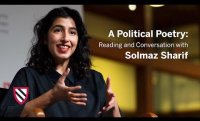
A Political Poetry With Solmaz Sharif

Caption: 

“It matters what you call a thing,” reads Solmaz Sharif from her poem “Look” in this 2017 reading and conversation with Evie Shockley for the Radcliffe Institute for Advanced Study at Harvard University. For more Sharif, read “Shadows of Words: Our Twelfth Annual Look at Debut Poets” from the January/February 2017 issue of Poets & Writers Magazine.

Genre: 

Stridulation

12.8.20

“Everybody’s got a song / they’ve gotta sing. / So they say. So they / think,” begins Rita Dove’s poem “The Spring Cricket’s Discourse on Critics,” published in the Believer this month. The deftly enjambed poem uses the perspective of a cricket and its ability to use its legs to chirp, known as stridulation, to discuss an artist’s defense against critics believing “they can / just… crank out the golden / tunes.” Use the perspective of an insect or an animal whose abilities come naturally to examine an aspect of being a poet. Try enjambment in your poem to emphasize particular words.

Disquiet Prize Accepting Submissions

Submissions are now open for the 2021 Disquiet Prize. Sponsored by the Disquiet International Literary Program, an annual writers workshop held in Lisbon, the prize awards three fellowships for tuition to writers working in the genres of poetry, fiction, and nonfiction; a grand prize winner will additionally receive a travel stipend and housing in Lisbon for the duration of the workshop. In the event that public health conditions prohibit the conference from being held in 2021, winners will be offered the option to defer their fellowships to a future year or to accept an alternative cash prize of $1,000. All three fellows will also receive publication. The winning poet’s work will appear in the Common, and the work of the winning fiction writer and nonfiction writer will be published on the Granta and Ninth Letter websites respectively.

Submit up to six poems, totaling up 10 pages, or one story, novel excerpt, or essay of up to 25 pages with a $15 entry fee by January 15. Visit the website for complete guidelines.

Established in 2010, the Disquiet International Literary Program “aims to deepen mutual understanding among writers from North America and writers from Portugal” and takes its name from Lisbon poet Fernando Pessoa’s The Book of Disquiet. A decision about whether or not the conference will proceed in 2021 will be announced on the workshop’s website in February.


Love After Love

Caption: 

“You will love again the stranger who was your self.” Dub poet Linton Kwesi Johnson reads Derek Walcott’s poem “Love After Love” from Collected Poems: 1948–1984 (Farrar, Straus and Giroux, 1986) for a tribute to the poet and playwright. Walcott, who won the Nobel Prize in Literature in 1992, passed away on March 17, 2017.

Genre: 

A Short Story of Falling

Caption: 

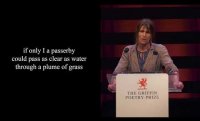
“What I love about water is that it spends its whole time falling,” begins Alice Oswald as she introduces her poem “A Short Story of Falling” from her 2017 Griffin Poetry Prize–winning collection, Falling Awake (Jonathan Cape, 2016). “It’s always, apparently, trying to find the lowest place possible and when it finds the lowest place possible, it lies there wide awake.”

Genre: 

Vestiges

12.1.20

Humans may no longer have the nictitating membranes, tails, and vomeronasal organs possessed by birds, monkeys, or reptiles, but we do still have vestiges of them, whittled down to nonfunctioning parts of the body: the folds at the inside corners of the eyes, tailbones, and the tiny sac in the nasal cavity above the roof of the mouth. What use, then, can one imagine for nictitating membranes that no longer draw laterally across the eye, tails that no longer help maintain balance, or Jacobson’s organs that no longer detect moisture-borne odor particles? Write a poem that considers the beauty of a body part with no clear-cut function. How might the specificities of the body be appreciated in different ways given our contemporary circumstances? What is the value in imagining new functions for old forms?

Natasha Trethewey at the Library of Congress

Caption: 

In this 2014 video for the Library of Congress, Natasha Trethewey delivers the final lecture of her second term as U.S. poet laureate speaking on the 150th anniversary of the Civil War and the major victories of the civil rights movement, as well as reflecting on how these events cross with her own personal history and laureateship.

Genre: 

Ocean Vuong on War, Sexuality, and Asian American Identity

Caption: 

“I would sneak out of recess, stay in the library to listen to tapes of famous speeches, and one of them was Martin Luther King,” recounts Ocean Vuong about his childhood in this interview with Michel Martin for Amanpour and Company. “You could hear the static when he was giving the ‘I Have a Dream’ speech, and I thought...who is this man talking about dreams in a snowstorm?” Vuong was awarded the 2020 Brooklyn Public Library Fiction & Poetry Prize for his novel, On Earth We’re Briefly Gorgeous (Penguin Press, 2019).

Genre: 

Pages

Subscribe to Poetry