Timeline

10.17.12

Choose one of your stories that needs revision. Create a timeline that includes each year of the main character's life, fleshing out details that support who he or she is. After you've finished, return to the story and revise it in terms of this more fully developed understanding you have of your main character.

Ferlinghetti Turns Down Hungarian Poetry Prize

The San Francisco-based City Lights Booksellers and Publishers announced last week that its founder, Lawrence Ferlinghetti, who had been selected as the recipient of the inaugural Pannonius Prize, would decline the award.

The prize, which was announced in September, is funded by the Hungarian government and the Hungarian chapter of PEN International, and offers an award of 50,000 euros.

In a press release, City Lights stated: “While honored to be chosen and recognized, Lawrence Ferlinghetti has been a resolute supporter of freedom of expression his entire life. Given that the Hungarian government is widely accused of officially and unofficially stifling free speech and civil liberties, Ferlinghetti has decided to decline the award.”

On the same day that City Lights released their statement, the MFA program in writing at the University of San Francisco announced the inaugural Lawrence Ferlinghetti Poetry Fellowship. Established in honor of the poet, activist, and City Lights founder, the biennial fellowship—which provides full tuition funding to the MFA program—will be given to a poet “whose work embodies a concern for social justice and freedom of expression, interpreted in the broadest possible way.”

Ferlinghetti, whose most recent book is Americus, Book 1 (New Directions, 2005), is a longtime proponent of the “wide-open poetry” movement; he published Allen Ginsberg’s Howl & Other Poems in 1956, and was subsequently arrested, tried, and eventually acquitted on obscenity charges in what became a historic first amendment case. Poet D. A. Powell, a professor of poetry at the University of San Francisco, said in a university press release, “The Howl trial changed the culture of American poetry overnight and paved the way for a more open, expansive poetics—for poetry that confronted American hypocrisies and political institutions, willing to put its proverbial heart on the line.” 

To learn more about the life and work of Lawrence Ferlinghetti, visit the City Lights website. For more information and complete application guidelines for the Lawrence Ferlinghetti Poetry Fellowship, visit the University of San Francisco MFA program website. 

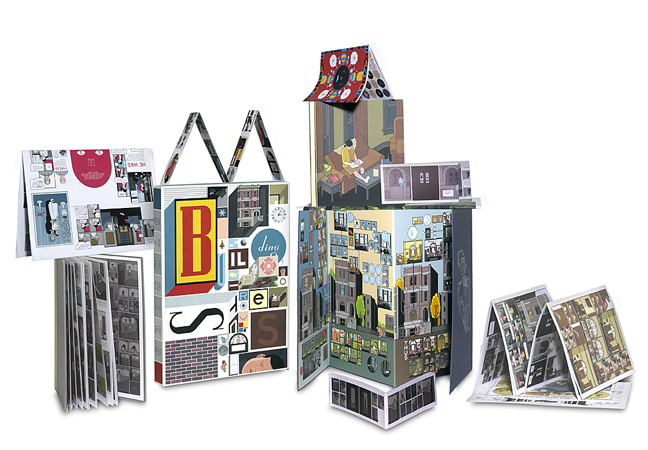
Building Stories 7

"A book, if taken care of, communicates so much about its time and writer, from the tiny, crinkly pages of the leather-bound miniatures of the 1880s to the crappy, wood-pulp paperbacks of the 1970s—it shows what our culture values at any given time," Ware says. "You also don’t have to plug them in or try to find a vitamin-D-deficient computer whiz who knows some outdated compression code to read them. All you need is a working eye and a brain and you’ve got one of the most mysterious interactive experiences ever invented."

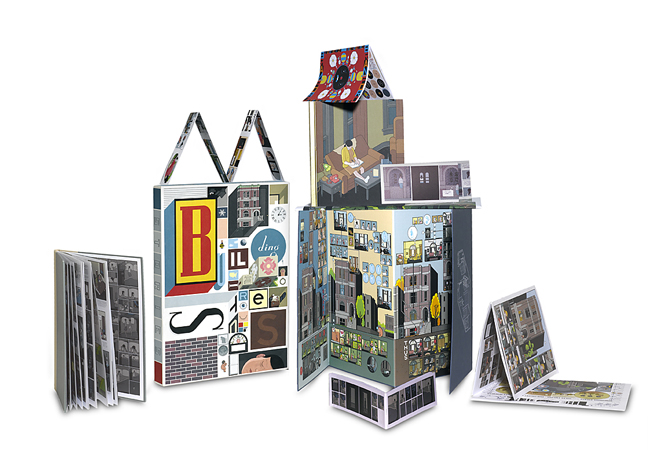
Building Stories 6

"The format [of Building Stories] is both an attempt to get at that non-beginning/non-end of every story that we have within our minds, and also at the notion of immersing oneself in a memory to the point that one can almost lose all sense of the present," Ware says. "I wanted readers to experience something as if it were happening right in front of them, but then discover later that the story actually happened in the character’s distant past, with all the uncertainty that suggests. I hope for the inverse of this experience as well."

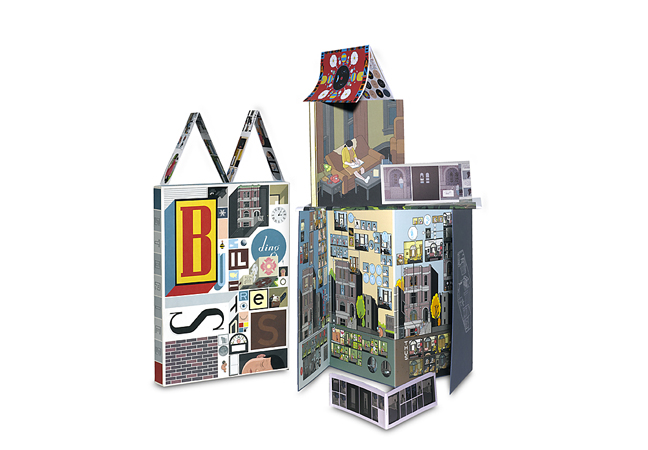
Building Stories 5

"Though my reading of poetry is humiliatingly limited, I realize what I’m aiming for is almost a kind of synesthesia, which I guess is the clinical description of poetry," Ware says. "I also consider the artist Joseph Cornell—whose work was a big inspiration for Building Stories—to be as much a poet as a visual artist.

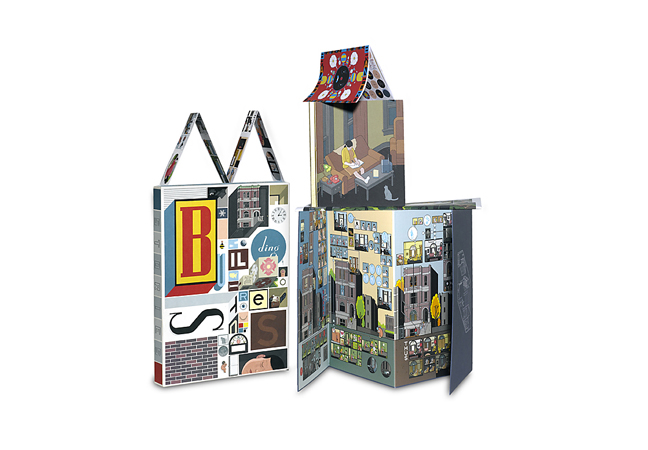
Building Stories 4

"I don’t script anything," Ware says, "because then all I’d be doing is illustrating my words, which to me isn’t cartooning. Cartooning is a mysterious process that involves writing with pictures and seeing what recollections they dredge up and superimpose as one reads what one has drawn (which, hopefully, is analogous to what happens when someone else reads them too). The mind is a very organized thing, and organically produced comic strips illuminate its structures in a strange and very tangible way, I think."

Building Stories 3

"I don’t place a premium on either the images or the words; I try to let both suggest the direction of the storytelling, from the phrases that occur to me as I’m writing to something as uncontrollable as the gesture of a character when I draw him or her," says Ware. "Sometimes even an accident of the pencil will create a strange movement of the head or hand that changes everything entirely....

Clip Art

10.16.12

Take one of your poems that you're not satisfied with and use scissors to cut it up into its lines. Rearrange the lines, omitting ones that no longer fit. With this fresh arrangement as a working draft, compose an entirely new poem. 

Sharon Olds

The poet, whose newest poetry collection, Stag's Leap, was published by Knopf in September, recently read "The Worst Thing" on the PBS NewsHour.

Pages

Subscribe to Poets & Writers RSS