Digging Deeper

3.24.16

Several years ago, after searching for more than two decades, Navy archaeologist Steve Schwartz and his team found what is likely the San Nicolas Island cave, which had been inhabited by the Native American woman who inspired the popular 1960 novel by Scott O’Dell, Island of the Blue Dolphins. Choose a favorite book that is inspired by, or references, factual events and write an essay about what draws you to the topic. Include any further historical digging—whether at an archaeological site or in a library—that you might find particularly engaging. What is it about the specific subject matter that resonates with your personal interests or your own life experiences?

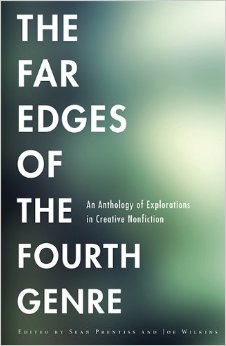
The Far Edges of the Fourth Genre: An Anthology of Explorations in Creative Nonfiction

by
Author: 
Sean Prentiss and Joe Wilkins, editors
Published in 2014
by Michigan State University Press

For this collection of more than a dozen essays on creative nonfiction, editors Sean Prentiss and Joe Wilkins requested a wide range of contributing writers, including Joy Castro, Brenda Miller, and Dinty W. Moore, to explore their own questions about the definitions and boundaries of the genre. Beginning and experienced writers, as well as those simply curious to learn more about these writers' perspectives, will find inspiring new ways to challenge and deepen their understanding of the art of personal essay and memoir.

Big or Small?

3.23.16

In Lewis Carroll’s Alice’s Adventures in Wonderland, Alice shrinks after drinking a potion labeled “DRINK ME,” and then later balloons in size after eating a cake labeled “EAT ME.” Write a story in which your main character is simultaneously confronted by these same two options and consequences. Which one does he choose? Does the sudden transformation in size help or hinder him as the story progresses? What aspects of his personality are brought to the forefront and magnified as a result?

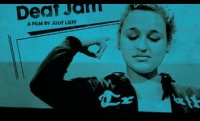
Deaf Jam

Caption: 

"Sometimes in my dreams I sign and everyone understands me." In this 2011 documentary directed by Judy Lieff, a deaf teen is introduced to American Sign Language (ASL) Poetry and enters into the spoken word slam scene. Deaf Jam has inspired a website which includes resources for ASL poets and workshops with the artists featured in the film.

That One Year

3.22.16

This week, select a random year from the last five to ten years, and by combing through your memory, old notes, e-mails, and calendars, jot down a list of events in your life from that year. What were some of your reactions and emotions that accompanied those situations? Write a poem that encapsulates the ups and downs of that single year. Be sure to explore how the intervening years between then and now may have provided you with a wiser, refreshed perspective on past occurrences, and offers a reflective conclusion to your poem.

Deadline Approaches for Indiana Review Poetry Prize

Submissions are currently open for the 2016 Indiana Review Poetry Prize, given annually for a single poem. The winner will receive $1,000 and publication in Indiana Review. Camille Rankine will judge.

Using the online submission system, submit up to three poems totaling no more than eight pages with a $20 entry fee by April 1. The fee, which includes a one-year subscription to the review, must be mailed separately to Indiana Review, Ballantine Hall 529, 1020 East Kirkwood Avenue, Bloomington, IN 47405. All entries are considered for publication. Visit the website for complete guidelines.

Judge Camille Rankine has written one poetry collection, Incorrect Merciful Impulses (Copper Canyon Press, 2016), and is the assistant director of the MFA program at Manhattanville College. “Poetry can say all the hard things, all the things that you aren’t supposed to say in polite conversation,” says Rankine in a recent interview with Indiana Review. “I’m drawn to poems that have something to say—it can be something large or small, but I want to read a poem that feels like it needed to be written.” Rankine’s full interview is available on the journal’s website.

Eduardo C. Corral selected Caitlin Scarano as the winner of the 2015 prize for her poem “Between the Bloodhounds and My Shrinking Mouth.” Eileen Myles selected Cecilia Woloch as the winner of the 2014 prize for her poem “2006.”

Established in 1977, Indiana Review is published biannually and edited by graduate students at Indiana University. The journal publishes poetry, fiction, essays, and art.

Listen to Camille Rankine read from her debut collection as part of the Poets & Writers’ Page One podcast series below.

The Power of Words Where Few Dare to Go: Literary Events in Unlikely Southern California Lands

Ruth Nolan is an author with lifelong Mojave Desert and Inland Empire roots. Her poetry collection Ruby Mountain is forthcoming from Finishing Line Press, and her newest fiction appears in LA Fiction Anthology (Red Hen Press, 2016) and in Desert Oracle. She writes about desert-based American Indian arts and culture for News From Native California, Artbound, Inlandia: A Literary Journey, and Desert Report. Nolan teaches at College of the Desert.
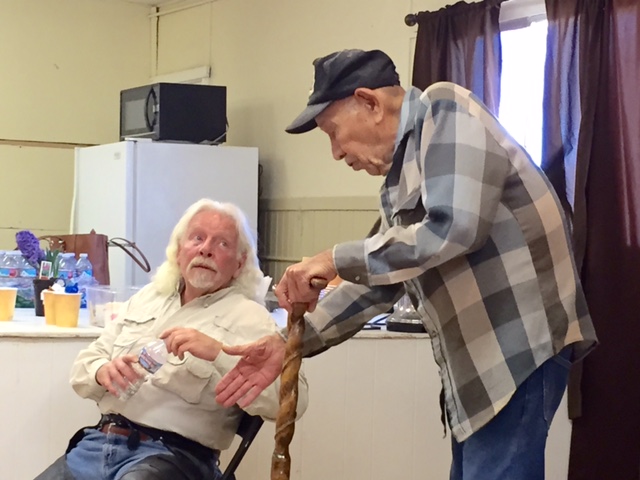
Martin Smith and Paiute elder George RossMojave Desert Writing Workshop: February 15, 2016
Stories from a Paiute Indian elder of traditional chuckwalla hunting techniques who watched a rattlesnake bite—and kill—itself. Stories from a Baker man about the time he hiked far into the Soda Mountains on a hot day, became dehydrated, and walked miles to the nearest bar in town for a thirst-quenching beer, which he credits with saving his life. Stories from a woman who rode a school bus to Death Valley High School that was driven by Edward Abbey. Stories about long desert road trips by a man who showed up on a Harley Davidson and wore his leather motorcycle chaps while he wrote.

These tales, and more, were among the writing samples penned and shared by the twenty-five participants at the February 15 Shoshone-Tecopa Arts and Literature Festival writing workshop, which I led along with desert author Craig Deutsche. Workshop participants drove long distances across the Mojave Desert from tiny towns with inspiring names like Furnace Creek, Lone Pine, Tecopa, and Wonder Valley.

Although some might consider the Mojave Desert an unlikely location for literature to flourish, we were, in contrast, able to demonstrate that the desire and need for a vibrant and community-connective writing workshop is strong and flourishing in this little-known desert region of Southern California. Using prompts drawn from poetry, fiction work, and essays by desert literary greats such as Mary Austin and John Steinbeck, workshop participants wrote their hearts out about their own desert experiences and observations.
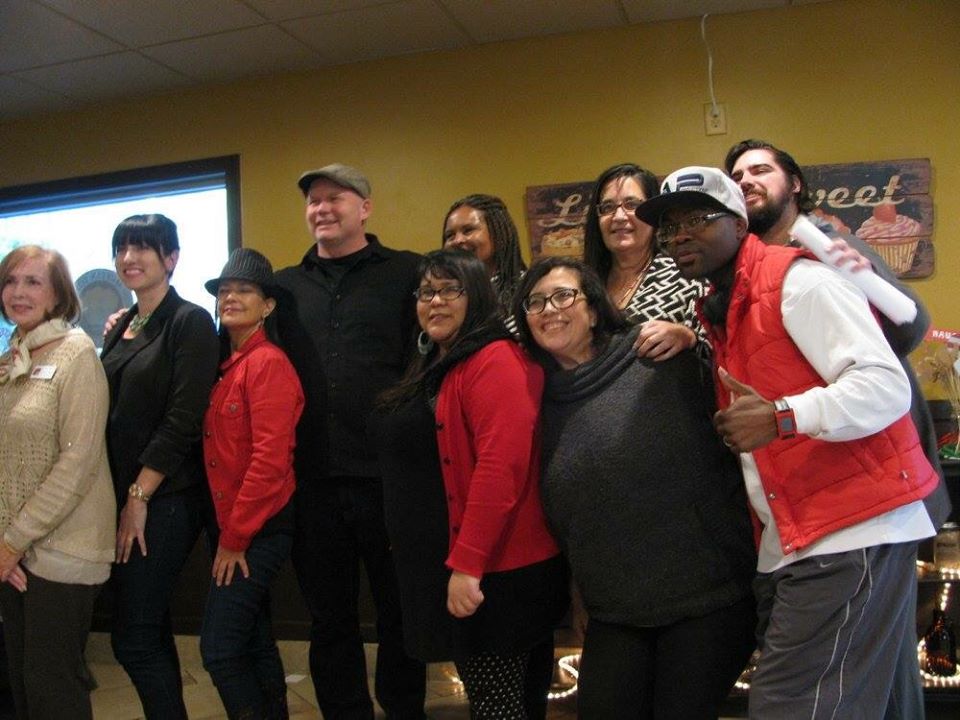
Songs for San Bernardino readersSongs for San Bernardino / Reading Helps Inland Empire Heal: December 20, 2015
The holiday tree was brightly decorated with ornaments at the entrance of the Muffin Top Bakery in downtown Redlands, California, and the atmosphere inside was warm and cheery, the smell of cinnamon rolls seasoning the air. But for those who gathered together this past December 20 for the poetry and prose reading, “Songs for San Bernardino,” this was no typical holiday literary event. This reading, which I coordinated with San Bernardino natives and authors Liz Gonzalez and Jessica Wyland, was intended to bring community together through the power of stories of place to help heal from the December 2 shootings at the nearby Inland Regional Center, a tragedy that ripped through the fabric of this proud but often overlooked part of Southern California.

Readers at “Songs for San Bernardino” included Chad Sweeney, Casandra Lopez, Frances J. Vasquez, Juanita Mantz, Darlene Kriesel, Alex Avila, Andre Katkov, Liz Gonzalez, Jessica Wyland, and myself, who all have strong connections to San Bernardino. Several read freshly-penned pieces that spoke directly of the impact of December 2, while others read works that reflected the strength, beauty, and strong community spirit of this town. San Bernadino Mayor Carey Davis also spoke. For nearly two hours, all chair and tables at the Muffin Top Bakery were full as the power of the stories and words of some of the Inland Empire’s finest writers gave testimony to the inner strength of this community. Afterwards, the day’s cloudy skies gave way to a gentle late afternoon sun, and rays of light filtered into the room.

Photos (top) Martin Smith and Paiute elder George Ross, (bottom) "Songs for San Bernardino" readers. Photo credit: Ruth Nolan

Major support for Readings & Workshops in California is provided by the James Irvine Foundation and the Hearst Foundations. Additional support comes from the Friends of Poets & Writers.


Pages

Subscribe to Poets & Writers RSS