

Fanny Howe, Ange Mlinko Win Big From the Poetry Foundation

The Poetry Foundation, the Chicago-based publisher of Poetry magazine, announced today that Fanny Howe and Ange Mlinko are the recipients of two of its Pegasus Awards, a "family" of annual prizes sponsored by the organization. Howe was named winner of the 2009 Ruth Lilly Poetry Prize, worth a hundred thousand dollars, and Mlinko won the ten-thousand-dollar Randall Jarrell Award in Poetry Criticism. 

The Lilly Prize, named after the Poetry Foundation's best friend in the whole wide world, is given annually to a U.S. poet "whose lifetime accomplishments warrant extraordinary recognition." Previous recipients include Adrienne Rich, Philip Levine, John Ashbery, Charles Wright, Yusef Komunyakaa, Lucille Clifton, and Gary Snyder. Howe, the author of thirteen books of poetry, recently published a memoir, The Winter Sun: Notes on a Vocation (Graywolf Press, 2009), in which she wrote, "Since early adolescence I have wanted to live the life of a poet."

In announcing the prize, Poetry editor Christian Wiman said, "Fanny Howe is a religious writer whose work makes you more alert and alive to the earth, an experimental writer who can break your heart."

Mlinko is the third recipient of the Randall Jarrell Award, which is awarded for "poetry criticism that is intelligent and learned as well as lively and enjoyable to read." She is the author of two books of poetry, Matinees (Zoland Books, 1999) and Starred Wire (Coffee House Press, 2005). The Poetry Foundation praised her criticism as "brilliantly wide-ranging" and "eclectic and astringent yet always lucid and generous." 

If you're unfamiliar with Howe, yet curious about the work of a poet who receives a cash prize with five zeroes attached to it, check out the video below, produced last year by the University of California Television and the Museum of Contemporary Art in San Diego.
 

USPS Honors Richard Wright With Stamp

by Staff
4.10.09
Richard_Wright.jpg

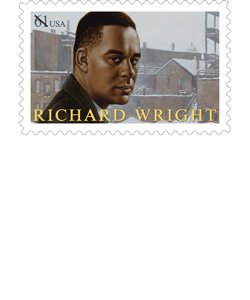
The United States Postal Service unveiled a first-class stamp yesterday honoring American author and former postal employee Richard Wright. The dedication took place in the lobby of the Chicago Main Post Office, just across the street from the building where the author of Native Son once worked as a letter sorter. 

Entry Fees "in These Tough Economic Times"

We've all read about the commercial publishing houses, independent presses, magazines, writers conferences, book festivals, and other literary operations that are feeling the financial pressure these days. At the risk of writing another sentence that includes "in these tough economic times," a phrase that, at this point, makes the eyes of even the most jittery realist glaze over, we'd like to turn the discussion to writing contests—especially those that require entry fees.

Given the economic forecast, are you submitting to more contests with hopes of winning that cash prize? Or has the budget item labeled “entry fees” been cut as a result of the belt-tightening measures that almost all of us have had to take?

Post a comment below and tell us how the economy has affected your contest submissions. And if you need a little something to get you in the mood for budgetary consideration—as if any of us needs more of that—here's “Economic Equation,” a video poem by Michael Ricciardo that, although produced in 2001, still resonates.


Nine Poets, Eleven Fiction Writers Get Guggenheim Fellowships

From a pool of almost three thousand applicants, 180 artists, scientists, and scholars—including more than thirty writers—received some good news from Edward Hirsch yesterday. The president of the John Simon Guggenheim Memorial Foundation announced the recipients of the 2009 Guggenheim Fellowships, each worth around forty thousand dollars. 

The fellows in poetry are Saskia Hamilton, Joseph Harrison, Terrance Hayes, Lyn Hejinian, Laura Kasischke, Barbara Ras, Lisa Russ Spaar, Larissa Szporluk, and Daniel Tobin.

The fellows in fiction are Chris Abani, Chris Adrian, Stacey D'Erasmo, Ellen Feldman, John Haskell, Ken Kalfus, Marshall N. Klimasewiski, Richard Lange, Zachary Lazar, Fae Myenne Ng, and George Singleton.

The other creative arts categories were drama, biography, general nonfiction, photography, fine arts, film, music composition, choreography, and video and audio.

Since its establishment in 1925, the foundation has awarded more than $273 million to nearly 16,700 individuals, including poets W. H. Auden, Langson Hughes, and Derek Walcott and fiction writers Vladimir Nabokov, Philip Roth, and Eudora Welty.

Below are videos of three of the new fellows—Terrance Hayes, John Haskell, and Chris Abani—reading and discussing their work.


Time to Show the Agents How Easy Their Jobs Are

by Staff
4.9.09

In response to the familiar complaint that some literary agents don't even bother to respond to author queries, agent Nathan Bransford launched on Sunday the "Be an Agent for the Day" Contest. "Think you can spot the good queries from the bad? Wondering how the view looks from our side? Think it's easy to respond to everyone?" he challenged.

Ohio Native in the Running for Both Orange Prizes

The telecommunications company Orange, in partnership with Arts Council England, announced today the finalists for the 2009 Orange Award for New Writers, an annual prize given to a woman novelist or short story writer who has published only one book of fiction.

The finalists are Ann Weisgarber, an Ohio native who now splits her time between Sugar Land and Galveston, Texas, for The Personal History of Rachel DuPree (Macmillan New Writing, 2008); Nami Mun, who was born in Seoul, North Korea, and currently lives in Chicago, for Miles From Nowhere (Riverhead, 2009); and Francesca Kay, who grew up in Southeast Asia and India and now lives in Oxford, England, for An Equal Stillness (Weidenfeld and Nicolson). The winner, who will be announced on June 3, will receive a bursary, or scholarship, of £10,000 (approximately $14,645). Joanna Kavenna won last year for her novel Inglorious (Faber).

Weisgarber is also on the longlist for the Orange Broadband Prize for Fiction, which was announced last month. The annual prize, also sponsored by Orange and given for the best novel by a woman writer, is worth £30,000 (nearly $44,000). Weisgarber joins Ellen Feldman (Scottsboro, Norton), Allegra Goodman (Intuition, Dial Press), Samantha Hunt (The Invention of Everything Else, Houghton Mifflin), Toni Morrison (A Mercy, Knopf), Gina Ochsner (The Russian Dreambook of Colour and Flight, Portobello), Marilynne Robinson (Home, Farrar, Straus and Giroux), Preeta Samarasan (Evening Is the Whole Day, Houghton Mifflin), Curtis Sittenfeld (American Wife, Random House), Miriam Toews (The Flying Troutmans, Counterpoint), and ten others on the longlist, which will be winnowed down to a shortlist on April 21.

Below is a video from last year's ceremony, where Rose Tremain received the Orange Broadband Prize for her novel The Road Home. (Don't miss the classic awards ceremony music they piped into the room after the announcement.) 


Pages

Subscribe to Poets & Writers RSS